You think they should test that?? I mean it is pretty obvious the advantage to riding in a 30 rider pack sitting directly on wheels, don’t you think?
As for this test, it should be interesting. I hope they use different protocols, or at least mother nature gives them some real world conditions to deal with. It’s great that we are finally in a place where this kind of test can be relevant, we have the RR for exact distances, and power meters to measure resistance. Only real variable is the actual rider, have to get them to stay consistent through the tests, would be very easy to jack the test one way or the other if they had a mind to..
Good to hear of the precision, and I agree that 4 inches is close enough. But does the technology have a way to factor in round about and 90 degree turns? Is it a straight line to the next rider or does it have a way to bend? You can see on many of those T100 bike courses that one could flip into the zone rather quickly and for a long period of time added up at the end of the race. All the while still outside the actual zone too..Might be something that riders have to adapt to in the future, instead of the usual bunching up on turns, they will have to force themselves to back way off to avoid false positives..In the heat of battles I can see this could be a problem, perhaps one technology can fix first..
Firstly, you introduced this Q in the thread this came from. I have ‘just’ dragged @sciguy 's excellent post as relevant here.
Idk (be gentle, a long time since I was examined in this area) but the measurements between tx element (on fork blade) and rx element (actually both) are achieved with Ultra-wideband (UWB) technology (frequency 3-10 Gigs). If the antenna gain arrays are narrow angle (but both forwards and back) they’ll ‘lose’ the lead rider round a corner rather than ‘see’ a shorter chord rather than the arc ridden.
On the chord/angle issue, this is fairly irrelevant on a 90o turn. Coming into the turn which will have a cycling line radius of curvature of (say) 6m (really tight), the difference between the chord and the 90o arc (quarter circle) is <1m.
But, and idk, I hypothesise that in 180o turns, there is the possibility (and this may be a ‘ghost’ yoy-yos source) that the two riders’ RRs generate a <12m start time and finish time. Some of the T100 shared (and IM athletes individual) data has multiple yo-yos which added together imply fractions of a second for each yo-yo. more likely this is just picking up concertinaring at 180s.
I ‘liked’ @marquette42 's observation, including the identification of the drafting=cheating zealots cohort (none on here?).
@Ironmandad and Ironman Head Referee Jimmy Riccitello and @E_DUB (so young! and did great job summarising and extracting the key points as they went along) in the chat
Riccitello at his most coherent, fact-based and persuasive on the merits of a 20m draft zone. @marcag in the thick of the testing (aka ‘running it’). Please appreciate this @talbotcox: https://www.instagram.com/p/DSvI50Oj-pB/
" . . today’s episode is about . . . drafting. . . . IRONMAN has [conducted] real-world testing to compare the legal benefit of riding at 12 meters versus: 16 and 20 meters, . . . The goal is simple to [describe] and hard to do: measure what kind of power savings . . . exist across different gaps and figure out what that means for fairness, safety, and how races actually unfold when packs form, the wind shifts, and the road narrows. . . . Jimmy breaks down how [they used] Race Ranger to control spacing, and how Marc Graveline is creating the testing. . . . From there, we get into the real fight: why [most] pros want 20 meters, why [a few] think it creates new problems, and why IRONMAN can’t treat this like a single-variable decision—because once pros and age-groupers mix on multi-loop courses, “simple” gets messy, fast."
@Ironmandad asks a key Q at 37:40 - would IM consider a 20m for Pros and stay at 12m for amateurs? Comment - in practice this is the only way (16 or 20) the draft zone is going to change. Reasonable to assume Race Ranger not for amateurs for the foreseeable future (a red-flashing bike ride anyone). Riccitello seemed to struggle to answer that Q: terribly difficult - but not clear for whom it’d be difficult in the amateur men getting in the WPro hen house (memo: they ride past, the WPros still need to respect a draft zone of 20m, whoever is the wheel in front. Amateur men do not affect the WPro race at the sharp end: it’s the weak swimmer weak rider pino pros which do (and they’ll be on 20m)).
“There’s no timeline I know of” says Riccitello.
J-P Ballard (emboldened for @monty ; clipped from a google talk which I link below):
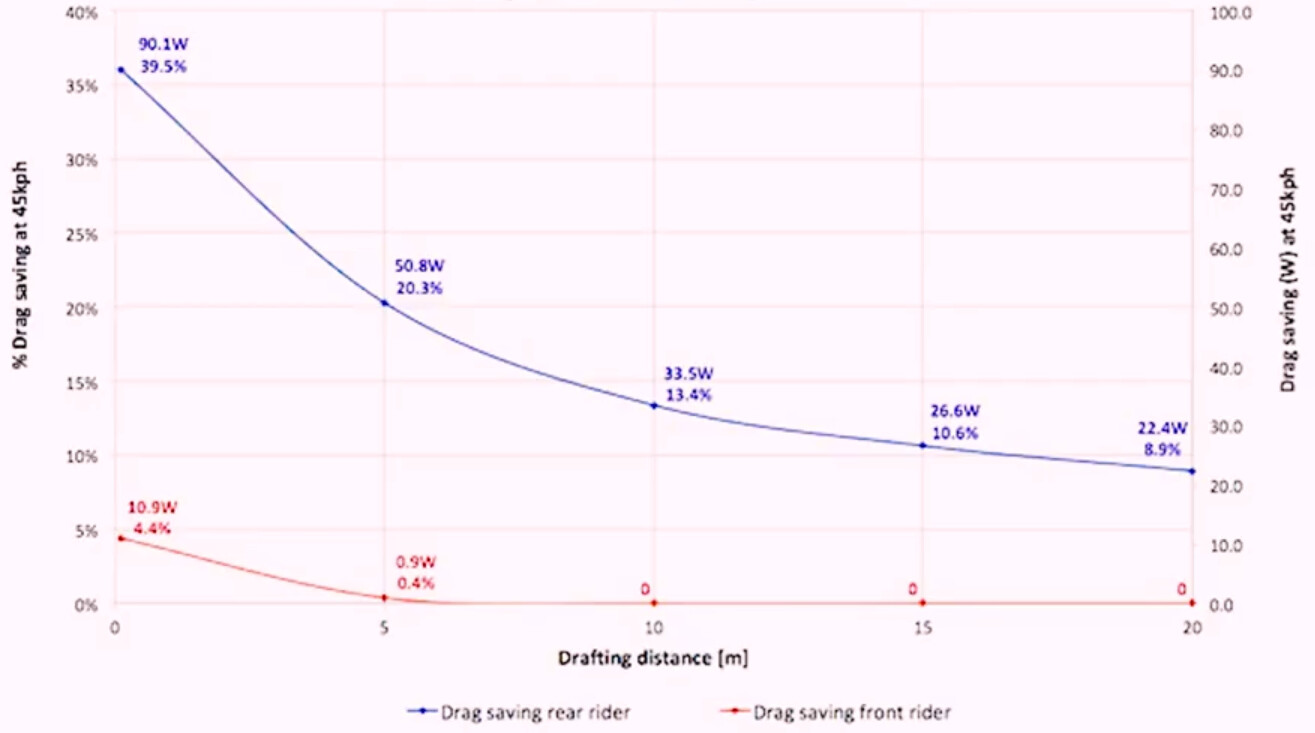
So from 12 to 20 looks like only an 8 watt savings, and presume under ideal for drafting circumstances. Most of the time and most races will not even have that 8 watts, so I think that the justification for keeping 12 is fine, since pushing it out causes several other problems.
Agree. The pro 20m crowd still obsess over “the group” at 20m. Sam Long et al used to presume the moto plus draft pack made it harder to chase down the front of the race and we’re seeing in 20m T100s he almost never catches the front anyway. And I’ll note, in prior years when T100 had less stringent enforcement of the draft rules, Sam raced better.
Anyway, that’s a single data point, but in general Im still not convinced that an occasional 10w in ideal case scenarios is providing such an insurmountable benefit that the rules need to be redone.
I’ll even go a step further. Race ranger, for all its cool geek factor, if the officials are on top of the races and actually giving penalties, it’s not worth the use of time and resources unless it’s somehow used to add value to the broadcast and the rules rebuilt around this product (ie. draft time, yoyo accumulates and you serve some kind of time based penalty immediately on course because of it). It’s a lot of effort to just show some guys the blinking lights to optimize their draft zone around.
I shall guess you have not listened to the pod. When asked what the results say (wrt power saving in wheels 2, 3, 4 ,5) or when we’ll see them, Riccitello obfuscated; mañana. He also (my perception) had set no pre-test criteria for whether there was merit in a move to 16m or 20m. And he was the only Ironman guy involved in the tests, so the extent of any checks and balances on the results and their interpretation is either low or again ‘not clear’.
I included the J-PB chart above as an illustration of the savings (CFD) - the talk is excellent btw: recommended.
That, and to go further: what race dynamic are we trying to disrupt? Presumably it’s the rat pack dynamics at major events, but it’s always with a caveat that if that hill wasn’t there or if the Kona winds weren’t there (but they are?).
Again, I’ll put out the challenge for discussion - what 12m races were such snoozefests that we need to start tinkering with the rules? IMO, all the WCs in recent memory have been absolute fire, and most of the pro series races have been awesome as well.
Even if 20m is some platonic ideal ‘pure race’ we still have to ask ourselves if it’s worth tinkering with the race dynamics we’ve been treated to recently.
(As a note, even the PTN guys were joking that the way to make the men’s T100 more interesting would be to move to a 12m zone to give Geens a better shot vs Wilde - I know it’s joke, but there’s some truth there)
Again, we acknowledge their joking, but the point bares consideration. The reactionary populist push to go one way with the rules will eventually swing the other way.
People who presume to know better, usually don’t or are surprised to find things done pan out the way they expected.
This is essentially the male equivalent of rearranging the household furniture. Just because you can argue and do something, doesn’t mean you should and certainly doesn’t mean things will work out as you suspect.
There may very well have been a case a few years back that if the fast swimmer/slower bikers didn’t have a nice group ride up front that the power bikers could ride to the front without towing everyone behind them at 12m.
But that world has changed as everyone has leveled up the cycling and now the fast swimmers are battling each other at the front on the bike, while no one is getting a free ride in the back as everyone is hammering full gas.
The so-called smart rider presuming to sit in like Kat Matthews without doing much work risk losing the podium entirely if they don’t want to push wherever they find themselves.