Originally published at: IRONMAN Puts Draft Zones to the Test With Race Ranger and Aero Expert Marc Graveline - Slowtwitch News
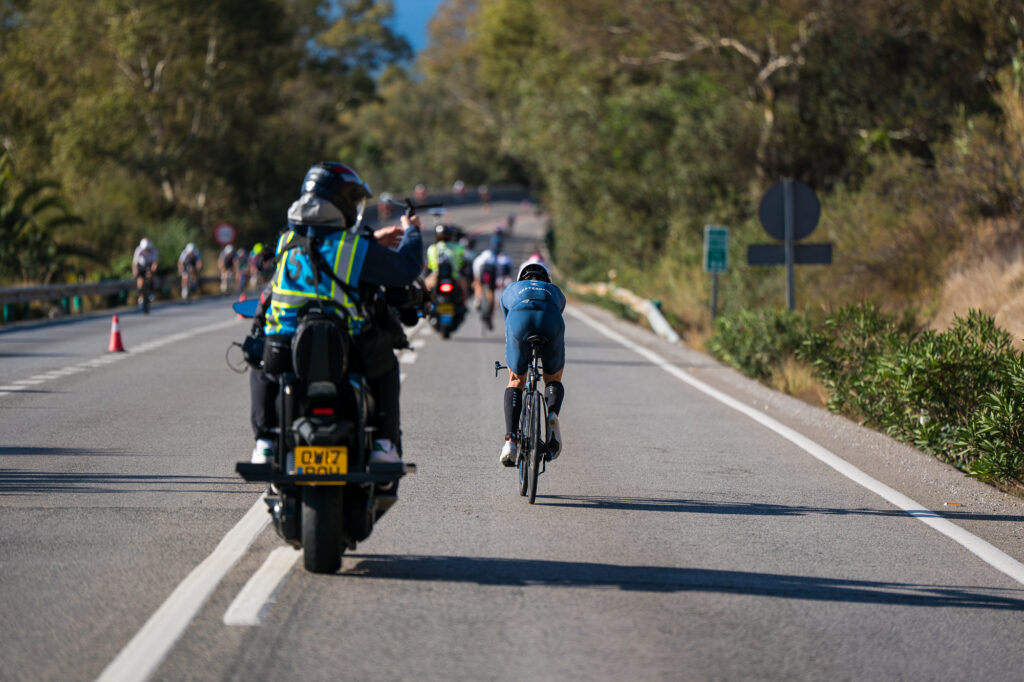
Athletes on the course at the IRONMAN 70.3 World Championship Marbella. Photo: Kevin Mackinnon
This week IRONMAN is doing a series of tests in Tucson, Arizona with a number of pro athletes “to test theories and simulations using real world conditions … with an end results that demonstrates to what degree there is meaningful impact between different draft zone distances and how they affect the race dynamics, including course density within IRONMAN and IRONMAN 70.3 events,” according to a release sent out earlier today.
IRONMAN has brought in aerodynamic expert Marc Graveline to help with the process. We wrote about Graveline and his innovative “Gizmo” aerodynamic testing sensor earlier this year.
Graveline doesn’t just work with triathletes and gravel riders – he also works with various World Tour cycling teams.
“I am excited to work with IRONMAN in collaboration with RaceRanger and professional athletes to apply technology that can accurately measure and understand the impact of draft zone distances,” Graveline said. “This data will be fed into sophisticated models that incorporate historical riding data and key factors such as pass times and slotting in, enabling a deeper understanding of how drafting impacts athlete performance.”
According to the release, the testing in Tucson this week includes six pro athletes and is being done “at IRONMAN 70.3 race pace speeds and wattage.” The various test runs include 12-, 16- and 20-meter distances. The bikes will be set up with the RaceRanger sensors in order to monitor the specific draft-zone distances.
“During the various testing runs, rider positions will be exchanged to examine how the size difference of riders may affect power data,” IRONMAN’s release stated. “Data computed from the baseline CdA will be compared to the data from the group test and can determine power savings at the various positions and distances. The data will then be used to approximate power differences at other race speeds as well. Once the data is produced, a team will review and determine other potential testing necessary.”
Further testing will be done in 2026, and data will be analyzed to come up with “the optimal draft zone distance that can be applied consistently across all events that host professional and age-group athletes.”
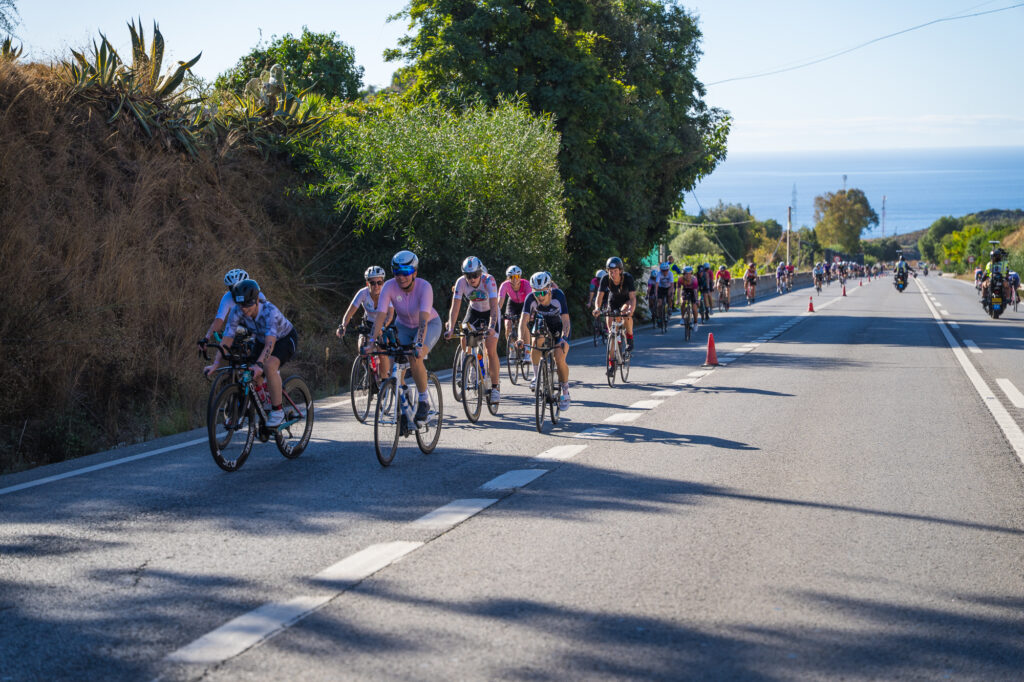
Age-group athletes compete at the IRONMAN 70.3 World Championship in Marbella, Spain in November, 2025. Photo: Kevin Mackinnon
Of course one of the key factors in any decision for IRONMAN races will be the number of athletes out on the course. As the photo above demonstrates, a large, competitive field (the 70.3 world champs, for example) racing on a narrow course can see some bunching at various times. According to IRONMAN:
Other key operational factors, such as course density, professional and age group start protocols, and race-course logistics, will also be considered as part of the decision in determining the optimal draft zone for our athletes. Any changes will be shared and could include both changes to the distance and time allowed to pass.
Since 2015 professional athletes at IRONMAN events have utilized a 12-meter draft zone, and that same zone has also become the standard for age group athletes. (See the 2025 IRONMAN Competition Rules.)
This isn’t the first time IRONMAN has done testing around draft zones. Former CEO Ben Fertic enlisted then sponsor Ford to help do some testing in the company’s wind tunnels between 2005 and 2008. There’s long been a push from pro athletes for a larger draft zone, which is why the Professional Triathletes Organisation has utilized a 20-m draft zone at its professional events, with age-group competitors using a 12-m zone. Challenge-Family events also utilize a 20-m draft zone for the pros, and also use the same zone at some age-group races as well. Today’s announcement no-doubt comes, in part, because of the pressure on IRONMAN to follow suit with a larger professional draft-zone at its races.
“The conversation related to the impact of different draft zone distances has been a topic for many years, and today it is a topic that many athletes care deeply about,” said Scott DeRue, CEO for the IRONMAN Group. “By bringing in outside expertise to do scientific testing, we are not only listening to the interests of our athletes, but also putting in the work and resources to test different models and simulations with real world conditions to understand the full impact of race dynamics for our professional and age-group athletes.”
IRONMAN events typically have much larger fields than T100 or Challenge-Family races (Challenge Roth being one of the exceptions, of course), which would make a 20-m draft zone for the entire field seemingly a challenge, especially on looped courses.