Official RaceRanger Thread

The battery life is more than you will need for a full day’s use. If you can imagine a cycle light that runs for 12+ hours continuously, while also powering 3-4 wireless technologies, it’s not a tiny battery. Batteries also ‘degrade’ (dont have the right term…) over their lifetime, so we don’t want them to be good for the first year and then only be good for 80% of the race after that. So we have to build in a margin for that drop off.
This takes up a lot of the space inside the current iteration, and for sure we’d like to reduce it and optimse where we can. This is part of what the upcoming testing we have planned is all about.
Type: LiPo Lithium Polymer

Sensors…where do we start…not all technically sensors, but cool anyway;
We have GPS/GNSS, but we are not 100% reliant on this for the system to run. So if we lose GPS for a period in mountains or similar it’s not the end of the world. The lights system still functions and the system is maintained.
Distance measurements in the effective range (within 25-35m) are done by Ultrawideband (UWB) technology, although different, its the same stuff as in the Apple Airtags that came out this year.
Then we have Bluetooth beaconing (not a pairing) and
LoRa - for the local connection to the referees.
The referees have a LoRa ‘gateway’ to recieve the signals, and they themselves have an internet connected tablet.
Again, non-sensor, but we also have a wireless charge coil so that we can have just a solid piece of plastic with no buttons or inputs to play with.

What’s the battery life on the sensors and what kind of batteries are used? What kind of sensors are being utilized in the device?

Short answer - we’ve got some big brains that have been working on it

People have been talking about such a system for a long time! What is the accuracy of the distance measuring and the sampling rate? What happens when you have 2-4 people approaching a rider from behind, all passing each other at different times and different rates? Can it identify all the riders specifically and keep track of all of the relevant passing dynamics?

Anybody that’s raced a large race MOP knows that the first hour is a continuous exercise in trying to interpret the rules in a bunch of special cases. I can’t even imagine an algorithm that would sort all that out.

That would be great if we are able to get them that small. as the ankle is rotating we would also lose some accuracy.
3 reasons we didn’t include live tracking yet was that we felt that
a) athletes want it for the whole race, not just the bike, but actually it turns out that the bike is by far the part of the course they do want spectator tracking for.
b) we wanted to keep it simple to reduce technical risks, so just focussed on the drafting issue.
c) it seemed not that hard, so surely a good solution already existed, but its still hard to find. Smart watches with a sim inside can do it well now.

Could you incorporate this into a timing chip racer have on their ankle?

if races were to use this system, I’d also love to see it on any and all of the moto’s to enforce the 25m draft rule for moto’s
.

Thats in our plans too. We’d give the moto driver a light indication so they maintain a gap to riders behind.

Thats in our plans too. We’d give the moto driver a light indication so they maintain a gap to riders behind.

that’d change the pro race quite a bit for the better

reading about it more here now: https://www.dcrainmaker.com/2021/11/triathlon-anti-drafting-technology-system-unveiled-by-raceranger.html

Thats in our plans too. We’d give the moto driver a light indication so they maintain a gap to riders behind.

that’d change the pro race quite a bit for the better

reading about it more here now: https://www.dcrainmaker.com/...d-by-raceranger.html

OK, finished DCR’s write up and I’m seriously impressed. Wow. The logic and flexibleness of this system is really impressive. I know pros would like to see this tested with them first ASAP (including the moto sensors).

now for the front sensor to blow up upon the rider getting a penalty. \pink

Thats in our plans too. We’d give the moto driver a light indication so they maintain a gap to riders behind.

Perhaps an electronic shock collar could be used instead of a flashing light system to really enforce better behavior from the photographers;)

Thats in our plans too. We’d give the moto driver a light indication so they maintain a gap to riders behind.

Perhaps an electronic shock collar could be used instead of a flashing light system to really enforce better behavior from the photographers;)

But the poor photographers are just sitting on the back…. Oh wait, you said shock collar on a Talbot? Carry on

Thats in our plans too. We’d give the moto driver a light indication so they maintain a gap to riders behind.

Perhaps an electronic shock collar could be used instead of a flashing light system to really enforce better behavior from the photographers;)

But the poor photographers are just sitting on the back…. Oh wait, you said shock collar on a Talbot? Carry on

Yes they’re just setting on the back of the bike but I can imagine them saying “slow down, slow down, I want a really great closeup here” To be honest I have no Idea who is controlling the moto operator’s decision on how close to be at any given time.

Honestly, on a moto it’s easy to underestimate how fast bikes can close on you and get into your draft zone. As an official, I’m always checking, and guiding my moto driver to speed up or slow down to avoid interfering with race dynamics, or to not force someone into drafting. That said, you sometimes shoulder check, and have a healthy gap, and 15sec later, they’re in your draft zone (honestly where this happens the most is in PTWC categories, because of how low the handcycles are to the ground, they can close gaps incredibly fast, and in my experience, the hardest races on a moto to keep people from drafting. Of course, if the photographers are less sensitive to the rules, they may not be guiding the moto pilots in the same way, but that’s why there’s often an official moto with the photog moto at the front of the race, to remind them not to let the riders get too close.

I’ll also add that I find the auto timing of penalties the least useful feature of all of this, and the reason being that there’s a penalty process, and a lot of rules on what you can’t be doing during a penalty (nature breaks, bike repairs, or basically anything other than standing and waiting it out…), and running the penalty timer off of a sensor doesn’t account for any times where the penalty time would be paused for any of these “illegal” behaviours. Again, pretty cool tech, and cool that you could enable that, but not sure that you would necessarily want to (tracking time in the tent off of the sensor in the background is super useful, since it could be used as evidence to support a DSQ where a penalized athlete leaves early).

Having data from a system like that would put an end (especially in the pro races) to people complaining about getting drafting penalties (or rather cause sympathy to evaporate, people will always still complain…)
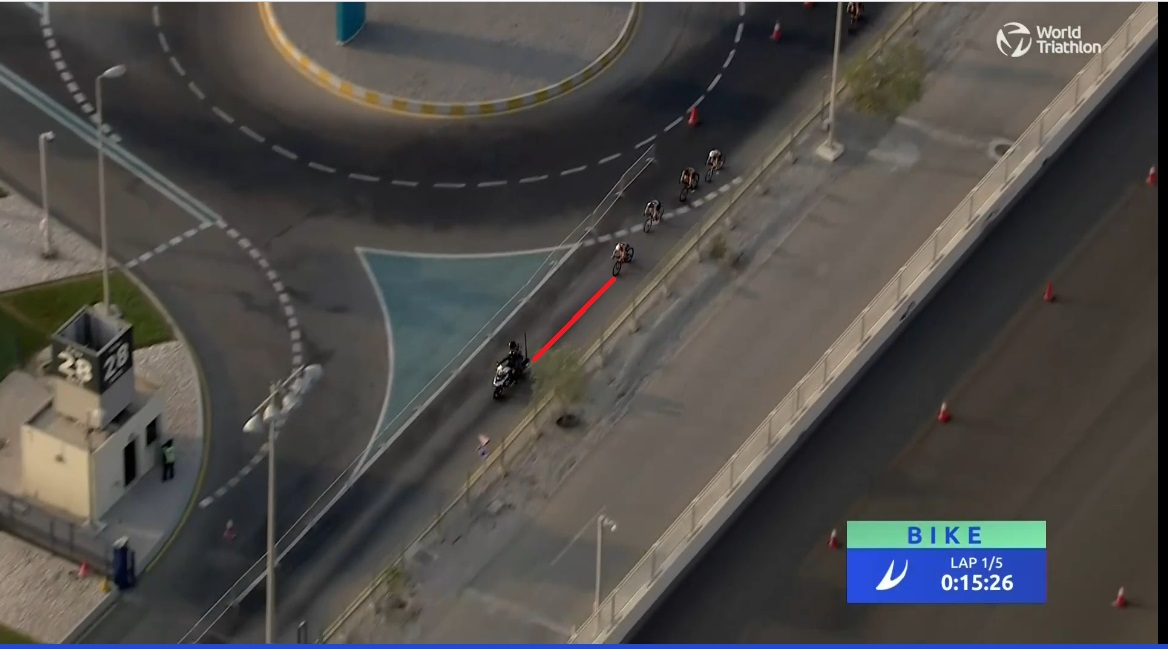
I find it bothersome how early on in ITU races the front few seem to almost always get an extra bonus for their quick swims. It always seems to improve as the race goes on but that initial assistance can make a good deal of difference in terms of who catches up to the lead group.

Abu Dahbi early bike moto.jpg

It can depend a bit on the event, the course and the officials that are there. At events I have worked, we haven’t had too many issues (but they tend to use experienced moto pilots), and the odd time it does happen, the officials will quickly tell them to open the gap. If the course is remotely reasonably wide, at a minimum they should not be driving directly in line with the pack (We had big time issues with PTWCs locking onto our wheel at one race but had a wide course, so we started driving way out to the one side, so if they did sneak a draft, they were adding significant distance to their race in order to do so…). Ideally one person in each moto pairing (moto pilot and official or camera operator) should be experienced racers, ideally with DL or bike racing, because they tend to be more aware and better recognize where their presence is interrupting the race dynamics.
If using a device like this on motos, having some sort of auditory signal for the moto pilot when trailing athletes get within the 25min draft zone would be super helpful, because they wouldn’t need to rely on the camera operator to tell them to speed up since they are often focused on getting the shot, and it’s hard to estimate distance through a camera lens… also being able to alert the officials if the proximity range on the camera motos is constantly being pinged, it can flag to them to intervene (I have seen events where we’ve benched specific moto pilots or camera operators for consistently interfering with the race, and either switched the operator to another moto, or asked the broadcaster to shuffle their crews (i.e. move one of the follow crews to the front, and the one from the front further back).

Hi Trauma

It’s always great to get the perspective from actual officials. That’s a good point RE the hand cycles catching the moto quickly. I know World Triathlon see a lot of potential use for RaceRanger in the Para-tri categories.

Regarding the countdown in the penalty tent within the app, there is definitely still a need for the referee in the tent, we’ll just try and make their job easier. The ‘basic’ version of the RaceRanger app, is an app that can be used at any event, big or small - not necessarily the larger LD events that will take up the on-bike hardware. This app connects the officials on course with each other, the penalty tent and the race HQ. We’ve actually built this already, and it’s what we trialled in Lausanne in 2019.

With this app, the penalty tent official has a tablet, rather than a table with lots of bits of paper and stopwatches. When an athlete is given a penalty it goes straight to the designated penalty tent official’s homescreen. (official giving the penalty selects the next penalty tent along the course, for the athlete to serve at rather than driving ahead , getting off the moto and handing over a piece of paper). So the official in the tent (or officials) has a queue of athletes that are due to arrive at their tent in a list on their home screen, ordered by the time they received their penalty, or by race number. The official can choose how they want to view that info.
When an athlete comes in the official hits a start button on the same line as the athlete’s number, to start the penalty countdown. Once started, there is a pause button where they can pause the penalty if the athlete doesn’t comply with their instructions. They can actually choose to officiate like any other referee on course and apply new penalties like littering or the ‘other violations’ category. If they accidentally start the wrong athlete’s penalty they can restart it as well.

Here’s a video that explains in basic terms how the app works. https://www.raceranger.com/referee-app

This is something that we are currently working with another company ‘Blerter’ on to integrate our two softwares. Blerter is an event delivery platform and an existing partner of orgs such as USAT, World Triathlon and is already used at some Challenge and Ironman events and others like Norseman. https://www.blerter.com/about

The result of us working together will be that events running Blerter for the overall event management of volunteers, staff, officials, medics etc will still operate on Blerter, and the TO’s will do their officiating in RaceRanger, within Blerter. So they only need to have 1x App open.

This integrated offering is something that we are currently working on with World Triathlon and consulting with a representative group of NF’s to arrange how to make it available to the NFs, likely on an affordable annual subscription basis, so they can use the Blerter-RaceRanger system at any triathlon no matter how small. Larger events would then be able to upgrade the functionality from that base level Blerter platform to add more of the premium Blerter features often required at the larger events, but the RaceRanger officiating functionality within it would become universal.

Then when an event that is running the RaceRanger on-bike drafting detection system comes along, for that event the officials would have the use of the set of tablets and harnesses provided as part of our service delivery at the event, and they’d have the added features required to ‘see’ and receive the drafting data off the bikes. The penalty tent officials will still have the ability to pause the penalties in the tent. They just won’t have to worry about starting the countdown, as this part will be automated.

Hope that helps!

Feel free to drop me an email if you’d like to have a discussion / Zoom - We’d love to get input from as many officials as possible.
hello@RaceRanger.com

Kind Regards!

I’ll also add that I find the auto timing of penalties the least useful feature of all of this, and the reason being that there’s a penalty process, and a lot of rules on what you can’t be doing during a penalty (nature breaks, bike repairs, or basically anything other than standing and waiting it out…), and running the penalty timer off of a sensor doesn’t account for any times where the penalty time would be paused for any of these “illegal” behaviours. Again, pretty cool tech, and cool that you could enable that, but not sure that you would necessarily want to (tracking time in the tent off of the sensor in the background is super useful, since it could be used as evidence to support a DSQ where a penalized athlete leaves early).

Having data from a system like that would put an end (especially in the pro races) to people complaining about getting drafting penalties (or rather cause sympathy to evaporate, people will always still complain…)

Since you didn’t previously respond to me specifically, but did go over part of your business model while also not stating your ideal price point. I did notice you spoke with at least one member of the triathlon media and there is an assumption that the surcharge for this service onto the current race entry fee would be near $30 for the athlete. Where’d you come up up with that number?

Hi TheStroBro

Sorry no offence intended there, we are just catching up on everything after the busy period of the launch. I’m basically a one-man marketing & pr dept, as all funds need to be directed towards the actual engineering & product development…

I did speak with quite a few media before the release, but didn’t specify a price point anywhere. I’m not sure where the $30 came from? I haven’t put that out there or heard it mentioned?
I think I’ve been clear that we can’t accurately put a number on it at this point due to Covid supply chain disruptions of components meaning no-one will quote for the larger quantities of parts. And secondly the nitty gritty of the discussions with the event organisers are yet to happen. As ultimately it’s their business, their events, and they are the ones collecting the entry fees, they are an important consideration. At this point we’d just like them to know we exist, that they keep an open mind, and after we’ve demonstrated some event tests, that’s when we’d be looking to start having those discussions.

What we have said in our FAQ’s on the website is;
‘the amount will be reasonable…significantly less than common event entry website processing fees, added as the final step of entering many races today.’

Now as we are looking at half and full distance events, you can do some maths and see what an athlete is currently paying to enter an event;

Not to intentionally pick on Ironman - they do what they do very well and set the standard in a lot of areas. As an example, let’s look at one of the next available Ironman events that you can enter in the US currently;
IM Tulsa in May. The current entry fee is $774.
Once you go through all the options, add your $15 one-day licence etc, you come to a base fee of $789.
Then finally there’s an additional $72.61 in Active.com processing fees.

What we are saying, is that we are aiming for the additional charge for having RaceRanger in use at an event, to be significantly less than this Active.com fee for the athlete. Like…a lot less.

It has to be ‘acceptable’ for the vast majority of athletes, and representative of the added value the RaceRanger system adds to the race-day experience to most athletes. Not everyone is the same, some will feel they absolutely need this and are prepared to pay quite a lot more than where we land, others will likely feel it’s too much, hopefully we find a balance that absolutely minimises the latter. Otherwise we won’t be around in 2yrs.

So how do we work out our cost structures? Well it’s a combination of many things;

  •   How much it costs us to manufacture the devices and peripheral gear such as custom manufacturing the mass wireless charging units, buying sets of tablets, leasing a large van etc, and all other gear required to deliver the service.
    
  •   Running costs to actually deliver the service, hiring staff, and their expenses to travel from week to week, meals accommodation etc. We need to have the minimum impact on the event company’s operational plan of delivering the event, so having 4-5 staff in the team at least initially.
    
  • The numbers of athletes that it’s in use for. Ie if applied to a full field, we can spread the cost quite thinly. If it’s only a portion of the AG field + pros, then likely the per athlete cost would need to be higher, but perhaps that portion of the field are ok with that? If it’s just on the pros, long term it’s not worth doing.
  • It’s also a moot point as to whether the charge should be the same for a full distance and a half. The feedback from athletes we surveyed on this has been split quite evenly, so again it will be a consideration for the events as to how they factor this. The cost of delivery would only be marginally higher on our side for a full, as we are out there longer, but most other expenses wouldn’t change. But if the charges are the same then that’s going to be a higher % of your existing entry fee for a half than it would for a full. Still some work needed in this area, once we engage with the events.
  • How long the devices will last is a big consideration – how many seasons? A big unknown, but we are budgeting for 3 seasons and hoping for 4-5, as they might each only get up to 25x uses per year. We are designing our next iterations with the ability to be refurbished by replacing the exterior enclosure and fitting a new battery / changing out any components prone to aging.
  • At the end of the day, we also need to build in a margin to provide a return on our IP developed, time and investment to date and still to come, to bring this to life.

Hopefully that makes sense. I’ve probably gone into more detail than I should, but hey, it’s a valid question. I hope you can see why we can’t slap a number on it at this point. But yeah an additional $200 as in your initial post; “because it’s gonna go up at least $200 for Tier 1 pricing.” ’would of course never fly! Apologies if the absence of a price could be interpreted as ‘a huge increase’ - not our intention.
Please trust that we do live in the real world, and we are lifelong athletes ourselves. We’ve been at this for a long time and have thought through a myriad of challenges.
As soon as we reach a price point, we’ll let you know.

Thanks for your interest.

Cheers

Since you didn’t previously respond to me specifically, but did go over part of your business model while also not stating your ideal price point. I did notice you spoke with at least one member of the triathlon media and there is an assumption that the surcharge for this service onto the current race entry fee would be near $30 for the athlete. Where’d you come up up with that number?

Thank you for the detailed and well thought reply. Yes I’m definitely interested in this technology being used if the target cost of the service is where you want to get it to. Now…to get race promoters not to throw 3500 extra Bike-Runners onto the course!

Yes, that’s the challenge. Hopefully we can help accelerate progress in this area.
Cheers

Thank you for the detailed and well thought reply. Yes I’m definitely interested in this technology being used if the target cost of the service is where you want to get it to. Now…to get race promoters not to throw 3500 extra Bike-Runners onto the course!

I can’t help but wonder how many podiums would have been altered when Moats (Mirror Man) was racing had this been around.