I was going to come in here and reply to all the haters, but then I asked myself.. what’s the point? This isn’t about them. It’s about the 80% of pros who wanted this and the fact that Ironman listened. That’s a huge win for the sport of triathlon.
3 Likes
IRONMAN Announces Change to 20-Meter Draft Zone for Professional Racing Following Comprehensive Testing Process
Formal testing conducted in partnership with RaceRanger and Aerodynamics expert Marc Graveline delivers conclusive insights supporting adjustment from 12 to 20 meters draft zone for pros
Updated professional race draft zone distance to be implemented beginning March 1, 2026, and will be included in upcoming release of 2026 IRONMAN Competition Rules

TAMPA, Fla. (January 27, 2026) – Following the completion of a comprehensive, multiphase draft zone testing initiative that originally began in June 2025, IRONMAN, the global leader in triathlon, today announced it will increase the professional draft zone distance from 12 to 20 meters, reflecting significant findings generated through scientific testing and research applied to race dynamics. The adjusted professional athlete draft zone distance will be updated in the 2026 IRONMAN Competition Rules, which will be released in February and be effective as of March 1, 2026.
The testing initiative, developed and led in coordination with leading aerodynamics expert Marc Graveline, was designed to produce data insights that could help objectively measure the impact of different draft zone distances on race dynamics, athlete performance, and course density. The results of the testing provided clear and consistent insights demonstrating a meaningful and measurable difference at a longer draft zone distance, supporting a move from the longstanding 12-meter standard to a 20-meter draft zone for professional athletes. Based on differing factors for age-groupers such as racing speeds, the age-group draft zone will remain unchanged at 12 meters.
“When we began our research in mid-2025, our goal was to move beyond opinion and invest in principled and rigorous testing that could provide us with the objective insights needed to make a sound decision for the future of the sport,” said Scott DeRue, CEO of The IRONMAN Group. “The data produced through this process delivered clear insights that a 20-meter draft zone meaningfully impacts race dynamics in the ways that uphold the integrity of our sport. Based on those findings, we are confident this change represents the right next step for the evolution of fair and competitive racing at the professional level.”
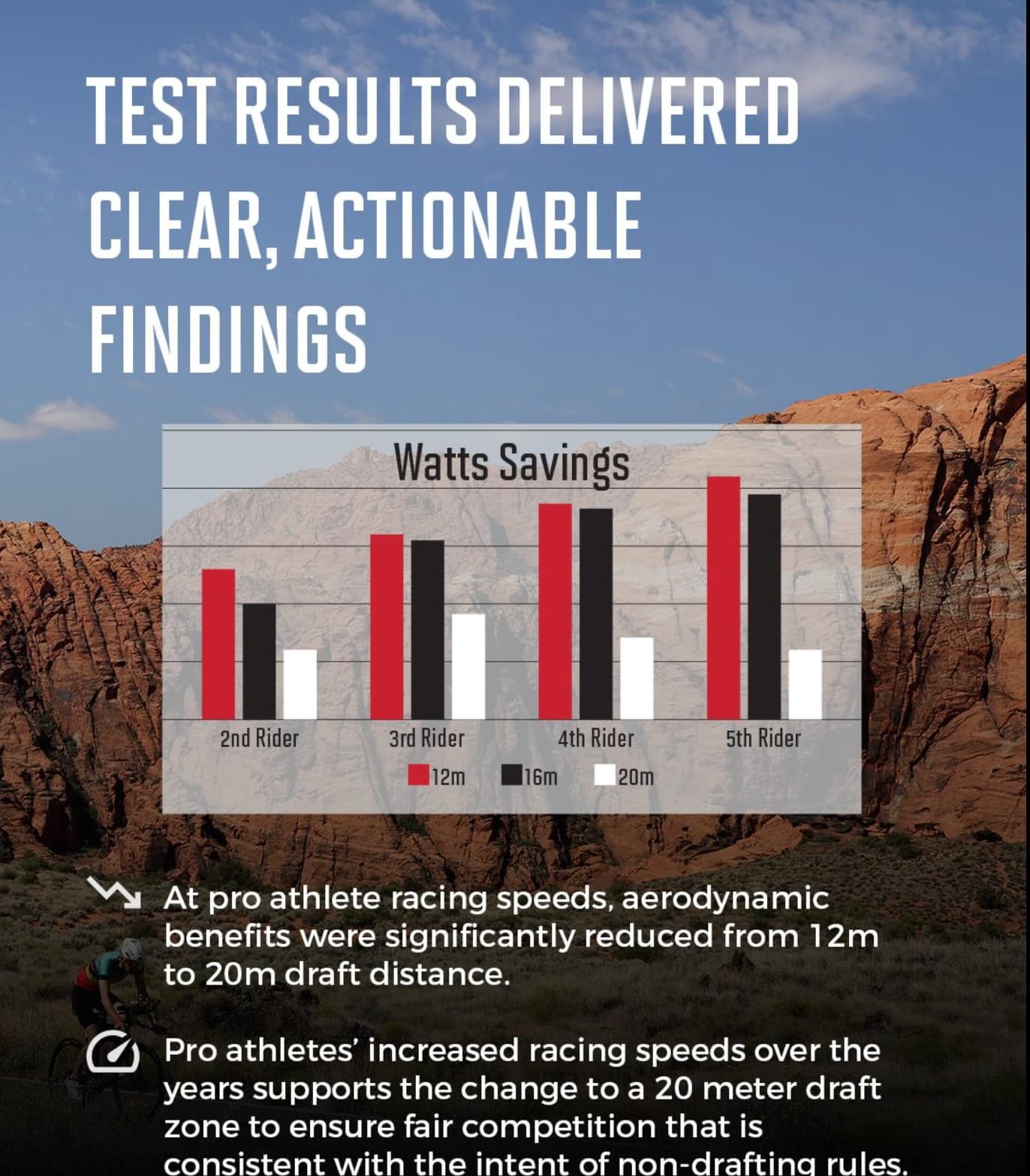
Testing Delivered Clear, Actionable Findings
The draft zone testing program included baseline aerodynamic testing to establish individual coefficients of aerodynamic drag (CdA), followed by controlled group testing using professional athletes riding at IRONMAN 70.3 race speeds and power outputs. The athletes’ bikes were instrumented to capture power, speed, wind, air density, road inclination, and additional variables, with RaceRanger technology used to precisely maintain designated draft zone distances.
Multiple test runs were conducted at 12, 16, and 20 meters, allowing for direct comparison across distances under consistent conditions. Rider positioning was rotated to account for athlete size and power variability, and the resulting data was analyzed to quantify power savings and draft effects at each distance.
Over multiple tests, the results showed that at professional racing speeds, increasing the draft zone distance from 12 meters to 16 meters did not have a material change, however, increasing from 12 meters to 20 meters significantly reduced aerodynamic benefits. As racing speeds have increased over the years, the change to a 20-meter draft zone for professional athletes will help ensure fair competition that is consistent with the intent of non-drafting rules.
Pathway to Implementation and Continued Evaluation
For the benefit of the sport, we will continue our planned tests of different aerodynamic effects across various race conditions during the 2026 season. We will also continue to collect athlete feedback throughout the season. However, the resulting data and findings from our testing to date provide sufficient and conclusive evidence to make the change to a 20-meter draft zone.
Operational details related to the 20-meter draft zone (e.g., time allowed to pass) will be communicated through the 2026 IRONMAN Competition Rules in advance of implementation to ensure clarity for athletes, officials, and event teams. In addition, as previously announced, IRONMAN will be expanding the use of RaceRanger as a tool across more pro events to support this change and fair competition.
“Our responsibility is to apply what we learn in a way that is fair, consistent, and operationally sound,” DeRue added. “This change reflects our long-term commitment to data and research-based decision making and to continually improve the racing experience for our athletes.”
Evolution of Draft Zone Standards
Prior to 2015, draft zone distances in triathlon varied globally, typically ranging from 7 to 10 meters. With the establishment of its first global competition rules in 2015, IRONMAN adopted a standardized 12-meter draft zone for professional athletes worldwide. Advancements in technology and data-driven insights into racing behavior have since enabled IRONMAN to more precisely evaluate and evolve those standards.
The move to a 20-meter draft zone for professional athletes represents the next step in that evolution, informed by data, technology, and athlete feedback.
Age-Group Draft Zone Clarification
Age-group draft zone distances will remain unchanged at 12 meters. “Compared to professional racing, age-group racing presents a very different set of factors, including racing speeds and course density,” DeRue said. “Based on those realities and informed by historical data, we are confident that the existing 12-meter draft zone continues to best serve the age-group racing experience at this time.”
IRONMAN will continue to monitor age-group racing conditions and leverage technology, officiating, and operational best practices to ensure a fair, safe, and consistent experience for all athletes.
For more information on the IRONMAN and IRONMAN 70.3 brands and global event series, visit www.ironman.com.
For any media enquiries on IRONMAN and IRONMAN 70.3 races please contact: press@ironman.com.
About The IRONMAN Group
The IRONMAN Group is the world’s largest operator of participation sports with a portfolio of brands, events, media, partners, merchandise, and digital platforms operating in over 50 countries worldwide. A global portfolio consisting of hundreds of events includes the IRONMAN® Triathlon Series, the IRONMAN® 70.3® Triathlon Series, 5150™ Triathlon Series, IRONKIDS®, premier running events including the Rock ‘n’ Roll® Running Series and City2Surf®, the UTMB® World Series of trail running, the Epic Series™ of mountain biking including the Absa Cape Epic®, and a collection of road cycling and other multisport races. Since the inception of the iconic IRONMAN® brand and its first event in 1978, millions of athletes have proven that ANYTHING IS POSSIBLE® by crossing finish lines around the world. From its beginnings as a single race among friends in Hawai’i, The IRONMAN Group has become a global sensation and collection of high-growth lifestyle brands that inspire people to unlock their potential in life. For more information, visit www.ironman.com/about-ironman-group.
1 Like
I guess its done now and we can all debate something else.
Do we know if they used any women’s tests to make their decision, or was this an all-guy type affair?
I am curious as to what the difference was between 12 and 20.
Can’t wait to see an ag male in a female pro group with the male following 12m and the females at 20m. The refs won’t get that wrong at all…
3 Likes
I don’t think most of us are actually haters, you’re just blinded by your passion on this particular topic. Personally I don’t care if it’s 12m vs. 20m. And I’ll get a front row seat on the Hardy Toll Rd this April (after buying you that Sprite I owe you!).
3 Likes
Come to the live show! hahaha
3 Likes
The awesomeness is so awesome here 
2 people I have SO much respect
Marc and Talbot.
Winning 
I just measure $hit 
5 Likes
My gut tells me a portion of those will end up with voter’s remorse
4 Likes
And Roth, latter as a trial.
So @marcag , how close were the watt differences from that old graph someone posted up here?I think from 12 to 20 it was like 7 or 8 watts, did you guys get that number or similar? More or less?
Lets keep in mind that @marcag probably can only say “too much” with this project.
1 Like
Yeah I was in the anything greater then 5-7 watts is sufficient to make a change.
I have been scolded by mods about too much data 
I am not sure which chart you are referring to. There were a lot of numbers thrown out here and there. All the previous studies we could find were checked against our results. Not all were equally good. I even ran it against some AI models. It was pretty funny because ChatGPT would give me an answer. Then I’d say “yes, but we saw this” and it would say “good catch…..this is why I got it wrong the first time……”. I bet I could get ChatGPT to admit there is an aero cost of drafting
I am not releasing any secrets because the IM chart, with no values, shows this. One BIG difference between 12 and 20 was how savings “stack” in position 3, then 4….then 5. The phenomena is much less at 20m. Again you can see this in the chart IM published. See how the bars grow from P2→P5 at 12m but don’t at 20m ? This has never been measured in the field before
I wonder how many athletes are saying to themselves “I wanted this, I wonder how this affects me ?”
5 Likes
That is an interesting sentence. During the whole process I would ask people “what is your threshold to change ?”, 100% by personal curiosity, and I got many answers.
To your threshold : is it 7 watts 100% of the time, or 7 watts 10% of the time ? Conditions are changing continuously. Position changes. I think a more valid “threshold” is kilojoules for the entire bike leg. That is the more important thing to look at in terms of savings. This is Marc the tri fan speaking.
3 Likes
I guess folks have their reasons, not like it isn’t all going to come out one day anyway. Thanks for the detailed response, for me it has been enlightening on what those further back spots entail. Of course conditions have to warrant any gains, but under those, does make sense that there is a cumulative draft effect. Personally I have never had a dog in this fight, it is up to those racing pro now, and those that put on those races to determine the rules. We get to now focus during races the uber biker once again, how did they ever win before with such advantages to their competitors!! (-;
This I think is gonna be the big impact and what can break apart some of the large packs we’ve seen in the pro races. This phenomenon explains what keeps the speeds exceptionally high in the front group, and allows relatively weaker cyclists to sit in and get a tow to T2 way faster than they would on their own. It should take the large groups and break them apart into smaller groups say of 2-4, which without as much benefit should all be at different speeds.
Like I had mentioned in the debate earlier, I think the big benefit to us as fans is having a sport that’s more “competitive” from the standpoint of allowing athletes to win multiple ways. Having the formula basically turn into short course “swim front pack, get towed on the bike, running race” doesn’t help grow the sport long term. Having the ability for a Laidlow to go Kamikaze off the front, or Sam/Lionel chasing from the back, or the Norwegians having to make choices on the bike instead of just sitting in getting maximum benefit adds unpredictability and should increase parity.
3 Likes
Yeah I think we’ll be seeing more post-race Instagram posts bemoaning how “I just didn’t have my bike legs today”.
4 Likes