Yup. My theory is that French senior are more in shape than the rest of the world in this AG, resulting in an over representation of the AG in the final result.
This makes sense. Being in your 60’s and coming in the top 200 overall is a strong argument for deserving a qualy slot!
You obviously have a right to have this opinion.
But I’d like to point out that we are talking about amateur world championship. So by definition it isn’t “the best” anymore already.
And if you look at amateur / master world championships in other sports you’ll see that other aspects, such as inclusivity and participation, play a part. A much bigger part than in elite/pro sports. I’ll leave the research to you, but go and look it up it’s interesting.
To be clear, inclusivity and participation are a part also of elite world championship. That’s why we want participants from all over the world, from both genders, disabilities/challenged, etc - not just the fastest athletes.
Another example. At the Olympic games, some fast athletes aren’t allowed to participate to make space for all continents.
World championship doesn’t imply that only the fastest athletes should attend.
The new system IM is introducing is interesting. Obviously it relies a lot on how the standards are set.
We’ll have to wait and see how it’s going to work in practice in the real world.
2 Likes
I want to do a few simulation (after all it all depends how the qualifying standards are set) but there also is a possible outcome where the most competitive AG (men 35-50) get more slots than they did in the past.
There is a possibility that this brings regional differences (maybe women are going to get more slots in the US and men are going to get more slots in Europe).
1 Like
Could be. But overall, I think it will reduce possible “unfair” AG penalties : if you are an f50-54, with 4 participants, but 3 of them are incredibly fit athletes, they all still have a chance to get a slot - wheareas on the old system, they would probably have had to share one spot while the other AG with more participants - but not potentially faster - would have had less “deserving” slots.
Not a perfect system, but I like the idea.
One of my concern is that using Kona as a reference to calculate the coef. is not great for certain AG categories, i.e. people below 29 : I don’t know a lot of people this young who can afford to go to Kona, strong money-selection biais in this category I think.
Where has this been debunked?
I’ve seen too many times where a relatively fast girl gets 2nd, or 3rd, or 4th in their ag, with a relatively fast finish, not too far off the ag winner and there is only 1-2 slots available. The 30-39 ag for females can be very competitive at the pointy end yet their slots for 1 day Kona were very minimal. In a typical 40 slot race, I don’t think any female ag would receive more than 2 slots.
Also, ag placing still matters. If you get 5th, that’s at least 4 getting a slot before you do. It now just ALSO depends how fast you are compared to other ag’s.
Edit: it may be statistically harder to get 5th or 6th in m40-44 than say 2nd or 3rd in f25-29 or f30-34, but that doesn’t mean the male is faster when normalized with the standard. Those standards are going to be a challenge for a lot of ag men 30-49. More than people realize right now. If you thought it was hard to qualify in the old system, I think it’s now harder for middle aged men. And that includes me.
2 Likes
Good point. How rolls down behave might be very different. Will the beneficiary of the new system be more or less likely to take up their slots?
So had some rather “holy shit” commentary with various athletes last night, If your trying to figure out races to give you an advantage? Has anyone figured out yet if you should target “hard” courses vs “easy” course or events that may have a better chance to have a course modification (ie- swim cancellation?).
I don’t think Kona is necessarily a “hard” course, it may be for sorta bop athletes with the heat. But from a course profile standpoint it’s more I would say mid? It’s just iconic location but from a omg that course is so hard I don’t think that is Kona. And of course you add in the WC factor that then can maybe make you race poorly with it obviously having all the best athletes mostly there. So you may have a meh performance and finish worse off than normal simply because it’s filled w/ more full better race roster (duh it’s a WC).
But from a “ok this is new pathway” would you want to have a better score than the Kona avg time? Or worse time then the avg Kona time within your AG?
Obviously you now have to race really really well and then because it’s only going to be ~50 slots per normal races that you will need a special day. It’s kinda wild once aq AG winners are accounted for your literally taking ~35 athletes after. So is there any pathway that is easier than another race type of question?
I don’t think the strategy changes much, if it all, for race selection. Pick a race that suits your strengths and gives you the best chance to place well. Number of slots still matters but that’s no different than before. If I’m on the borderline, I’m going to target a race that has 100 slots (Cozumel). Unless for some reason, that course doesn’t suit me and there’s a better opportunity somewhere else.
3 Likes
So if an age group start going slower e.g. M60-64 at Kona, that will make it easier for them toe qual = more slower M60-64 at kona, who will then go slower again etc… i think you see my point. How do you stop that spiral?
It is based in 5 years of data, so any one year should get smoothed out.
I thought about that too. Is the Kona standard gonna be stable for any given age-group? There does seem to be some potential for an unintended feedback loop…
1 Like
Haven’t seen this here so far, so maybe for illustration: Here are two examples of time needed in each age-group to be equal to M30 9:00 and 9:30 respectively. Historically, this should be in the ballpark of the cut-off times for qualification on a lot of courses.
Discuss 
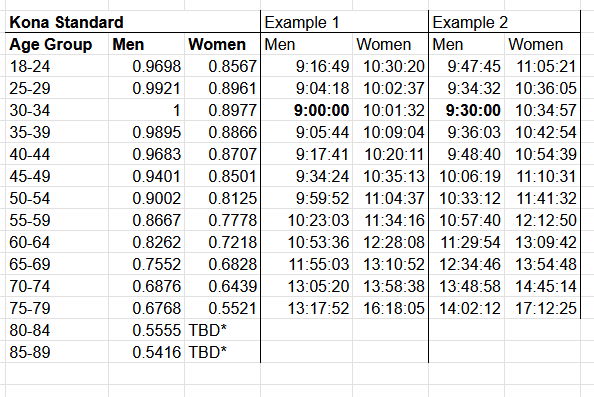
Fun-Fact: According to this, just finishing within the time-limit as a 75-year-old lady is pretty much equal to my PB from my 20ies. (Full disclosure: as of now i am not a lady)
Here’s a neat side-effect of that system: After having retired from ironman a couple of years back i can maybe come back in a few years and compete against my PB on fair terms if i age-grade it with this…
2 Likes
The new system will flat out qualify more women because it normalizes for age and gender speed, but not for gender participation numbers like the old system did.
1 Like
It would be interesting and see an analysis of a previous race where we know the slot allocation and compare it to the new model and see how the allocation differs assuming no rolldowns.
1 Like
Playing a bit with some recent results,if I’ve got it right
-you need at least a 8:45/ 8:50 adjusted to secure slot.
-only 2 women would have grab a slot at IM Frankfurt 25’
-M50&M55 are always the ones getting more slots
-Extra slots if no one shows up in the 70+ AG Men and Women
-Lanzarote 2025 0 Woman
-Nice 2025 2 Women
Can anyone explain to me how I can somewhat easily calculate the top KS times from a 2024 race result? Is there an excel spreadsheet available?
I put the data against Ironman Cairns 2017, I have not removed the 1st place qualifiers from the data but you can see how qualification would have played out that year. I just made a link as cant seem to attach the file https://drive.google.com/file/d/1TGNq699QMcJtYRsjLudLh2RxwtZaKp_l/view?usp=sharing
1 Like
Here is my google sheet you could download this to excel and input data from the race you are after. This is based on Cairns 2017 as I was just interested to see how it looked. Ironman Cairns 2017_ New Qualification.xlsx - Google Sheets
1 Like
Based on my analysis of Cairns 2017 if there was 100 slots about 30 would have gone to Females include age group winners and 70 to males including age group winners. This is very close to what it was then. The difference is in the age break down and I have not fully anlaysed that difference, but looks like little less going in the generally big 30-40 ages and more going 50-60 ages. The older fast guys who been doing the sport for years and less slow newbies in their age who generally just bulking up the size of the age group and getting more slot due to size alone.
1 Like