Maybe… it will be interesting to see how the deviation plays out on different course types and conditions. For example, do older AGs have a more difficult time on hilly courses or hot courses vs their multiplier. Remember the multiplier is based on Kona. My hope is they tested the multipliers against all races from the past few years to ensure course and condition didn’t statistically impact how the new system would work against a baseline.
Hey @stevej can you explain the reasoning behind this?
My guess is that the Kona standard coefficient is most generous for these groups, thus making them (relatively speaking) higher up in the adjusted overall standings as compared to middle aged men.
Is that a hunch, or based on a review of the data compiled by some others for some prior races? Do you see that differently for 70.3 vs full distance, given the separate gender slots for 70.3 WC?
1 Like
Yes that’s true. I was trying to keep it simple for folks. Some seem to think that you are racing against others at different races. Which isn’t the case.
1 Like
If someone at Ironman or can ask Ironman this very important question before I book my next race planning hotel and flight in November .
Do I need to stay for the awards/ kona slot allocation or is it now a system of number crunching and emails .
Will they know like instantly at 8 pm who has the slots and can register or will it take a day or two.
I glanced at a few races with the new calculation but every race is a bit different. If a bunch of really fast 30-34 and/or 35-39 males show up, obviously they are going to score really well in the adjusted overall rankings. So that race may not support my theory in full.
But if you take a step back and look at common themes on how slots were previously awarded:
- slower middle aged men that finished 3rd-7th or so would get slots. Sometimes these could be guys that are 45 min or more slower than the ag winner.
- fast females that finish second or third wouldn’t get slots.
With the new system, the first part above doesn’t happen anymore. You can’t get 5th in your ag and get a slot unless 1-5 are all stupid fast which is atypical. And I think it’s pretty obvious that fast females will be rewarded and aren’t limited by number of starters anymore.
You could email them yourself. But I would assume that you need to stay for awards to accept.
I keep seeing posted about people saying at least it will stop people from posting they got a kona slot when they finish 40 th in Their age group ??
That’s nice not kona I have not seen a kona slot roll past 15 even or heard about one ( women 2023 excluded hence why back to kona only ) .
Did anyone get a kona slot prior 2019 or men 2022, 2024 that rolled past 15 in your age group ???
True , but would the email reach the right person that knows ??
My biggest gripe with Ironman ( which is nice that this is the biggest) is they keep us there for another full day at many locations and although I would like to stay at the location I don’t want the day to be waiting 4 hours to register “ online “ at the slot allocation.
I just have an issue with waiting for stuff.
I foresee a couple inequities with the new policy:
- A system that already disproportionately rewards women will do so even more. (BTW, don’t forget women are getting a second women’s only race this year that will take everyone with a pulse—men got one of those).
- You’ll see more slots given to old men and women from small age groups that are close to the lower standards of those groups. It’s cute when one of three 76 yo’s gets his 15th slot, but less so when the guy finishing second of three does
1 Like
I realize, but isnt the multiplier/standard is based on Kona times which includes swimming. So what happens when a race cancels the swim and the time standard is then very different from the actual race times because that race had no swim (or whatever other deviation).
Its also entirely possible that I misunderstand and am not quite asking the question in the right way.
Appreciate the reply!
In my VERY limited experience, the men in the 30-49 age groups are fast, and even a 5th place slot is a very fast time, especially in Europe (disclosure: I’m US-based).
I didn’t know fast women in AGs with fewer slots were having trouble qualifying, but that makes sense.
Will be interesting to see how it all shakes out
Ok, thats what I figured and it makes sense. What I am not smart enough to understand is how is the Kona standard figured in this scenario? Is there a methodology for removing the average swim time for each of the AG’s to then calculate that Kona standard without the swim? So, average swim time standard for F70-74 is xx:xx and 20 minutes faster for M35-39?
Or are Kona slots then just based on the age group winner’s finish time in a modified event? I just dont know how then a F70-74 can be compared to a M35-39 in an age graded finish time.
Again, I’ve read through the article once and may not have totally absorbed it or understand it. My apologies.
Each AG has a multiplier that is in effect for the entire qualifying year. In each race every athlete will have their multiplier applied to their finish time. This will give them their adjusted WC qualifying time. Then all athletes will be ranked based on this time. The roll down will then be based on this ranking not your age group ranking.
For example men 30-34 their multiplier is 1, so their time is the same as their adjusted time. So if he finishes in 10hrs his adjusted time is still 10 hrs.
A woman 70-74’s multiplier is 0.6439. So if she finishes in a time of roughly 15:32 her adjusted time will be slightly under 10 hrs.
If a male in 30-34 goes 9:30, places 4th, on a typical course, I think they are going to have a hard time qualifying. Sure that’s a fast time in general but when normalized, it falls down the list pretty quickly.
2 Likes
You bring up a good point. There is no adjustment to the standard if the race is modified (cancelled or shortened swim, short/long bike, etc). It also doesn’t take into effect any course terrain or weather except for Kona. So yes there will be some variation. Time will tell how that works out in the end.
I kind of think AG-M that rank outside top5 are out of luck in the new system, unless they are really fast. But buddy, you can make to the top 5, I am sure you can.
Can we please please put the “fast females” narrative to bed? There has never been a fast females problem. This is a sexist, ageist myth that has been debunked decisively. There is (was?) a “small AG” problem. But it was equally as often an advantage as it was a disadvantage, depending on your luck.
There are tons of middle aged men at these races and getting 3rd-7th in those AGs is pretty hard to do. Like, easily more difficult statistically speaking than 2nd in a small AG.
These folks are by no means out of the running in the new system. The entire point of the new system is that your AG rank no longer matters.
2 Likes
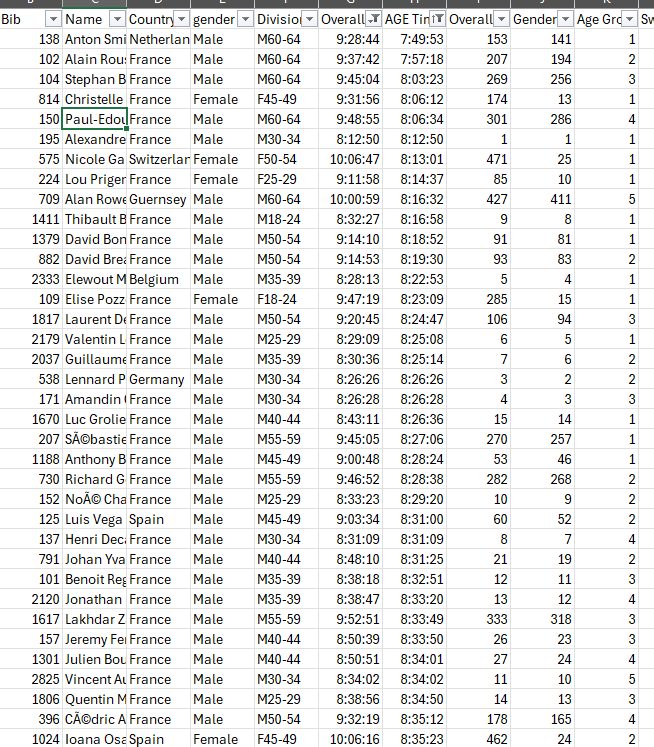
What I would love to see is a table for a few recent races that ranks finishes under the new system, and also indicates whether that person got an automatic slot based on the old system. To see what the delta is – way different? Or largely the same folks?
Sorry if someone already compiled and posted this, hard to keep track in this big thread.
It will be drastically different. It remains to be seen how many people show up to the roll down, but I wouldn’t be surprised if in a race where M40 previously got 7 slots now they’d “get” 2-3.