I’ve done a little work on this topic, so excuse my brevity on the explanation. In short, a 250m perfectly circular track would be fastest if ridden on a bike with a BB height of ~124 meters.
At infinite speed ?
I understand the idea (rider body not moving), but what speed could keep him in the middle ?
I do not buy this. Theoretical approach, too simple physical model ?
Still convinced lower BB is faster. Because aero gain beat… very slight course reduction.
Can’t prove it.
But you can’t prove the opposite either, apparently.
Apparently he tried several options to go full mantis, refused by UCI. If anyone know the full story, I’m interested.
I guess these experiences lead to the UCI regulation regarding pad / tip of aerobar limitations (+/- 10cm)
You can just barely see it, but there are actually two sets of pads, one where you’d expect and another mounted on the actual basebar. That’s likely where they busted him. If you only had the normal pad placement and could rest your arms reasonably/controllably on the base bar, you could beat a jig.(although it’s possible you’d get nailed for something in the safety clauses) He definitely meets the angle and +/-10cm rules if you measured from the top pad placement to bar ends.
*Also, in 08 he had to be with the bike when they checked it, probably made it tougher.
I’ve done a little work on this topic, so excuse my brevity on the explanation. In short, a 250m perfectly circular track would be fastest if ridden on a bike with a BB height of ~124 meters.
At infinite speed ?
I understand the idea (rider body not moving), but what speed could keep him in the middle ?
I do not buy this. Theoretical approach, too simple physical model ?
Still convinced lower BB is faster. Because aero gain beat… very slight course reduction.
Can’t prove it.
But you can’t prove the opposite either, apparently.
If a frame had a BB drop of 0mm for example instead of ~7cm there would be less FA as well as greater surface from which to build larger 80mm x 80mm fillets.
I appreciate the dialogue and having you challenging my assertions.
The lower the BB, the most important portion of the frame is hidden behind the front wheel.
Of course, to quantify we would need to test. Can’t do that.
But I’m confident that if T4 was designed with 75mm drop instead of 45mm like most track frame, or 0mm, and Cervelo saying it was a specific design features oriented toward reducing drag, it is for good reason.
I also appreciate discussion and challenge.
The “smaller course with higher rider” make sense also.
But as previously said, realistic evaluation of gain is a challenge.
I’ve done a little work on this topic, so excuse my brevity on the explanation. In short, a 250m perfectly circular track would be fastest if ridden on a bike with a BB height of ~124 meters.
At infinite speed ?
I understand the idea (rider body not moving), but what speed could keep him in the middle ?
I do not buy this. Theoretical approach, too simple physical model ?
Still convinced lower BB is faster. Because aero gain beat… very slight course reduction.
Can’t prove it.
But you can’t prove the opposite either, apparently.
If a frame had a BB drop of 0mm for example instead of ~7cm there would be less FA as well as greater surface from which to build larger 80mm x 80mm fillets.
I appreciate the dialogue and having you challenging my assertions.
I appreciate the dialogue and having you challenging my assertions.
In the spirit of challenging assertions, I’m keen to see your response to my question about left hand drive and center of mass. Still thinking about it?
Cheers,
Jim
Other possibility is the SRM he had on his T4 vs the FRD’s Vision crankset. Aero cranksets make a difference.
I have actually never seen aero cranks tested. I can see the reversed orientation of the Felt would work, given the yaw experienced on the track is only one side (there is a cool Red is Faster video testing yaw on the track. Way more of a factor than I would have guessed). Would you care to share the results you have seen for aero crank benefits?
Zipp did a lot of it when they launched the VumaChrono. There are quite a few Zipp guys who still use that crankset - in spite of the hassle of needing a special adapter plate to go from the proprietary 9-bolt pattern to a 144 track 5-bolt pattern and the fact that it’s now about 10 years old. Also a reason that Wiggins chose an aero crankset for his hour record attempt.
Specific gains will vary based on the particular crankset, chainring, and frame. I don’t have published results or anything I can share. This all stems from just talking track and aero stuff with a bunch of Zipp engineers, many of whom are themselves trackies.
Josh might be able to share the data from the VumaChrono testing now that it’s a legacy product. But it will of course be different for a track frame since there’s no front derailleur or derailleur hanger to mess things up.
I appreciate the dialogue and having you challenging my assertions.
In the spirit of challenging assertions, I’m keen to see your response to my question about left hand drive and center of mass. Still thinking about it?
Cheers,
Jim
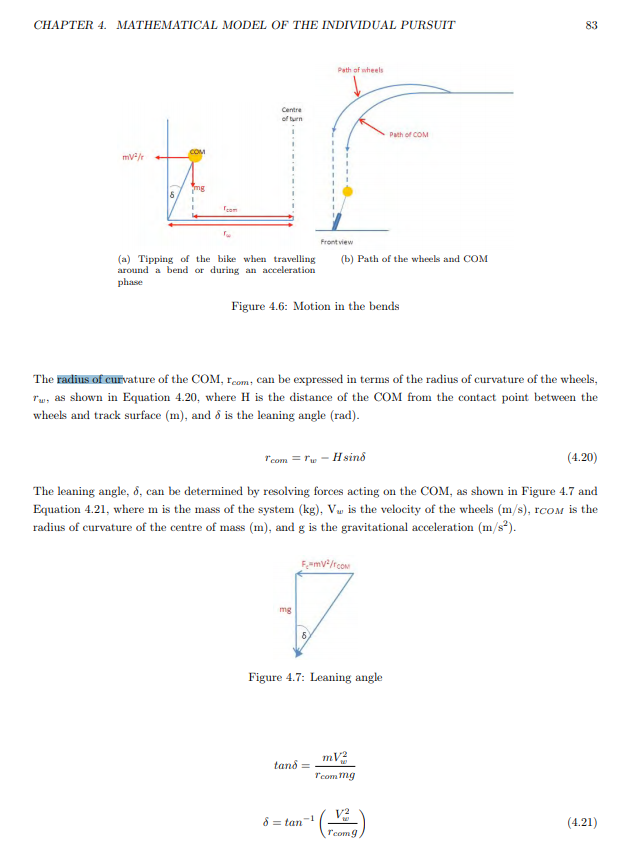
Interjecting, and using my very lay maths and physics, the best source my 18 seconds of Google-fu could find is this:
(seemingly credible source)
Now this is a bit tricky because the lean angle is dependent on the…lean angle (as noted by the author later in the text where he discussed the iterative numerical techniques required to arrive at an optimal lean angle given these equations).
But stipulating that this physics is sound, the key bit seems to be figuring out what LHD vs. RHD does to the value H, which is the distance between the contact patch and center of mass.
Now I’m not entirely sure, here, but my mental visualization seem to say that H does not change when changing from right to left, if I’m understanding H correctly (which I may not be). It’s symmetric with respect to linear distance from the track surface. And if H doesn’t change, then I think this would corroborate Felt and SuperDave (and all the left-hand-drivers who came before).
But I could have gone wrong at several points here, including selection of valid equations.
Now I’m not entirely sure, here, but my mental visualization seem to say that H does not change when changing from right to left, if I’m understanding H correctly (which I may not be). It’s symmetric with respect to linear distance from the track surface. And if H doesn’t change, then I think this would corroborate Felt and SuperDave (and all the left-hand-drivers who came before).
But I could have gone wrong at several points here, including selection of valid equations.
Nice find Trail. I believe you have put your finger on the reasoning that might be behind the LHD.
My reason for challenging that line of reasoning is has to do with the forces exerted by the tires on the track. Those contact forces must represent both the weight and the centripetal force. So the tires push down and outward on the track surface. The track pushes back with an equal and opposite force; call this the track reaction force. The line of action (where the vector points) of the track reaction force must pass through the overall bike+rider center of mass. If it didn’t the bike would fall over because the tires are free to rotate in the frontal plane about the track surface.
Next time you’re riding your bike on a straight road, hang your body off to one side of the bike and observe what happens. The lean angle of the bike will change but your center of mass must remain directly over the tire contact patches. The same thing must happen when riding through a turn but now the lean angle will be influenced by the centripetal term.
Would love to hear from SuperDave or from any of the Felt engineering team on this.
My immediate reaction the first time I saw it was that it was a placebo design. Give the riders something no one else has and tell them its faster. If they believe it, they will likely go faster. Placebo studies have demonstrated up to 6% improvements due to belief so its not something to be dismissed. Perhaps Felt has an engineering staff as well as a sports psych staff.
Cheers,
Jim
You can see in the photos I required a less-than-ideal Bayonet stem angle on the Felt and also a stack of spacers on the Cervelo to match my position, so those are considerations which could give a different rider slightly different results. Lower front end setups tested slower for me.
Jordan, I actually tried to get that nice R1 Track Wing aerobar but it was out of production at the time and we couldn’t come up with one in the early winter 2017, but I also wasn’t sure I could get the front end high enough with that R1 stem. The Tula Track Wing let me use any stem so I at least knew I could match the position - and I could get it in time! I wasn’t even sure I’d be able to test this setup, and considering I couldn’t use a brake to field test outdoors the first time I rode this aerobar was the last session on test day. I’d ridden it on the rollers a few times after setting it up to match the same position and ran through all the UCI legal measurements.
We tested my Felt Tk1 vs the Felt TA FRD with Jim Manton and the Velonews guys in Carson, which was an awesome experience. The data however does use two different power meters - my SRM on my Felt Tk1 and the Vision Stages dual-sided power meter on the TA FRD. The TA FRD sure felt like the fastest thing I’d ridden, but while we came up with some 0.025-0.03 CdA reduction across both frames I’d imagine the real world difference is something less than that. I want one! https://fitwerx.com/felt-ta-frd-aero-test-session-velonews-dean-phillips/
Thanks to all the contributors this was a great read!
Dean