http://jalopnik.com/you-suck-at-aerodynamics-1797349697
For all our expert internet aerodynamicist we have a quick test for you.
http://jalopnik.com/you-suck-at-aerodynamics-1797349697
For all our expert internet aerodynamicist we have a quick test for you.
Except this is just drag coefficient. Drag force = drag coefficient * characteristic area * ((fluid density * velocity^2)/2)
In general, I suspect the cars that look more aero are more aero. It’s also possible that this doesn’t include all of the components of drag
http://jalopnik.com/...odynamics-1797349697
For all our expert internet aerodynamicist we have a quick test for you.
x2, it is NOT a good test because it is only looking at cD. Any internet expert knows there is more to aerodynamics than just cD. However, it is an excellent novelty click-bait game for the person who doesn’t really understand the full equation.
On the other hand, the bulk of this forum at one point was really, really sure that the P5x was super slow.
Turns out it’s probably really aero.
Thanks for that.
Knowing aero and automotive engineers, most cars have a lower Cd going backwards. The normal configuration of front engine and windscreen is really bad. Hence why the E-Type has a poor Cd.
Airliners don’t have hoods.
On the other hand, the bulk of this forum at one point was really, really sure that the P5x was super slow.
Turns out it’s probably really aero.
I’m still laughing about that
Very small changes can have big aero impacts. Just rounding the corners slightly (see below) can more than halve the drag of a bus.
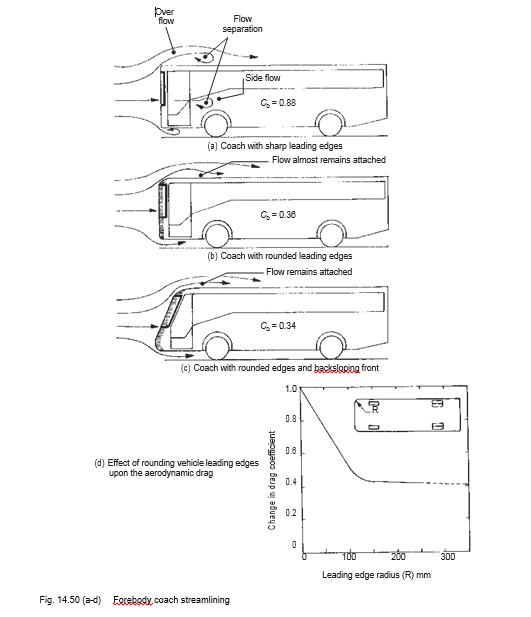
Additionally, overly sharp training edges can lead to flow separation and nullify what may look to the eye to be a reasonable “tail” (shape 3 vs. shape 4 below).

I believe this article is using published Cd of these cars, not Cd of the shape alone. That’s quite misleading. Many sports cars with high bhp have a lot of cooling components that results in increased Cd.
Formula 1 cars tend to have Cd over 0.7. On the other hand, Honda Insight (only 98hp) has a Cd of just under 0.25.
I call BS on that diagram of the kamn tail. There is a lot more wake behind a kamn tail than the zero they show. A kamn tail is a compromise shape that is more marketing than science. There is a sizable amount of turbulent airflow behind the kamn tail and will never be as good as a true teardrop airfoil.
The compromise is slightly higher pressure drag because the space behind is a vacuum rather than the remainder of the aerfoil. Probably some slight turbulence at the lip, but the shaping means that it has laminar flow across the edges, which detatches when it reaches the lip. Why would a kamm tail produce turbulence like you say?
I call BS on that diagram of the kamn tail. There is a lot more wake behind a kamn tail than the zero they show. A kamn tail is a compromise shape that is more marketing than science. There is a sizable amount of turbulent airflow behind the kamn tail and will never be as good as a true teardrop airfoil.
Yes, it is a simplified diagram (just look at the “good shape” at the top of the image…not exactly a NACA airfoil). Kamm tails obviously won’t be as good as full airfoils (otherwise, why ever use a full teardrop shape). This thread shows how the length of the tail for a Kammfoil impacts Cd: http://ecomodder.com/forum/showthread.php/boat-tail-drag-reduction-estimates-12969.html
The compromise is slightly higher pressure drag because the space behind is a vacuum rather than the remainder of the aerfoil. Probably some slight turbulence at the lip, but the shaping means that it has laminar flow across the edges, which detatches when it reaches the lip. Why would a kamm tail produce turbulence like you say?
What??? You really bought into all that marketing that there is no turbulence behind a kamn tail? That is asinine. Any one that is not blind can see that air will form turbulent wakes in the chopped off section of a kamn tail. Just look at the huge amount of drag increase you have from using a kamn tail versus a real airfoil:
From that link the poster above listed:
From zero-to-20% chopped-off,the drag rises 3.95%
30%-chop = 12.5% drag increase
40%-chop = 29.6% drag increase
50%- chop = 59.6% drag increase
60%- chop = 99.85% drag increase
70%- chop = 257% drag increase
80%- chop = 330% drag increase
90%- chop = 426% drag increase
And on the bikes marketed today, the kamn tails have around 50% chop so there is a huge penalty for cyclists today versus true aero bikes.
And that’s IF the bike you buy is even using a real kamn foil shape. A lot of the tube shapes I see going around today claim to be but they are CLEARLY NOT. For example, the D-shape seatposts on the BMC Road Machine and new Specialized Tarmac. Those D-shape seatposts are just about the worse shape you can do for drag short of just using a square shape. Even a round seatpost would have way less drag than these new D-shape seatposts.
Actually, no, the fluids I learned from my mechanical engineering degree tell me that the chopped tail shape will not produce turbulence provided the flow over the airfoil is laminar. The drag increase mentioned is due to the pressure drag created by the vacuum behind the chopped off part. I’m not saying it’s perfect, but there is science behind it. Again, what tells you there will be so much turbulence created?
Actually, no, the fluids I learned from my mechanical engineering degree tell me that the chopped tail shape will not produce turbulence provided the flow over the airfoil is laminar. The drag increase mentioned is due to the pressure drag created by the vacuum behind the chopped off part. I’m not saying it’s perfect, but there is science behind it. Again, what tells you there will be so much turbulence created?
What do you think happens to a vacuum? Nature abhors one. Air is sucked into the low pressure zone of the chopped off area and this is what creates the turbulence. It’s common sense. And no, your degree doesn’t stop air flowing into a vacuum in a turbulent manner. Either way, it is plainly clear that there is a huge drag penalty from the faux-“kamn” tails marketed on bikes today as shown by the drag table versus a real airfoil. It’s all to part fools with their money.
I apologize, lower pressure air region, if that makes you feel better. Obviously the air flows back into the region. However, because it stays attached past the widest point, it does so in a more controlled manner than a round tube would, for example. The same phenomena describes why semi trucks often have a rear fairing, which measurably improved their fuel economy. There’s a non bike, non marketing driven example for you. Is it as good as a full size airfoil, no. I’m not actually arguing that it’s as good. Is it better than the smaller airfoil that the tube shape limitations the UCI imposes would require? I don’t know. Possibly. I havent done the math, and i doubt you have either. However, it is undoubtedly better than a round tube.
Please draw for me the laminar flow lines you think exist in the chopped off area of the kamn tail to fill in the “low pressure”. You can’t. Because it’s turbulent flow.
I apologize if i didnt make myself clear. The flow over the airfoil is laminar. Yes, turbulent flow will exist after it detaches. However, the low pressure region immediately behind the tube is the source of drag, not this turbulence. Because the flow stays attached longer, the magnitude of this drag is reduced, not eliminated. Yes, as i said before a perfect airfoil will do the job better. However, depending on your design limitations, a truncated design might have some advantages.
I thought the quiz was fun.
Long hoods = higher drag, is what I got out of it
Please draw for me the laminar flow lines you think exist in the chopped off area of the kamn tail to fill in the “low pressure”. You can’t. Because it’s turbulent flow.
It depends on the design. For a Kamn tail that has had a small amount cut off like on a seat post the air flows predominantly like the full shape exists, but with a very little turbulent flow that is reflected in the minor increase in drag. With a given shape, as the truncation is increased then you will get those notable eddys, the drag will increase and the drag values will fluctuate with those eddys.
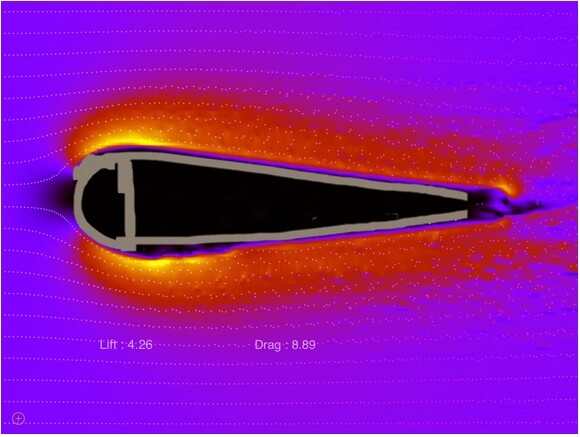
The attached simulation shows the flow and the speed. My apologies for such a crappy sketch, but thats all you’re getting 
Except this is just drag coefficient. Drag force = drag coefficient * characteristic area * ((fluid density * velocity^2)/2)
In general, I suspect the cars that look more aero are more aero. It’s also possible that this doesn’t include all of the components of drag
This