Wealth distribution in the US: Fair or unfair? And what to do about it?

On my way to work this morning, I was listening to NPR as I normally do, and there was a piece with a Harvard biz school professor about US wealth distribution and public feelings about how it “should be.” It was interesting in that the Harvard prof used the terms “wealth inequality” and “unfair” wealth distribution. The overall tone, and implication, of the piece was that the people in this country that have most of the wealth have somehow acquired it unfairly, or that the very notion that such wealth is accumulated in the top 10% isn’t fair and should be redistributed.

I think it’s easy to talk like this generically, but in my own experience, when you examine individual people who have made it into that top tier, it’s not nearly as it seems. Let’s take my parents…my dad came from a relatively low-income family, and started off with pretty much zilch. He started with Honeywell as a draftsmen, and then he got a job with IBM that had a program that allowed him to work during the day and take classes towards an EE degree. My mom would keep us kids quiet and occupied while he studied. My dad worked his way up at IBM, and my parents scrimped and saved…we didn’t have fancy cars, expensive clothes, or vacations. But, my parents were able to afford to put both my sister and I through college, and now they are retired and their wealth (house, savings, etc) probably puts them in the top tier. Did they come by their wealth “unfairly”? Should they be taxed more simply because they saved their entire lives and now are living comfortably? I would bet that many of the folks in the top tier of this country are where they are through their own hard work, and not through some nebulous “unfair” or inequitable means that is almost always implied when you hear statistics about wealth distribution in this country.

So, should we “do” anything about this? Can you redistribute wealth in a fair method that doesn’t penalize people like my parents who earned it the hard way? It seems to me that its possible, but you have to take a long term view of it, and I don’t think that simply taxing the wealthy and giving their money to others is the way to do it. Making higher education more accessible and affordable would seem to be a good place to start, as that appears to be the ticket to better paying jobs and a better future.

What say you, ST?

Spot
i won’t really comment on the ‘front end’ of how people earn their money and whether or not that’s fair. except to say that i thought a big part of that was why the USA introduced capital gains taxes?

but i will say that income inequality is negatively related to a lot of things. getting richer doesn’t make people happier, and higher levels of income inequality in a region or country are also bad for broader indicators, like health. interestingly, everyone’s health suffers, not just the people on the bottom of the pyramid.

-mike

It sounds like your dad is much more middle class comfortable that what could be really called wealthy. In the USA the top 5% of the population holds 80% of the wealth.

The big fear is that in our changing world is that the rich will only get richer and the poor only poorer. Worse yet, the middle class will shrink and more will join the ranks of the poor. This is a worse case scenario, but many are predicting this is the future.

I love that show “American Greed”. It shows to what extent some people will go to pursue more money than they will ever need.

‘getting richer doesn’t make people happier’

Just read a study about that which stated that money beyond a certain level of comfort doesn’t make anybody happier. To have more just for the sake of having more acutally makes people less content. Also in societies were people are more or less equal, even if everybody is poor, they are quite happy and content which is reflected in lower crime rates, etc. In societies where there are large income gaps, people tend to be much less so.

I like to respond with the “It’s unfair in America” with the “Well America is unfair in the world”.

A while back I read an article that said a total net worth of ~2K puts you in the top 1% wealth in the world. You want “Fair” with everything being equal you can’t just sit back and say “Oh gee America is unfair” without considering the rest of the big picture.

Being poor in America is rich by global standards. So either we allow the freedom to a let people define their own wealth, or we don’t and make sure everyone get’s the exact same thing. If we do the latter it would be only fair to do that on a global scale to be really “Fair”.

I also won’t go into how the latter clearly does not work and that ANY attempt to make it a little more fair simply is the first step to implementing it 100%. That does not mean that any redistribution will without doubt lead to attempting to create 100% equity, but that any redistribution doesn’t give 100% freedom to let people define their own wealth…which of course is unfair by that definition of fair.

~Matt

“Making higher education more accessible and affordable would seem to be a good place to start, as that appears to be the ticket to better paying jobs and a better future.”

My parents had a “Jesse Jackson for President 1988” bumper sticker on our grocery getter for years. After 22 years, I see things a bit differently that they do…

I am aware of organized programs that match at-risk, inner-city kids with “mentors” who provide a positive example and, in many cases, funds for private high school, modest vehicles and college tuition among other things. I am also aware that these same kids end up in federal indictments for drug and firearms trafficking. I agree that access to better education is a critical component to future success, but even that is not an exact science.

It is a very frustrating and sobering reality. The common denominator across the board is making poor choices. Even in the best of environments and circumstances, we see Americans making mind-boggling and galactically stupid decisions that send their financial stability into a tailspin. What do we do about that? Should we do anything? Draining your 401K to buy two Corvette Z06’s and then later being unable to pay the mortgage is not my problem. That is a “you” problem.

Don’t have an answer for you and I suspect that no one really does. I can certainly empathize with your situation and it is a disgusting feeling.

I also won’t go into how the latter clearly does not work and that ANY attempt to make it a little more fair simply is the first step to implementing it 100%.

~Matt

i don’t buy the slippery slope argument here, nor with stuff like gay marriage (ie., if we let gays marry, what’s to stop us letting a man marry a goat?). we are, that’s what. it precludes human reason and agency, somehow, and imagines that we’re not capable of making decisions. if we decide to do X, we can do it. if we don’t want X to turn into Y, we don’t have to let it.

-mike

i don’t buy the slippery slope argument here, nor with stuff like gay marriage (ie., if we let gays marry, what’s to stop us letting a man marry a goat?). we are, that’s what. it precludes human reason and agency, somehow, and imagines that we’re not capable of making decisions. if we decide to do X, we can do it. if we don’t want X to turn into Y, we don’t have to let it.

-mike

Who is “we”? It’s the govt that is making these decisions, and all they have to do is promise >50% of WE that they will take from the <50% that has more money, and spread it around. Is that what you think is the best way forward?

“Fair” and “unfair” are moral judgments, and moral judgments only apply to situations where there is free will involved–i. e., individual choice. After all, nature isn’t good or evil, so it can’t be “fair” or “unfair”; it simply is what it is. So if we consider unequal wealth distribution to be unfair, then we must be able to point to particular individual choices leading to such inequality that we think were wrong.

Logically, people are wealthy either because they produce value or because they steal it; they are poor because they don’t produce and don’t steal, or else because they squander what they have produced or stolen. So which of these choices can we condemn?

Are you going to condemn the poor for failing to steal? Not likely, unless you really prefer anarchy and chaos to civilization. Are you going to condemn the poor for failing to produce or for squandering? Maybe, but I think they’re suffering the consequences of that anyway, so I’m not inclined to try to make them feel even worse by adding my criticism to the shit they are already experiencing.

Are you going to condemn people for producing value? I could offer a detailed line of argument as to why that’s not a good idea, but let me just sum it up just by saying that if you value something and want to condemn those who produce it, you’re trying to have your cake and eat it too, which never works in the long run.

So the only remaining basis for criticism is that we might want to criticize some wealthy people because they stole their wealth. Does that actually happen? As a matter of fact, sometimes it does, most particularly when people acquire wealth by means of special favors from government–subsidies, trade protectionism, legal monopoly privileges, and other forms of market intervention. So if there is one valid kernel of truth we can extract from the whole “unfair distribution” argument, it is that we should vehemently oppose, on both moral and practical grounds, the use of state interventionism to bestow special benefits on the wealthy.

I’m also not going to get into the ‘fair’ vs. ‘unfair’ argument. It’s entirely too micro to try to divide the wealthy into people who gained their fortunes ethically and those who gained it unethically. I’ve known some very wealthy people who are in extremely different places on what I see as the ethics scale.

But I’m also in the camp that is troubled by the increasing income inequality in the country since it’s not a healthy place to be in the long run for a society.

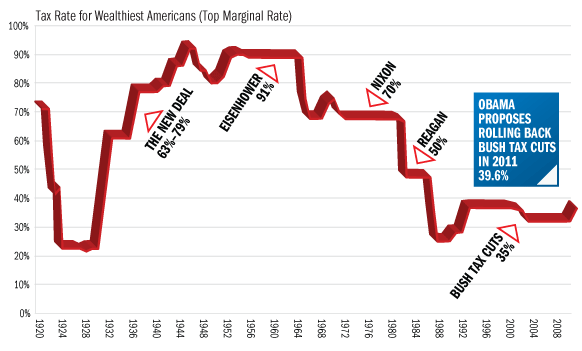
And I will note that during what so many conservatives and even Tea Party types see as the peak of American culture in the 1950s and early 1960s, the top marginal tax rate was something like 90%, and yet it was far easier then for a family to make it on a single income than it is now in the same urban area.

No comments on tax policy at the moment, but the one piece of wealth distribution that really galls me is the gross overcompensation of executives in publicly traded companies. The amount of money dumped here is astronomical - actually macroeconomic in scope. As an investor, I consider this to be irresponsible, and most likely contrary to the interests of both the shareholders and employees. Sure, you hear all the time that this amount of pay is justified by the level of responsibility a CEO has for keeping his company profitable. I don’t buy it.

From an article in the Electronic Journal of Business Ethics and Organization Studies: Vol 13, No.2 (2008)

Considered at the level of comparing CEOs between firms, if exceptional CEOs can generate exceptional performance for their firm, this theory would predict and justify a large range of CEO salaries, ranging from very low for poor to average executives, to very high for exceptional executives. The actual distribution of CEO salaries is not as would be predicted by this theory. While there are some CEOs paid more than others, none are paid poorly, and the average salary for CEOs is exceptional(Bebchuck and Grinstein 2005).

Additionally:

For any employer to approve an exceptionally high level of reward for an employee, presumably the employer would want to be satisfied that it was justified. In the absence of such proof, a reasonable employer might pay the employee the average level of reward, but would seem to have little reason to go beyond this. In the same manner, for corporate directors to approve what are exceptionally high levels of reward for executives, presumably they would want some evidence of it being deserved. Otherwise the directors would have failed in their duty to protect shareholders’ interests, from whose returns the reward must ultimately be paid.

The author also touches upon the “opportunity cost” of this high pay; in other words, there should be due diligence that there isn’t a cheaper way to improve the company’s position.

I live near to a very wealthy town, where these executives keep their third (or seventh) mansions, or bring their yachts into the harbor. When I see someone enjoying this level of extravagance, I sometimes feel like walking up to him and saying, “Having a good time? Great. NOW GET BACK TO WORK AND MAKE MONEY FOR YOUR SHAREHOLDERS, ASSHOLE.”

i don’t buy the slippery slope argument here, nor with stuff like gay marriage (ie., if we let gays marry, what’s to stop us letting a man marry a goat?). we are, that’s what. it precludes human reason and agency, somehow, and imagines that we’re not capable of making decisions. if we decide to do X, we can do it. if we don’t want X to turn into Y, we don’t have to let it.

It’s not a slippery slope argument at all, it’s an A or B statement.

Either you have conditions that allows the individuals to dictate their level of wealth, or you don’t.

If A is allowing the individuals to make the determination, and B is interfering with those individuals determinations then anything other than completely allowing individual determination is by default B.

The “Slippery slope” argument would be that once you move into B, some level of government control or redistribution that you will slide into 100% government control. I clearly stated that is not the case and yes that determination is created by us.

As history has shown time and time again however the tendency is to follow that slippery slope and that moving back in the direction of A is far more difficult than going further into B.

~Matt

And I will note that during what so many conservatives and even Tea Party types see as the peak of American culture in the 1950s and early 1960s, the top marginal tax rate was something like 90%, and yet it was far easier then for a family to make it on a single income than it is now in the same urban area.

http://the-wawg-blog.org/wp-content/uploads/2009/10/tax_rate-chart2.gif

Was going to bring up this same point but you beat me to it. I’m amazed when conservatives bring up the “Golden 50’s” as the standard, but completely remove the tax brackets that we lived under back then. Not to mention it was a time when American manufacturing was at a clear advantage because the European manufacturing industries were still recovering from WWII.

To me your last sentence tells me of the troubled times we have coming. In the past living on 1 income, with a decent home, a car, 1-3 kids and yearly vacations was completely normal. Now? You’d be hard pressed to find a middle class American family living comfortably on a single $40k-$50k (pre-tax) a year income.

Also to add to this, was wondering if someone has a reference to the study (graphs) on US middle class income growth in comparison to 1) upper class income growth 2) increase in insurance rates 3) increase in mortgage rates over the past 50 years. I saw it a while back but can’t remember where it came from. I think it showed middle class income growth was around 20%, while insurance/mortgage rates were up more than 75% and upper class income rates were off the charts in growth. That’s off the top of my head but would love to see the actual numbers.

I suspect there are lots of reasons why a 1950s family could do well on a single income, while perhaps a 2010 family cannot. Think about cars:

http://www.eere.energy.gov/vehiclesandfuels/images/facts/fotw186.gif

In 1950, we had .28 cars per capita. It’s .77 in 1999, likely higher today (this graph was the best that I could find). In 1950, you had .7 vehicles per licensed driver in a household (likely meaning that there was one car shared by two or more adults). In 1999, that was up to 1.12 cars/licensed driver…meaning each driver was responsible for more than one car. This alone could represent many hundreds of extra dollars/month that a 1999 family was spending that a 1950 family wouldn’t have.

etc…

getting richer doesn’t make people happier,]
I agree but as we say in France: money does not make/create happiness but it does contribute to it.

Thanks,
Fred

If you have time, there is a great 10-part article on this on Slate.

I agree with the title of that article. Regardless of your view as to the cause, you can’t ignore it. And it’s nearly impossible to argue that it’s healthy, even if you think it’s fair.

To say that the wealthy earned it and walk away, is, I think, unwise.

I also won’t go into how the latter clearly does not work and **that ANY attempt to make it a little more fair simply is the first step to implementing it 100%. **

Your quote above was clearly a slippery slope argument, notwithstanding the caveat “I won’t go into it” (but it’s true anyway, wink, wink). That’s probably what he was objecting to. You misspoke, and I’m glad that you cleared it up. But wait, You said, “As history has shown time and time again however the tendency is to follow that slippery slope…” Also, the erroneous “moving back in the direction of A is far more difficult than going further into B.” is a hidden slippery slope argument (without the elevation imagery). Perhaps you aiming for a “floating downriver” fallacy? :wink: Well, I’m certainly glad that you aren’t making a “slippery slope” argument!

Spot, the situation your parents are in is exactly what pisses me off about our unfair tax system. I’ll go so black and white as to say Wealth redistribution is unfair, as is a progressive tax system. The opportunity is there; so a lack of a will to succeed is not a viable excuse for what I deem as theft of the highest caliber.

So long as the wealth was not gained illegally (read: monopolies, extortion, racketeering, etc) then not one penny should be re-distributed against the will of the wealthy. If they choose to give back (which I do believe is the moral thing to do) then they should be doing so of their own accord, anything short of that is approaching on communism.

Thomas Jefferson:

To take from one because it is thought that his own industry and that of his father’s has acquired too much, in order to spare to others, who, or whose fathers have not exercised equal industry and skill, is to violate arbitrarily the first principle of association – the guarantee to every one of a free exercise of his industry and the fruits acquired by it

And I will note that during what so many conservatives and even Tea Party types see as the peak of American culture in the 1950s and early 1960s, the top marginal tax rate was something like 90%, and yet it was far easier then for a family to make it on a single income than it is now in the same urban area.

http://the-wawg-blog.org/wp-content/uploads/2009/10/tax_rate-chart2.gif

Was going to bring up this same point but you beat me to it. I’m amazed when conservatives bring up the “Golden 50’s” as the standard, but completely remove the tax brackets that we lived under back then. Not to mention it was a time when American manufacturing was at a clear advantage because the European manufacturing industries were still recovering from WWII.

To me your last sentence tells me of the troubled times we have coming. In the past living on 1 income, with a decent home, a car, 1-3 kids and yearly vacations was completely normal. Now? You’d be hard pressed to find a middle class American family living comfortably on a single $40k-$50k (pre-tax) a year income.

You can live on one income as easily now as you could then. But you can’t spend $150-200 a month on cell phones, drive 2-3 cars, $125 on cable/internet, live in a house that is 40-50% larger than in the 50’s, have your kids in costly activity programs, take expensive vacations, etc. That generation didn’t spend on all that stuff.