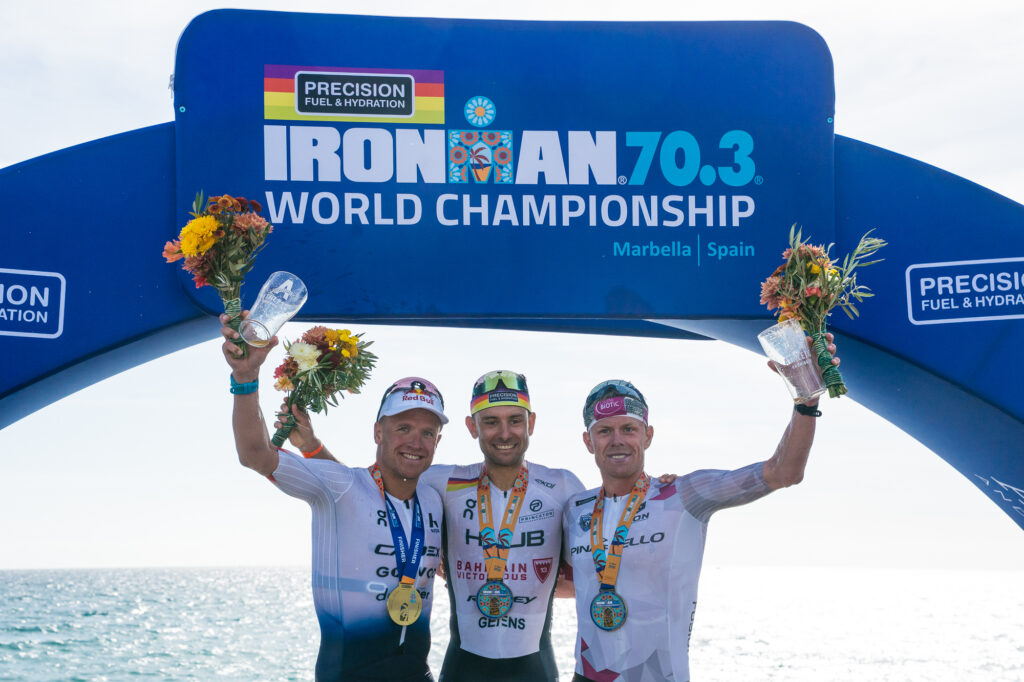
 Precision Hydration was the title sponsor at last year's 70.3 worlds in Marbella. Photo: Kevin Mackinnon
Precision Fuel & Hydration came on board as a last-minute title sponsor for last year’s IRONMAN 70.3 World Championship in Marbella, so it’s not a big surprise that the company has done a multi-year deal with IRONMAN to be the title partner for the 2026, 2027 and 2018 IRONMAN 70.3 World Championship events.
“We’re absolutely delighted to be expanding our partnership with IRONMAN once again,” says Jonny Tye, CEO of Precision Fuel & Hydration. “Marbella was one of the highlights of last year for us, and we’re excited for Nice and the IRONMAN 70.3 World Championships in the years to come.”
The company has certainly been front and centre when it comes to on-site activations over the last decade or so, and that will continue in style throughout the 2026 season. In addition to the on-site promotions, the company will continue to provide its low-calorie PH 1000 electrolyte drink on course.
“In 2026, PF&H are executing a campaign that aims to celebrate the 1980s as a formative decade in the sport and IRONMAN’s history,” today’s release states. “This starts in earnest this week at Athlete Brewing IRONMAN 70.3 Oceanside triathlon, where they will be showcasing some special memorabilia from 1980s triathlon at their expo activation: The Tri Bar. This theme will continue through the year, culminating in activations at the Precision Fuel & Hydration IRONMAN 70.3 World Championship, Nice and the IRONMAN World Championship in Kona.”
Apple Partners with London Marathon
This year’s London Marathon takes place exactly 11 years and two days after the launch of the first Apple Watch, and this year’s event is the first time that Apple will be partnering with a major marathon event. We reviewed the latest of the Apple Watches earlier this year (you can read our review of the Apple Watch Ultra 3 here, and our review of the Apple Watch Series 11 here), noting that the company has definitely become more serious about attracting endurance athletes over the last few years.
As we noted in our reviews, Apple has been building more and more high-end running tools into its watches, making it a very viable option for training and racing for most athletes. (Battery life remains an issue for ultra-marathon types who will surge past the Ultra 3’s 42-hour limit, but for marathon runners, that isn’t an issue.)
Now, as the “Official Performance Technology Product Partner” for the event that’s billed as “the world’s most popular marathon, with more than 1.13 million people applying to enter the ballot for the 2026 event,” Apple is signalling that the company is really ready to go after the serious running crew.
“The London Marathon is one of the world’s greatest sporting events and a powerful celebration of the global running community,” says Jay Blahnik, Vice President of Fitness Technologies at Apple. “Apple’s technologies support runners at every level with powerful tools and insights that help them stay motivated, track their progress, and better understand their health and fitness. We couldn’t be more excited to be a partner of the 2026 TCS London Marathon.”
TUE Questions
 From ITA.SPORT
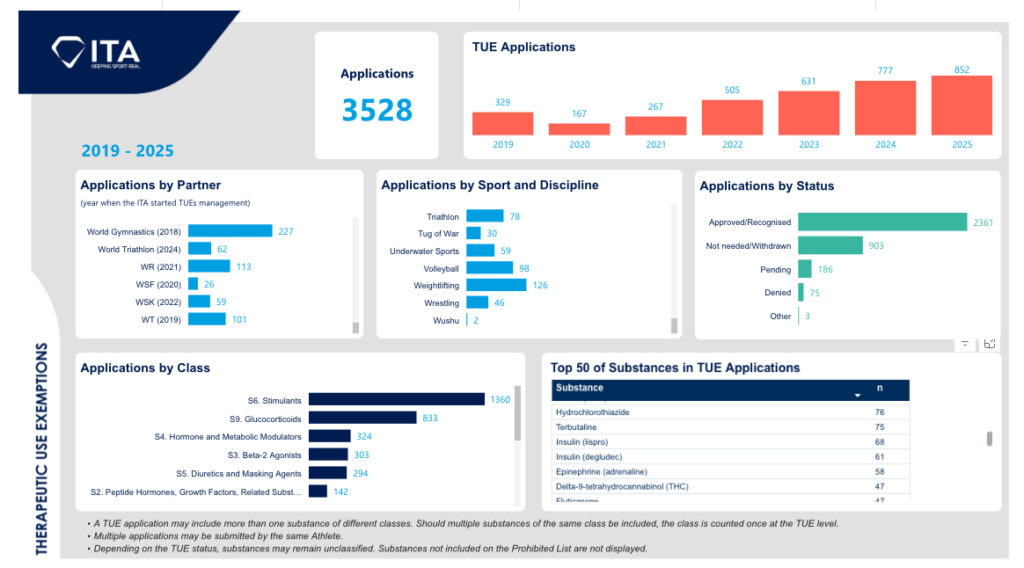
The International Testing Agency (ITA) has launched a new “interactive dashboard publishing anonymized statistics on therapeutic use exemption (TUE) applications it manages on behalf of its partner international federations.”
The idea behind a TUE is to allow athletes who need to take a medication that might be banned to be able to do that. Athletes who suffer from asthma, for example, might be able to apply for a TUE to be able to use an inhaler that might include a banned substance.
“The TUE Program is a necessary part of sport, allowing athletes with legitimate medical conditions to receive appropriate treatment,” says World Anti-Doping Agency Medical Director, Dr. Alan Vernec.
“TUEs are a vital – yet often misunderstood – component of the global anti-doping system,” the ITA explains in a post on its site. “By making aggregated data publicly accessible, the ITA aims to strengthen transparency, improve understanding, and reinforce trust in how TUEs are assessed and managed across international sport.”
Only one to three percent of athletes require a TUE, according to the ITA. To get a TUE, applications follow strict rules and “are carefully assessed by the ITA’s independent International TUE Committee.”
There was roughly a 25% increase in TUE applications between 2023 and 2025, but the ITA says that’s more a factor of it representing more sports as opposed to more athletes asking for exemptions. According to the data released, the ITA managed 650 TUE applications in 2024, and there were about 850 in 2025. About two thirds of TUE applications are approved, one quarter are withdrawn or determined not to be necessary, 10-15% remain pending and only about 2% are rejected.
Triathlon has had 78 TUE applications submitted between 2019 and 2025 – IRONMAN had 16 of those applications, while World Triathlon had 62. (IRONMAN joined the ITA earlier than World Triathlon – who only had the organization take over its anti-doping and TUE management in 2024.) Of those, 54 have been approved, with the rest either not needed/ withdrawn, still pending or denied. Over the years there have been more and more applications made within triathlon – one was made in 2023, 34 submitted in 2024 and 43 last year.
There’s been mixed reactions to the release of the data. 2023 IRONMAN world champ Sam Laidlow has started a petition, stating on Instagram that the goal was to “push organisations to make TUEs public in order to compete professionally.”
The Czech Republic’s Aneta Grabmüller Soldati points out that “because of a TUE, I have a daughter.”
“The ITA recently published statistical data on TUEs which sparked quite a discussion, criticism and even calls to make TUEs public,” Grabmüller Soldati writes in an Instagram post. “The medication I used, letrozole, is on the prohibited list. Yes, it can be misused to mask doping. But it’s also a common part of fertility treatment. Now imagine this is public. My federation, sponsors, EVERYONE would know I’m trying to get pregnant while treatment might not even work. As if pregnancy in elite sport wasn’t already complicated enough.”
https://www.instagram.com/p/DWO_N1uDJBl
There’s certainly lots to debate here. I have absolutely no doubt that there are athletes abusing the TUE system. But, based on the numbers – I was actually surprised that there were only 54 TUEs approved – there aren’t likely to be a lot of people using this as a way to cheat. I also don’t believe that athletes should have to tell the world that they’re trying to get pregnant, or that they might be taking a drug to alleviate symptoms from ADHD or any other condition that they might want to keep private. I also applaud the ITA for disclosing as much information as they can without betraying the privacy of the athletes. In other words, I’m not sure the “make it all public” approach is truly the answer, but I would love to see some sort of solution where people could have more faith in the system.