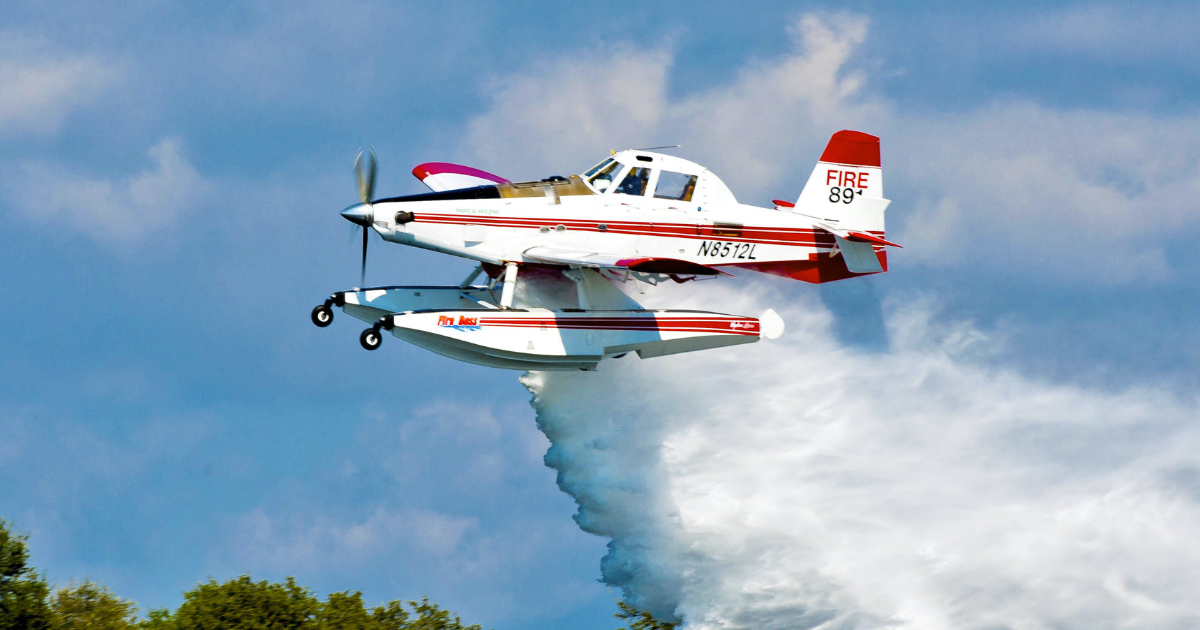
If you’re asking about the twin turboprop Canadairs, they have two small scoops that sit flush with the bottom of the fuselage until they’re extended immediately before skimming a body of water. The pilots then barely touch down, just skimming the surface, and those two scoops introduce water into the tanks. There are videos out there taken by cameras inside the water tanks that show how incredibly fast the tanks are filled. (I’m going from memory so there may be more than two but I’m fairly certain there are only two.)
ETA: The first pic is of the scoops in the extended position, the second is mainly of the “bomb bay” doors open but you can see the small scoop immediately behind, in the closed position.
If you’re asking about the twin turboprop Canadairs, they have two small scoops that sit flush with the bottom of the fuselage until they’re extended immediately before skimming a body of water. The pilots then barely touch down, just skimming the surface, and those two scoops introduce water into the tanks. There are videos out there taken by cameras inside the water tanks that show how incredibly fast the tanks are filled. (I’m going from memory so there may be more than two but I’m fairly certain there are only two.)
Cool! I think these are them. I’ve never seen them before in CO but there was a video posted on a local FB page of them in action on Wolford Reservoir fighting the East Troublesome Fire.
Seems crazy they can skid along the water, fill up with heavy water and then have the power to take off from the water.
I was wondering how they filled up and then sealed off the tanks.
A bit off topic but I read an interesting article about how water bombers are pretty ineffective in the most large forest fires, but citizens want to see them as evidence that someone is doing something. Ends up costing a lot of money for little result in many cases.
A bit off topic but I read an interesting article about how water bombers are pretty ineffective in the most large forest fires, but citizens want to see them as evidence that someone is doing something. Ends up costing a lot of money for little result in many cases.
When a forest fire is propelled by a hot strong wind, ain’t NOTHING going to stop it. And you are right that water bombers will make little impact on a large fire - large fires are too big for the relatively small loads carried by water bombers.
However, when you focus the effort on something smaller, then they can be effective. This might be to protect some critical infrastructure (eg. a communications mast), a small town, keeping a narrow road open for an extra 20 minutes to allow residents to evacuate, etc. Water bombing along an pre-constructed fire break can make it less likely to jump the break, also water bombing inaccessible small spot fires in the morning may prevent them becoming a large blaze later in the day when the heat and wind pick up.
You’ve gotta pick the time and place to use limited aerial resources, rather than wasting them fighting a large fire front in unfavorable weather conditions.
this isn’t a water tanker, but this video (i don’t know who took it) is within a few miles one way or the other from the compound. we saw a lot of this DC 10 over the last month, and i’m now riding thru or past quite a bit of phos-check or whatever that plane drops.
There is a TV show some time ago called Ice Pilots NWT. Basically about Buffalo Airways up in the North West Territories that flies a fleet of piston driven planes carrying cargo.
One of the episodes they sold a couple of the Canadair planes to Turkey and had to figure out how to get them there via ferry flights. Very interesting series getting them to Newfoundland then jumping across the atlantic ocean eventually to Turkey. The main problem was fuel range and the plane does not have de-icing capabilities. Lots of hops across the pond.
Once delivered they trained the Turkish pilots to fly them and one pilot didn’t have the landing gear down on a touch and go. Ground open the water tank on the plane which was a massive repair.
Great show if you like these kind of planes and if you can find episodes.
Once delivered they trained the Turkish pilots to fly them and one pilot didn’t have the landing gear down on a touch and go. Ground open the water tank on the plane which was a massive repair.
Today I learned that the early 415s were actually 215s and had radial engines, as opposed to the turboprops we mostly see today. Here’s a video of the Turk you mentioned crashing their “new” 215.
My previous employer was Coulson (the owners of the Mars) and it’s sadly just a museum now up in Port Alberni, BC. It was getting too hard to find the parts to keep her flying. Plus, she was too big and cumbersome to get into the places that the 415s could.
There is a TV show some time ago called Ice Pilots NWT. Basically about Buffalo Airways up in the North West Territories that flies a fleet of piston driven planes carrying cargo.
One of the episodes they sold a couple of the Canadair planes to Turkey and had to figure out how to get them there via ferry flights. Very interesting series getting them to Newfoundland then jumping across the atlantic ocean eventually to Turkey. The main problem was fuel range and the plane does not have de-icing capabilities. Lots of hops across the pond.
Once delivered they trained the Turkish pilots to fly them and one pilot didn’t have the landing gear down on a touch and go. Ground open the water tank on the plane which was a massive repair.
Great show if you like these kind of planes and if you can find episodes.
If not on Discovery Channel maybe check Mikey McBryan’s youtube channel. Buffalo is operating a PBY and possibly a CL-215.