
An Olympian and a world championship gold medalist have filed lawsuits against Puma and its subsidiaries, claiming that the Puma products marketed to make them faster instead caused devastating, career-ending injuries.
Olympian Damion Thomas Jr. and World Championship Gold Medalist Champion Allison filed lawsuits against Puma (and its partner in developing some of its racing shoes, Mercedes-Benz Grand Prix Ltd.), alleging the companies failed to disclose that the sneakers could place abnormal and unnecessary stress on athletes’ feet and lower legs, contributing to life-altering injuries.
Thomas Jr. and Allison’s separate suits join that of Abby Steiner, who sued Puma in April 2026. Nike has also seen multiple lawsuits over its carbon-plated footwear.
Taken together, all of the suits point toward the combination of carbon plates and supercritical foams as changing the forces that transmit through feet and lower limbs while running. According to the suits, Puma promoted the products as safe, extensively tested and suitable for both elite athletes and everyday runners while failing to warn users about potential risks including stress fractures, bone stress injuries, Achilles injuries and Haglund’s deformity.
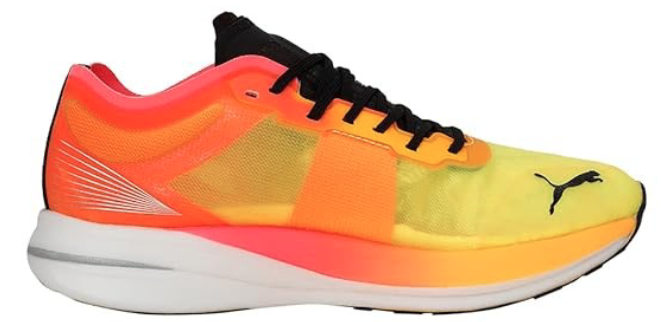 Puma Deviate Nitro Elite 2, one of the shoes at the center of a lawsuit from Olympian Damion Thomas against the manufacturer. Image: Thomas v. Puma court filings.
“As professional athletes, our bodies are our livelihoods. When you sign with a major brand, you trust that the equipment they put on your feet has been tested and is safe. You don’t expect that what they’re giving you might end your career. If there are dangers or risks, that is something they need to tell people,” said Champion Allison.
Allison signed with Puma in 2022 and represented the United States at the 2022 World Championships, winning gold on the men’s 4×400 relay team. He also owns the 13th-fastest 400 meter dash time. The following season, he competed just once due to an unspecified injury at the time. He returned to racing in 2024 and last competed in June 2025, with times significantly slower than before his injury. Per Allison’s Instagram bio, he currently works as a real estate investor.
Thomas Jr. last competed competitively in July 2024. He raced for LSU from 2018 to 2021, and won the NCAA National Championship in the 60-meter hurdles in 2021. Thomas Jr. then competed at the 2021 Tokyo Olympics, where he competed in the 110 meter hurdles and was eliminated in the semi-finals. He also signed with Puma in 2022. Thereafter, his results slid backwards; from finalist to semi-finalist, then to not making it out of the heats stages. Thomas Jr. underwent surgery to remove a bone spur in his foot in the fall of 2024, which he said caused him “extreme discomfort and pain” to his achilles and lower heel.
“When I learned about Abby Steiner’s lawsuit, it was the first time I considered that what happened to me wasn’t just bad luck. Like a lot of athletes, I assumed my injury was something I had to deal with on my own. If it took a lawsuit for me to realize I wasn’t alone, there have to be so many other athletes out there who still don’t know,” Thomas Jr. said.
The lawsuits, filed in Massachusetts Superior Court, seek damages for physical and emotional injuries, medical expenses, pain and suffering, loss of enjoyment of life, loss of earnings, loss of earning capacity and lost sponsorship, endorsement and career opportunities.
According to their respective attorneys, a dangerous pattern is emerging from the so-called “super-shoe” revolution: footwear designed to make runners faster may actually be causing devastating, costly injuries that permanently impact their quality of life. The resulting lawsuits are sparking a debate over whether major sports brands rushed these high-performance shoes to market before fully understanding or communicating the risks.
“These companies have prioritized the promise of speed over safety, and the consequences reach far beyond elite athletes,” said Peter J. Flowers, Partner at Meyers & Flowers, which represents Thomas and Allison. “An Olympian or world champion has access to specialists, trainers and lawyers. A high school kid whose foot is hurting is going to the local urgent care, being told to take some time off, and never knowing why. We may be looking at tens of thousands of people who have been seriously hurt and have no idea what caused it.”
Flowers, along with Sugarman & Sugarman, also represents Abby Steiner in her suit against Puma.

 . No, but, I agree with you - it seems a bit over the top. Though kind of hard to know without whatever information they are not telling us… Though these days, I am more concerned about the billionaires stealing from everyone than the occasional athlete… Even if that athlete could be making a couple hundo to a million (more likely the former). It’s chicken feed to the kind of theft going on elsewhere in the world…