Wanted to pick y’all’s brains about the thru axle vs quick release axles. I am looking to upgrade my TT bike which is a very entry level frame (2013 Felt B16). Is it worth spending the extra $$ to get a bike with thru axles and disc brakes? Is there much of a performance difference? I know the bike feels a bit different riding with thru axles, I am just trying to figure out which route I should go.
I’ve found a handful of secondhand bike in the $1500-3000 price range, some having TA and others have QR. I’m happy to hear y’all’s thoughts on which you prefer.
(I’ve done 1 70.3 and about to start training for a full in 2026)
Rim brakes are unfortunately considered obsolete by current and future gen bike makers. If you are going to upgrade your bike now you really have to get disc brakes - and hydraulic shimano disc brakes are awesome.
Yes, there is a massive braking difference, especially inTT bikes with poorly located rear brakes.
But the question really isn’t about thru axles… it is about disc brakes and wider wheels and tires. Those are game changers. Thru axles are just a byproduct of disc brakes.
I just upgraded from a 2012 Felt B16 to a 2017 Felt IA10. To me, I really wanted to stay with rim brakes on TT bikes. I like the mechanical simplicity of rim brakes. The B16 is still a plenty fast bike though. The only thing you’d gain with a newer bike is being able to run wider tires, and most likely a front end with more adjustability.
I don’t find need for disc brakes for triathlons, but would be beneficial for technical and/or wet conditions.
I absolute love them for gravel and MTB. I would love it for road in conditions mentioned above but I don’t ride road often.
I’d rather put money towards electronic shifting. Not really a performance benefit but I find that I ride more efficiently, especially with syncroshift. Oddly, I don’t find a need for e-shifting for gravel and MTB but that’s because 1x is good enough for places I ride.
Also if you haven’t done this, getting a good fitting first supersedes all this.
I think a lot of the no need for disk brakes/ they are awesome on a TT bike comes down to the specific frame/brakes you had. I do all my spannering, and know how to tune brakes well. Had decent brakes on some bikes, but my last rim brake bike was 100% abysmal. Racing wasn’t too bad but in training it was lethal with cars on the road, pedestrians, etc. And that was just the frame specific brakes and the specific levers. No amount of fancy cables or pad swaps made any difference. And that was with Alloy brake tracks, god help it if I’d gone to carbon. Most retardation effect came from me screaming and forcing a large volume of air forward - far more than anything from the contact of pad and rim.
Main thing is where you are with wanting to invest. If you are still at the point that you may do tri for another couple of years, then either upgrade again, or find a new hobby, then rim brakes really is a good way to go. Dirt cheap, loads of options second hand and can still get spares for most stuff. But at some point then if you stay with it all that literally goes in the bin, and you swap frames/wheels to disk.
So really it’s if you want to start that now as you are long term committed, or delay that expense.
I upgraded from a 2008 roadie to a 2023 roadie…disc brakes + thru axels.
as @lightheir mentioned, my brakes had gone obsolete and I had contacted and purchased small parts from TRP multiple times until those stashes of small parts were no longer.
I love disc brakes and find them better for stopping per my riding style, and easier to wrench on. There was a time when I could not get a front rim brake centered and dealt with rubbing and other annoyances.
I like thru axels too. When they’re in they’re in. I’ve had QR’s open up a couple times, or not be completely tightened, etc. All user error? Probably, I’ll own it, but disc brakes and thru axels are solid!
Ignoring the disk brake system and its stopping performance, I wouldn’t say the feel is a night-and-day difference for TT; at least it isn’t for me on a typical ride or for my riding style. Unless you often stand out of your seat or do a lot of climbing, you’re probably not going to notice it. The improvement for other types of cycling is greater. Think of it in terms of the difference between cranks with oversized axles (24mm+) compared to the old square-taper standard. For many people, the improvement in power transfer is noticeable when you’re off the saddle and apply a lot of torque. You’ll notice the improved efficiency most when there’s a high load on the drivetrain.
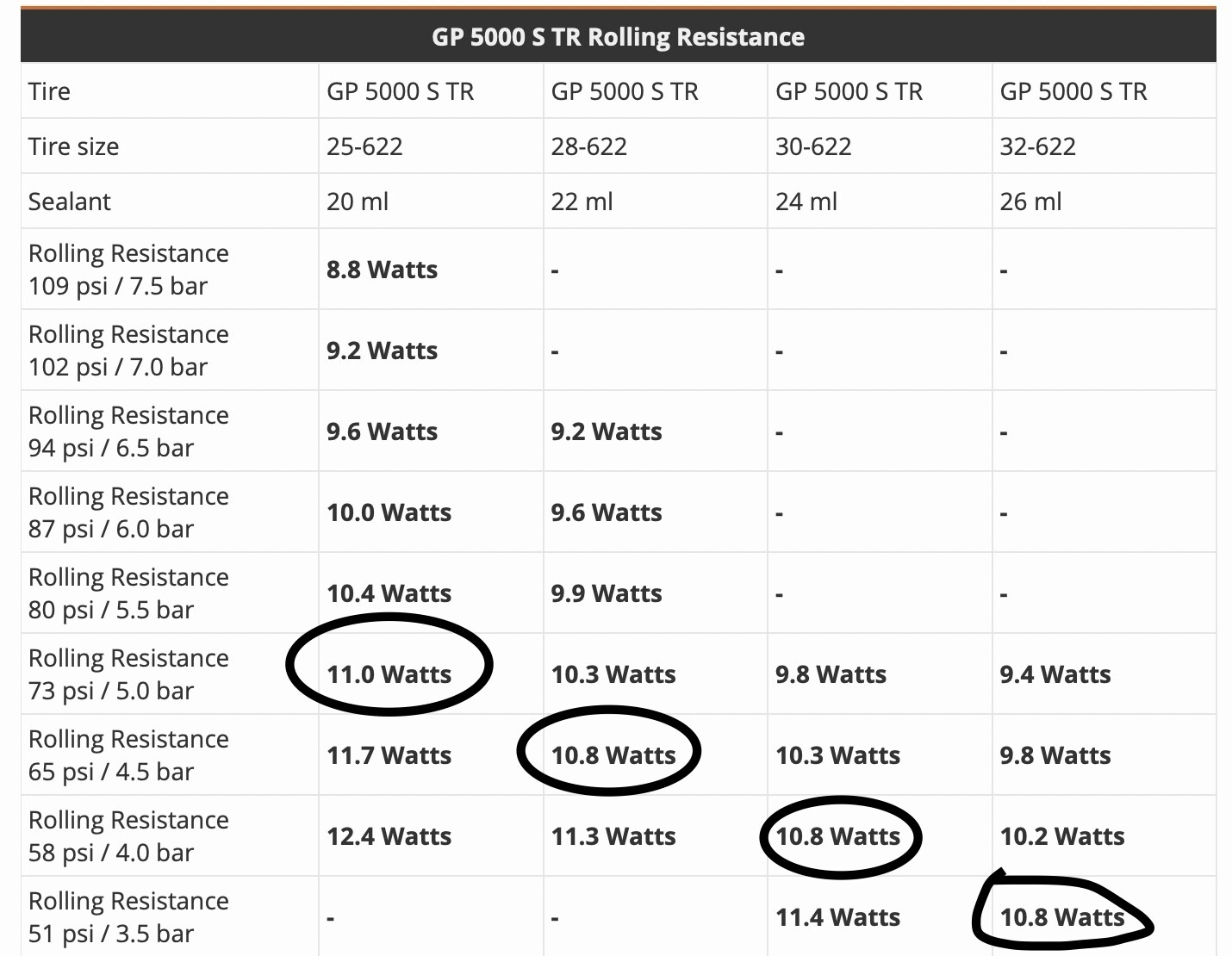
There are two benefits to a thru-axle: 1) the brake rotor lines up consistently and 2) you can run wider wheels/tires than with a rim brake bike. Now, if you don’t run wide tires, you don’t need a disc brake to allow for it, and if you’re not running discs, the alignment of the non-existent rotor is moot. Thru-axles are not stiffer than QRs, that’s marketing/myth. ( https://youtu.be/KMdsSuXGniU?si=hlCLZlB5Iw471IdV ). As for wider tires, they only roll faster than narrow tires if you’re talking about higher pressures, but when the pressures are adjusted for a similar casing pressure, the rolling resistance differences between tire widths evaporates. IOW, to get a wider tire to roll faster than a narrower tire, you have to inflate it to a pressure that’s bordering on unrideable. This chart from bicyclerollingresistance.com shows how differing widths of tires have the same rolling resistance when inflated to pressure appropriate for the width.
Maybe I do some test series with the Gibli in the near future going from 4 to 7 bar in smaller steps. I do not have time for that now, but will share when I have. Off-topic in this thread though.
This is nonsense. I have a QR disc brake bike and both wheels go in and out of it every week with no problems at all. I have more problems with disc rub on my thru axle bikes, but I think that’s more Shimano vs SRAM
FWIW, I don’t think that’s a benefit, either, but it’s one of the two lies the industry tells us about thru-axles, the other being that they’re stiffer. With a suspension fork, where the legs can move independently, the solid connection of the thru-axle helps. On a rigid fork, the reported ‘extra stiffness’ doesn’t actually exist. The forks aren’t moving.
It’s easier to solve mechanical problems with a rim brake and mechanical set up. I haven’t noticed any difference in performance between QR and TA. I have noticed a difference in performance between my mechanical/QR rim brake bikes vs my TA/disc brake bikes as bikes being from a vastly different set of operating systems. If it’s good, it’s good. If I have a dragging brake on one of my TA/disc set ups it’s a little more of a pain in the ass to rectify while moving. QR/rim not so much.