 OCEANSIDE, CALIFORNIA - MARCH 28: A triathlete finishes the 2026 IRONMAN 70.3 Oceanside on March 28, 2026 in Oceanside, California. (Photo by Sean M. Haffey/Getty Images for IRONMAN)
I just got back from Oceanside and let me tell you Kristian Blummenfelt and Taylor Knibb got all the news headlines at Saturday’s IRONMAN 70.3 Oceanside, rightfully so. Blummenfelt’s 3:40:07 and Knibb’s 4:01:38 were both course records. But, buried in the full results, is a story that rarely gets told, and rarely is as evident as it was at this weekend’s event.
The bigger conversation that I wanted to talk about was the success of the age group race. According to the results, 3,026 age group athletes toed the line this last Saturday morning. (This is only male and female solo racers in those divisions.) With around an 84% finishing rate, that meant 2,525 finished. While there were 55 Countries represented, nearly 80% of the field was American, and I’m going to guess that a solid chuck of those are from the triathlon hub around the Oceanside area. It was awesome to see such large numbers of excited age groupers and, according to IRONMAN, 1,400 of those were first timers.
So Let’s talk about the 126 age groupers that crossed the line ahead of at least one professional athlete.
The Women: Age Groupers
Julia Day (F30-34, USA), the day’s fastest age-group woman, finished in 4:36:49 — ahead of 10 female pros. That’s not a typo. Ten.
The pros she beat included Maia Watson (+0:31), Kelly Barton (+0:48), Ali Brauer (+2:04), Joanna Ryter (+5:48) and six others. That Day’s time would have placed her in the top 50% of the women’s pro field at many IRONMAN 70.3 events around the world.
Some other noticeable athletes were Christina Case, a 45-49 age grouper from the U.S., who finished in 4:50:36 and beat six female pros, including Anna Guzman, who she beat by 24 seconds. And then there’s Julia Weisbecker, competing in the 60-64 category, who crossed in 5:14:21 and beat two pros. Sixty-plus and faster than two women with pro licenses. That’s impressive. Who are all these rock star women?
70 Female Age Groupers Who Beat Female Pros
The women's pro field ranged from (4:01:38) to (5:26:56).
| # | Athlete | AG | Time | Pros Beaten |
|---|---|---|---|---|
| 1 | Julia Day | F30-34 | 4:36:49 | 10 |
| 2 | Nicole Heininger | F35-39 | 4:43:03 | 6 |
| 3 | McKenna Morello | F25-29 | 4:43:27 | 6 |
| 4 | Lexi Wright | F25-29 | 4:45:08 | 6 |
| 5 | Anna Ikelheimer | F18-24 | 4:46:08 | 6 |
| 6 | Leah Winckler | F30-34 | 4:48:54 | 6 |
| 7 | Amelia Zwiener | F30-34 | 4:48:54 | 6 |
| 8 | Christina Case | F45-49 | 4:50:36 | 6 |
| 9 | Rennie Tankersley | F30-34 | 4:51:21 | 5 |
| 10 | Kristen Radtke | F35-39 | 4:52:33 | 5 |
| 11 | Abigail Archer | F25-29 | 4:52:47 | 5 |
| 12 | Molly Lesser | F35-39 | 4:53:40 | 5 |
| 13 | Jordan Stiewig | F25-29 | 4:53:53 | 5 |
| 14 | Alexandra Sborov | F30-34 | 4:56:09 | 5 |
| 15 | Ava Smith | F18-24 | 4:57:55 | 5 |
| 16 | Kaitlin Carew | F25-29 | 4:57:56 | 5 |
| 17 | Laura McDonald | F40-44 | 4:59:04 | 5 |
| 18 | Ashley Anderson | F35-39 | 5:00:31 | 4 |
| 19 | Meghan Grant | F40-44 | 5:00:57 | 4 |
| 20 | Nicole Mohajer | F35-39 | 5:02:01 | 4 |
| 21 | Mariana Martinez Suarez | F35-39 | 5:04:26 | 4 |
| 22 | Claire Koeppel | F25-29 | 5:04:39 | 3 |
| 23 | Nina Broccard | F18-24 | 5:05:49 | 3 |
| 24 | Jamie Schnuck | F30-34 | 5:06:16 | 3 |
| 25 | Grace Banas | F30-34 | 5:06:21 | 3 |
| 26 | Carly Hyland | F30-34 | 5:06:34 | 2 |
| 27 | Gillian Micoli | F40-44 | 5:07:10 | 2 |
| 28 | Christina Sebastian | F25-29 | 5:07:21 | 2 |
| 29 | Julia Ferreira | F30-34 | 5:07:54 | 2 |
| 30 | Lara Erlank | F35-39 | 5:08:03 | 2 |
| 31 | Becky McQuain | F40-44 | 5:08:34 | 2 |
| 32 | Justine Quach | F35-39 | 5:08:56 | 2 |
| 33 | Wendy Fawley | F50-54 | 5:09:07 | 2 |
| 34 | Sophie Collin | F30-34 | 5:09:14 | 2 |
| 35 | Camille Buchanan | F18-24 | 5:09:53 | 2 |
| 36 | Kayla Marmolejo | F35-39 | 5:10:03 | 2 |
| 37 | Monica Folts | F40-44 | 5:11:25 | 2 |
| 38 | Ana Gallardo Avila | F35-39 | 5:11:30 | 2 |
| 39 | Ana Maynez | F18-24 | 5:12:11 | 2 |
| 40 | Ellee Becker | F25-29 | 5:12:53 | 2 |
| 41 | Kelsie Yamano | F18-24 | 5:13:36 | 2 |
| 42 | Kaley Suero | F30-34 | 5:13:50 | 2 |
| 43 | Meagan Perlstein | F45-49 | 5:13:50 | 2 |
| 44 | Carolyn Carter | F30-34 | 5:14:00 | 2 |
| 45 | Julia Weisbecker | F60-64 | 5:14:21 | 2 |
| 46 | Kristen Lamb | F50-54 | 5:14:36 | 2 |
| 47 | Sarah Mensinger | F30-34 | 5:14:47 | 2 |
| 48 | Allison Johnston | F30-34 | 5:14:55 | 2 |
| 49 | Johanna Hudson | F45-49 | 5:16:13 | 2 |
| 50 | Mylene Ghestin | F35-39 | 5:17:08 | 2 |
| 51 | Maggie Feikes | F30-34 | 5:17:40 | 2 |
| 52 | Karine Levert-Amyot | F30-34 | 5:17:47 | 2 |
| 53 | Lauren Sayles | F25-29 | 5:17:55 | 2 |
| 54 | Sophia Goland | F25-29 | 5:18:23 | 2 |
| 55 | Christine Houser | F45-49 | 5:18:35 | 2 |
| 56 | Kelly Hellman | F25-29 | 5:19:24 | 2 |
| 57 | Ulyana Zarubina | F35-39 | 5:19:25 | 2 |
| 58 | Liz Cullen | F45-49 | 5:20:00 | 2 |
| 59 | Marcella Rietz | F50-54 | 5:21:20 | 2 |
| 60 | Alison Lany | F30-34 | 5:22:18 | 2 |
| 61 | Emily Egart | F40-44 | 5:22:39 | 2 |
| 62 | Hannah O'Hearn | F30-34 | 5:23:05 | 1 |
| 63 | Kristen Day | F40-44 | 5:23:27 | 1 |
| 64 | Rochelle Arko | F50-54 | 5:24:11 | 1 |
| 65 | Helen Sheirbon | F50-54 | 5:25:37 | 1 |
| 66 | Tracey Hayes | F45-49 | 5:25:43 | 1 |
| 67 | Jacqueline Beaulieu | F45-49 | 5:26:07 | 1 |
| 68 | Jennifer Finotti-Sheppard | F45-49 | 5:26:17 | 1 |
| 69 | Marie Town | F40-44 | 5:26:19 | 1 |
| 70 | Ann Rusk | F35-39 | 5:26:40 | 1 |
Women's age groupers who beat the most pros
| Athlete | AG | Time | Pros Beaten |
|---|---|---|---|
| Julia Day | F30-34 | 4:36:49 | 10 |
| Nicole Heininger | F35-39 | 4:43:03 | 6 |
| McKenna Morello | F25-29 | 4:43:27 | 6 |
| Lexi Wright | F25-29 | 4:45:08 | 6 |
| Anna Ikelheimer | F18-24 | 4:46:08 | 6 |
| Leah Winckler | F30-34 | 4:48:54 | 6 |
| Amelia Zwiener | F30-34 | 4:48:54 | 6 |
| Christina Case | F45-49 | 4:50:36 | 6 |
| Wendy Fawley | F50-54 | 5:09:07 | 2 |
| Julia Weisbecker | F60-64 | 5:14:21 | 2 |
The Men: Age Groupers
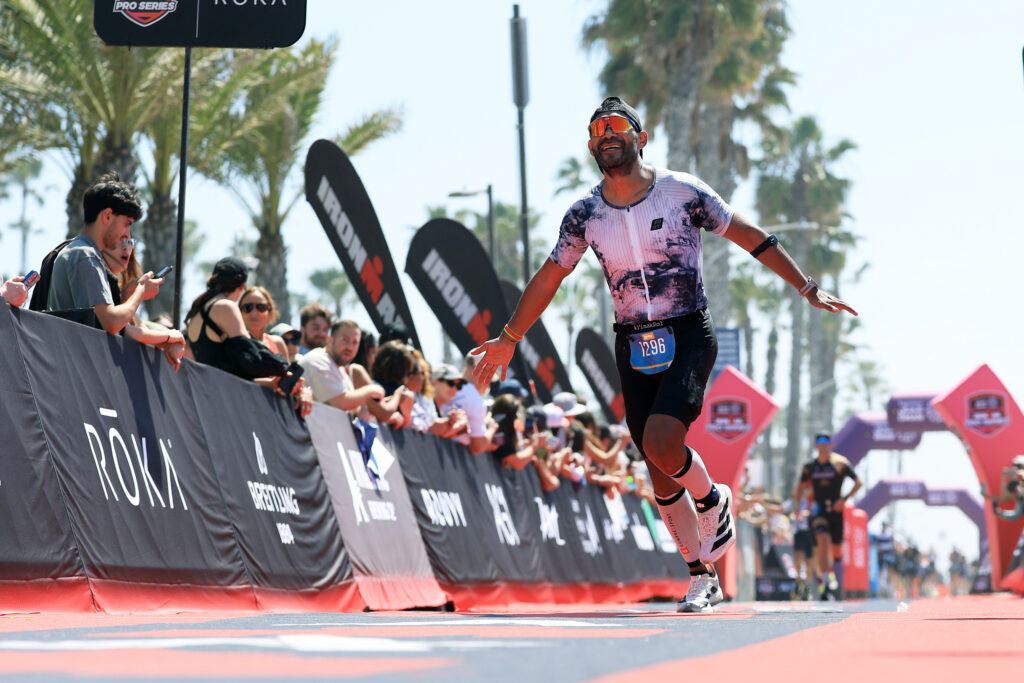 OCEANSIDE, CALIFORNIA - MARCH 28: Orlando Campos Sanchez of Mexico finishes the 2026 IRONMAN 70.3 Oceanside on March 28, 2026 in Oceanside, California. (Photo by Sean M. Haffey/Getty Images for IRONMAN)
Reed Legg, an 18-24 age grouper from the U.S., finished in 4:01:15 — ahead of 20 male pros. Another 18-24 competitor, Sigurd Elvestad, came in at 4:03:08 and beat 16 pros.
But, as with the women’s results, the more interesting cases were the masters athletes. Tom De Bruyn, a 40-44 competitor from Belgium, clocked 4:09:36 and beat eight male professionals. Pedro Gomes (a retired pro from Portugal), also competing in the 40-44 category, was also ahead of eight pros with his 4:10:18. Jordan Nichols (M45-49) finished in 4:27:55 and still crossed ahead of three pros.
56 Male Age Groupers Who Beat Male Pros
The men's pro field ranged from (3:40:07) to (4:32:44).
| # | Athlete | AG | Time | Pros Beaten |
|---|---|---|---|---|
| 1 | Reed Legg | M18-24 | 4:01:15 | 20 |
| 2 | Sigurd Elvestad | M18-24 | 4:03:08 | 16 |
| 3 | Arthur Benson | M25-29 | 4:07:06 | 11 |
| 4 | Nathan Kim | M18-24 | 4:08:16 | 9 |
| 5 | Addy Epp | M18-24 | 4:09:09 | 8 |
| 6 | Tom De Bruyn | M40-44 | 4:09:36 | 8 |
| 7 | Hippolyte Colin | M25-29 | 4:09:48 | 8 |
| 8 | Pedro Gomes* | M40-44 | 4:10:18 | 8 |
| 9 | Liam Kennedy | M18-24 | 4:10:35 | 8 |
| 10 | Christian Oakley | M25-29 | 4:12:26 | 7 |
| 11 | Sean Saxton | M25-29 | 4:12:34 | 7 |
| 12 | Justin Wegner | M35-39 | 4:12:54 | 7 |
| 13 | John Rak | M25-29 | 4:15:28 | 7 |
| 14 | Denis Santana Vera | M25-29 | 4:15:35 | 7 |
| 15 | Reilly Walsh | M25-29 | 4:15:50 | 7 |
| 16 | Guglielmo Schiavoni | M35-39 | 4:17:26 | 4 |
| 17 | Colin Chetelat | M25-29 | 4:17:50 | 4 |
| 18 | James Riegger | M30-34 | 4:18:13 | 4 |
| 19 | Cody King | M25-29 | 4:19:32 | 4 |
| 20 | Duncan Bullock | M40-44 | 4:20:10 | 4 |
| 21 | Ezra Swell | M25-29 | 4:20:23 | 4 |
| 22 | Cal Wilson | M18-24 | 4:21:01 | 4 |
| 23 | Eric Osband | M18-24 | 4:21:24 | 4 |
| 24 | Keith Eriks | M30-34 | 4:22:05 | 4 |
| 25 | Stephen Yang | M25-29 | 4:22:10 | 4 |
| 26 | Sean Obrien | M35-39 | 4:22:31 | 4 |
| 27 | Zack Reuter | M25-29 | 4:22:34 | 4 |
| 28 | Eric Frorenza-Hubbard | M30-34 | 4:22:41 | 4 |
| 29 | Carson Kidwell | M30-34 | 4:22:59 | 4 |
| 30 | Vincent Lete | M35-39 | 4:23:19 | 4 |
| 31 | Kristoffer Buus Langkilde | M25-29 | 4:23:24 | 3 |
| 32 | Lucas Lherbier | M25-29 | 4:24:42 | 3 |
| 33 | Mathew Engle | M35-39 | 4:24:53 | 3 |
| 34 | Ryan Star | M35-39 | 4:25:02 | 3 |
| 35 | Nicolas Shellhammer | M35-39 | 4:26:18 | 3 |
| 36 | Stephen Gould | M25-29 | 4:26:28 | 3 |
| 37 | Ryan Teshima | M25-29 | 4:26:40 | 3 |
| 38 | Tyler Woodward | M30-34 | 4:26:41 | 3 |
| 39 | Daniel Emmanuel Gamino Anguiano | M18-24 | 4:26:45 | 3 |
| 40 | Jordan Nichols | M45-49 | 4:27:55 | 3 |
| 41 | Marcus Lounello | M35-39 | 4:28:10 | 3 |
| 42 | Alexandre Campino | M35-39 | 4:28:11 | 3 |
| 43 | Anton Komarov | M35-39 | 4:28:57 | 2 |
| 44 | Rafael Moraes | M40-44 | 4:29:19 | 2 |
| 45 | William Reid | M30-34 | 4:29:30 | 2 |
| 46 | Brendan Murray | M25-29 | 4:29:33 | 2 |
| 47 | Justin Spence | M18-24 | 4:29:38 | 2 |
| 48 | Vinicius Pelissari | M25-29 | 4:29:39 | 2 |
| 49 | Will Kelsey | M30-34 | 4:30:52 | 2 |
| 50 | Tyler McGinnis | M35-39 | 4:31:00 | 2 |
| 51 | Peter Clements | M35-39 | 4:31:00 | 2 |
| 52 | Danny Syrkin | M18-24 | 4:31:05 | 2 |
| 53 | Nelson Alexander Doleman | M35-39 | 4:31:29 | 1 |
| 54 | Jeffrey Krotche | M18-24 | 4:31:31 | 1 |
| 55 | Carlos Rojas | M40-44 | 4:31:33 | 1 |
| 56 | Kevin Stumpf | M35-39 | 4:31:38 | 1 |
Men's age groupers who beat the most pros
| Athlete | AG | Time | Pros Beaten |
|---|---|---|---|
| Reed Legg | M18-24 | 4:01:15 | 20 |
| Sigurd Elvestad | M18-24 | 4:03:08 | 16 |
| Arthur Benson | M25-29 | 4:07:06 | 11 |
| Nathan Kim | M18-24 | 4:08:16 | 9 |
| Addy Epp | M18-24 | 4:09:09 | 8 |
| Tom De Bruyn | M40-44 | 4:09:36 | 8 |
| Hippolyte Colin | M25-29 | 4:09:48 | 8 |
| Pedro Gomes* | M40-44 | 4:10:18 | 8 |
| Liam Kennedy | M18-24 | 4:10:35 | 8 |
| Christian Oakley | M25-29 | 4:12:26 | 7 |
* Ex-professional — Pedro Gomes is a former IRONMAN champion (Ironman Sweden 2013) and four-time Kona qualifier who now races as an age grouper. Also.. Please let me know if I missed anyone else that used to race in the pro ranks.
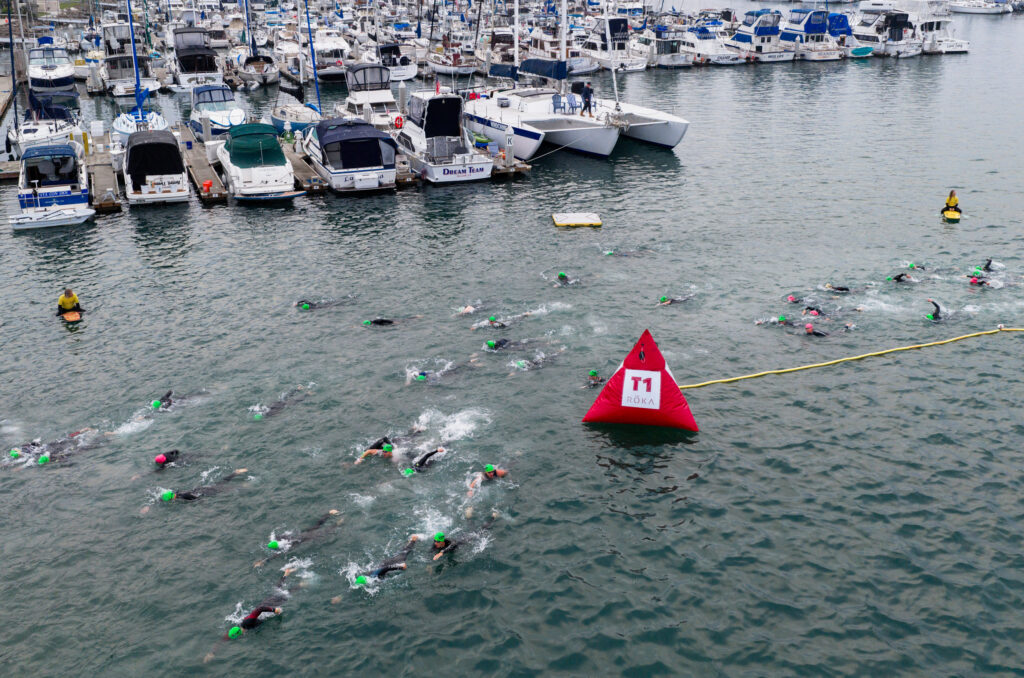 OCEANSIDE, CALIFORNIA - MARCH 28: An aerial view of competitors during the swim portion of the 2026 IRONMAN 70.3 Oceanside on March 28, 2026 in Oceanside, California. (Photo by Sean M. Haffey/Getty Images for IRONMAN)
What Does This Mean?
Let’s be clear – this isn’t the first, or last, time this has, or will occur, and some of these pro’s just had really off days. But, still, the numbers are big. And it does lead to some questions I have.
First, as the depth of age group triathlon continues to grow. The athletes at the front of age group fields are legitimately fast — fast enough that the line between amateur and professional is thinner than it’s ever been. So what will that mean moving forward.
Second, the women’s pro field at Oceanside was deep at the top (Knibb, Solveig Løvseth, Jackie Hering, Audrey Merle, Sif Bendix Madsen, etc.), but had a long tail. When 70 age-group women finish ahead of at least one pro, it raises the question of what the pro card really means.
Third — and this isn’t about beating pros, it’s about racing with them and this does sort of combine 1 and 2 alittle — as age-group athletes starting behind the professional waves they are dealing with traffic, positioning and pacing dynamics that affect their races, and that’s also likely affecting the pro’s race, too. For example 422 age group males passed pro women on the bike. Clearly that will affect that race. (Also another topic for later)
As these things aren’t going away anytime soon, It will be interesting to see how these Ironman will address any of these things they see as challenges and also what category these athletes will race under later. Some of them have been winning age group titles for a long time with ZERO desire to go pro while others take the first chance they can to be called a “Professional Triathlete”. Until then it’s pretty rad to see just how fast some of these athletes are moving to that finish line. Are you one of these athletes? Let us know what yours plans are? Going pro? Or are you going to continue to collect age group titles.
