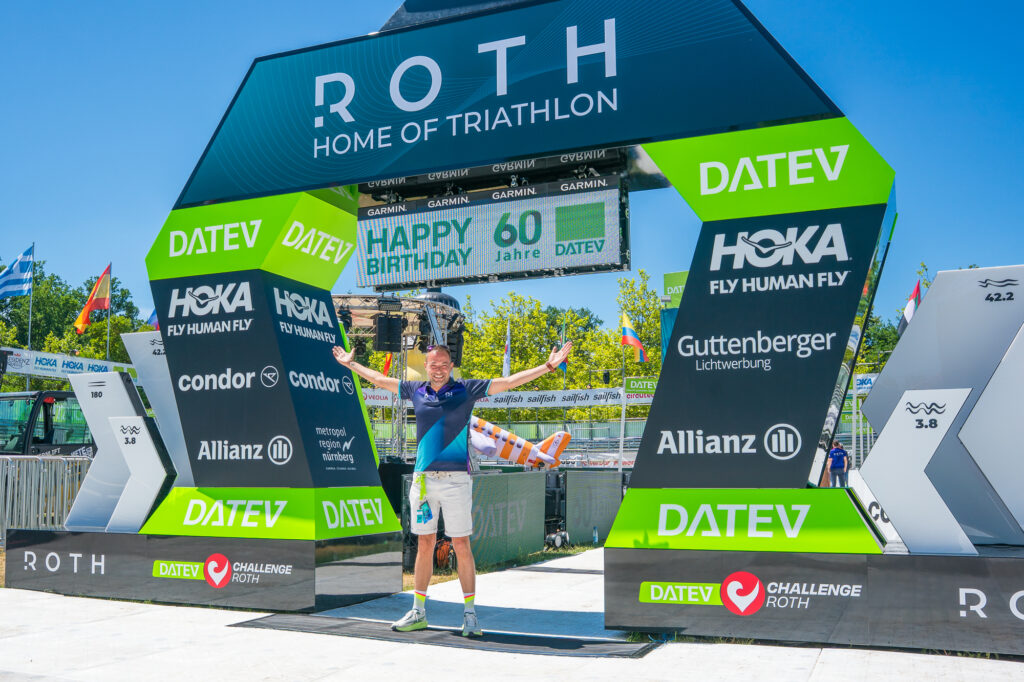
 Photos: Kevin Mackinnon
What separates Challenge Roth from other major events around the world is that it has always been owned by one family – the Walchshöfers. While Felix is very much the face of Challenge Roth, his mother Alice is renowned as the “soul” of the event, while his sister Katrin is every bit as integral to the operations. With a couple of days to go before the 2026 edition of the race, we caught up with Felix Walchshöfer for an engaging interview that explored the passion and history that keeps his family so committed to the race.
Slowtwitch.com: We are here at the spectacular finish line area again. Very exciting, the brand-new finish arch. Yet another big year here at Challenge Roth.
Felix Walchshöfer: Yeah, it’s crazy, because every year we are very afraid — how can we make it better, how can we make it bigger? And then a year after, when you come back, you nod your head and you can’t believe it yourself. It’s going to be the biggest one ever.
What keeps that drive? Why do you — and it’s not just you, it’s your whole family — have this drive to just keep having Challenge Roth get bigger and better?
Well, what I do, and what I’ve learned in leadership, is that I just explain my vision. And all my employees, my colleagues, the directors, all the volunteers — if they understand my vision, they will go even further than I would expect them to. And so much comes up, and it’s amazing to see that.
And the county — the triathlon county of Roth — is the second part. Everybody has been breathing triathlon here since ’84. It’s gone through generations, and people have grown up with triathlon. It’s triathlon soil here. The best example is the president of the county: his volunteer shift is from three o’clock in the morning to eight o’clock in the morning at one of the parking lots in Überg, letting cars in, and only at eight o’clock does he resume his post as president of the county. I think that says everything.
I asked Thorsten [Radde] yesterday what makes this event different to IRONMAN races. He brought up something interesting — that the Walchshöfer family made a decision to focus on one race, one race only, and that you’ve been able to get the community to buy in on that whole process. Is he right, is that on the right track?
He’s absolutely right. We live here, we know each other, we know exactly who to call if there is a problem. Everybody has the same drive to make it better. And I think the second part to the answer is that everything we earn here, we reinvest in the event. We want to be the best event in the world, and that comes with huge investments — but we are not shy about that. We like it. I always assume I’m in the shoes of the triathletes that come here: how would I like to see it, what would my expectations be? And we love to exceed the expectations.
The other thing he said — obviously the event needs to be profitable and needs to be successful, so there’s no fear of that, but you make sure the community doesn’t feel like they’re losing, like there’s this one corporation making tons of money and they’re not seeing anything.
On a yearly basis, the firefighter squad gets 45,000 euros. We help all the kindergartens if they need something for a raffle. At Christmas time, in all the communities along the race course, we sponsor a “Christmas Together.” That’s for people who are alone, or people who don’t have money — we invite them for Christmas Eve, for dinner and music, and we go there ourselves. So we do a lot outside the Challenge Roth race as well, and I think that brings the community together. Only if you invest in the community will it be as open as it is now, towards athletes from 108 nations.
I joked about this last year — you’re the Switzerland of triathlon, with Scott DeRue (IRONMAN CEO) coming, and this year we’ve got (World Triathlon President) Antonio Arimany. I noticed you were very quick to put something up on Instagram saying, yes, Challenge Family will be part of the PTO, but we are still our own thing. Why is it so important to you to be that Switzerland, that event that is across everything?
For us, it’s important because we strongly believe that we can only grow the sport together. We hated the times when Andrew Messick was so fully against us and tried to kill us and all those things — it’s a very unhealthy environment. Now, with Scott DeRue, we are in very, very good contact. With Antonio, we are in good contact. With Sam (Renouf) from the PTO. And I think only with a good working relationship can we grow the sport together. That’s my absolute strong belief.
And I guess the way you see it, the better the sport is, the better this race does.
Absolutely, absolutely. We need everybody in our ecosystem. We need the small triathlons — here in Roth we have the Rothsee Triathlon, just two years younger than our event. We support them with our infrastructure, we support them on the marketing side as well. Only if we work together — from very small collaborations on the side, towards collaborating with IRONMAN, with the PTO, with World Triathlon — is it (the sport) going to be healthy.
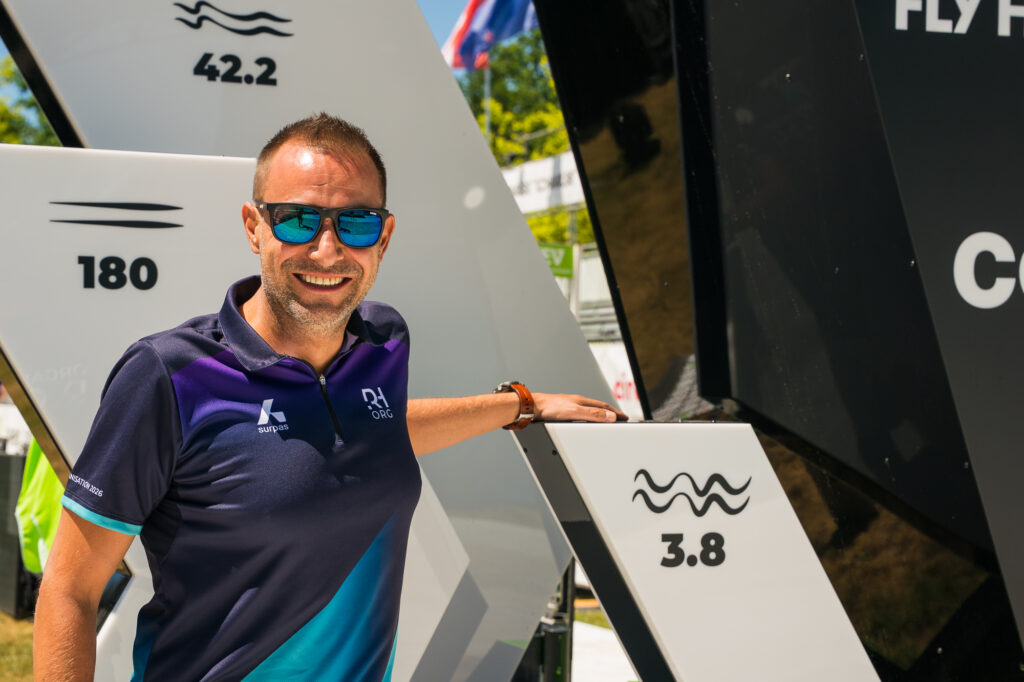
What I don’t want anymore is somebody else telling us what to do here. We had that in the IRONMAN years, where Florida was calling and telling us what to do, and I know what’s best for the race. I don’t want anybody telling me, “okay, you have a budget,” or whatever else — here in Roth we are burning budgets, because if we need something to make it better, we just do it. It’s all for the benefit of the sport, but more than this, for the benefit of our age-group athletes, that we want to send home saying, “hey, this was one of the top three moments in my life, after the birth of my kids and my marriage.” Roth is there on the top three.
Do we need more of that in our sport, do you think?
I would wish so. I think we are such an amazing sport with so much emotion, and when different organizers look too much at the money, or are forced to look too much at the money, it loses a lot — it diminishes the emotions that our athletes have. So the more we all invest in the sport, the better it is for the athletes, but also for us organizers.
Triathlon has had ups and downs over the years — 2014, 2015 was really the peak in terms of participation, and then we saw that drop-off elsewhere. That hasn’t happened here — you’ve never had a year where you’ve only got, say, 2,400 [entries]. Is it because you’ve been able to maintain that independence, do you think, and keep the events the way you wanted to run things?
Yeah, absolutely. You see it, for example, back in the days of [Andrew] Messick, when pasta parties stopped happening because they cost something, volunteer parties didn’t happen anymore. Well, we kept all that — it’s an integral part of our sport, it’s a big investment. The two parties cost me about 200,000 euros. But it’s important, and I think this investment in the sport is super, super important for the sport.
The other thing you guys have always done is have a huge pro component — and that’s a challenge, pardon the pun, because it’s hard to make money off of pros. Obviously you need to make money, but that’s not what’s driving it. How do you see that relationship, because it’s clearly worked here.
I see us as a platform for the pro athletes, and we have to create the biggest platform out there — media-wise, and also for them and their sponsors. I think we’re in a very good way — you see the expo here, with three-storey-high infrastructure from Hoka. We need to be a platform for them, and then we have to treat them in two ways. Of course there needs to be an appearance fee, there needs to be bonuses, and there needs to be a higher prize purse, because they have a very short amount of time to make money and make a good living. That’s one thing. But, the other thing, and I think it’s equally important, is to treat them with respect and see what their needs are.
It was very interesting to see both Lucy Charles-Barclay and Magnus [Ditlev], who came into the party really late — they called me and said, “hey, we just want to have this feel-good race.” And there you see why they are in the sport, why they came into the sport. It’s not only about doing races for money for them, but it’s also important for them to do a race that they love, and where they know how much energy they will get from the race.
But you’re in a wonderful position, because you can make that call. As Thorsten pointed out yesterday, it’s really hard for IRONMAN on a Tuesday or Wednesday morning to say, “hey Magnus, come on in” with the infrastructure and everything. But you have that ability.
Yeah, well, the crazy thing was that both called me — I didn’t call them, they both called me. Lucy sent me a wonderful video asking if she could join the party, and Magnus called me.
Which is interesting, because obviously with Laura [Philipp] pulling out, the first thing everyone thinks is you get on the phone and start calling around trying to find someone. But that isn’t what happened.
No, actually, it isn’t what happened. And I’m in a wonderful position because Belinda [Granger] is helping me on the pro athletes, and she has wonderful connections, just because of her personality — she breathes Roth. She has won this race, and she participated ten times in a row here. She knows the race inside out. We talked, of course, but actually Lucy and Magnus called themselves — it wasn’t us calling. It was like a miracle for me, and it made me extremely happy.
I wanted to round out with the family component. Challenge Roth is associated with — to me, you guys have always been the leaders of the family concept. I know you’ve talked about your sister’s children eventually taking it over — do you feel good that this is a realistic thing, that it will continue this family vibe?
Yes. Lenny, the younger one of my sister’s [children], just won the Bambini run — he’s super proud. The two of them went with Sam [Laidlaw] to the hairdresser to get the same hairdo as Sam. It was so funny — when Sam decided to race Roth, the kids wanted to send him a video, and we did, and Lenny said in the video, “hey Sam, I still have your hairdo,” and Sam replied, “okay, let’s go together to the hairdresser.” And he did. The kids love it, and of course our biggest wish would be that the kids will take it over at some stage and continue into the future.
How come we don’t see more of this — not just in triathlon, in other businesses and corporations?
Because I think if you have a successful race, there is a tendency you can make money out of it by selling it to one of the big series — a lot of people say, “hey, let’s cash in on that,” and let’s move on to something different. But this is what I love. There’s no other job in the world that would give me the same emotions, and I wouldn’t want to change it for anything in the world. I hope my sister’s kids will feel exactly the same. My mom is still feeling exactly this, my sister is feeling it. And there’s also a bit of a legacy of my father (Herbert), who started this. At the beginning, nobody believed in it — we were one race with a new name, and out there was just IRONMAN. He believed this could be the biggest race. He got seriously ill — he had a double lung transplant — and he died after two years. He never saw the success of the event. It’s a big legacy of his vision that we are continuing into the future.
I had heard a story once that when he was in the hospital, you went to visit him, and he said, “Felix, don’t ever sell the race, keep this in the family.” Is that true?
Yeah. There’s another very interesting thing, because I think the triathlon community doesn’t know where the saying “See you at the finish line” comes from — and I laugh a lot when I hear it now at many IRONMAN events, because they don’t where it comes from. My father was lying, after the transplant, in a hospital in Munich, and he said to his doctors, “okay, if I’m going to survive this, I will see you at the finish line.” And he was there the year after, with his doctors — he made it to the finish line. And since then, “see you at the finish line” is something very personal to us, and we give that very personal message to all our athletes.
I can’t think of a better way to end this interview — that is so special. Thank you so much.
It is for us as well. Thank you.