Happy holidays everyone! I recently did a YouTube with MyVeloFit that you all might find interesting. https://www.youtube.com/watch?v=QkYtOCrCAi0
6 Likes
Interesting. I’ll try it during my ride tomorrow.
I watched the whole video, although I think it got a little too “in the weeds” for me in a few places. The one thing I couldn’t figure out is how does this apply to the triathlete? He kept talking about taking the weight off the elbows but how do you do that when you’re down in the aero position? You kind of have to have that point of contact for stability.
Having said that, I do tend to ride a bit more upright than a lot of triathletes just because of the arthritis in my back and neck. For reference, here’s a pic of me in the Santa Barbara tri back in August. This is about as aero as I can hold for any length of time.

Are you cycling with your running shoes?
Jeroen
1 Like
1 Like
I’m with Jen. Found this very interesting, but not sure how to apply it as a triathlete. Also, seems like more work is needed to verify this. Like the guy said, multiple anecdotes do not equal data.
To understand the concept, try this: With your bike on a trainer, get on your aero bars and have someone lock up the rear brake. Now, push hard with one leg at about 3 o’clock and try to reduce the weight on your elbow pads. Actually lifting your elbows off the pads this way will require core strength as well as high pedal force. But lifting off the pads is not necessary. Just reduce the weight a bit and you will start to engage more of the hip extension action. That’s what the talk is all about. Good luck!
I really appreciate the reply!!! I watched your video on pedaling technique and the one on crank length you did with velofit before you posted here. Both were quite interesting.
This is a fascinating topic, l heard much of this discussion in your recent appearance on the Flo podcast a few weeks ago. Where this all gets really wild is in the triathlon arena. Because, generally, well fitted triathlon aerobars allow riders to sort of “rest” their elbows on their armrests. So, this immediately leads to the question (ignoring any aerodynamic benefits from the use of aerobars): does “resting” your torso using typical triathlon aerobars improve power output, or harm power output?
For climbing, I think the results that you are discussing make intuitive sense, as lots of riders at slower climbing speeds naturally get away from the drops and instead lightly hold on to the tops while climbing.
However, for high power pedaling on flatter terrain with aerobars, things get harder to understand. Anecdotally, I know that I have had the best success in 40k TTs (done within a triathlon) when I set up my aerobars so that I can, at least occasionally, weight the bars even more than from just the weight of my torso. In other words, there are times when I grab the ends of my aerobars and pull on them (“lifting them” up or back) while simultaneously intentionally pressing down quite hard with my forearms on the armrests. When I grab aerobars that way, there is a feeling that the aerobars give me a sort of “leverage” to be able to twist the cranks more powerfully. Is this all in my head, or is something actually happening biomechanically?
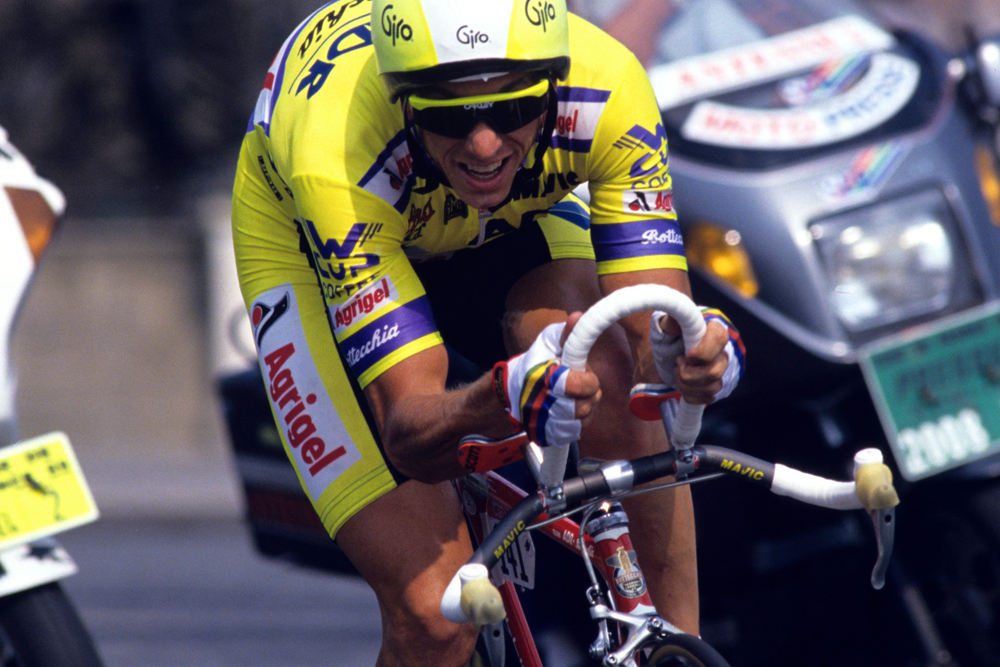
And then this anecdote sort of connects to the famous final TT in the 1989 Tour de France where Greg Lemond used aerobars in the TdF. In that final TT, when the aerobars were initially set up on Lemond’s bike, the bar clamps for the aerobars were insufficiently strong for Lemond. Greg would test out the bike and find that the aerobars would rotate when he would pull up hard on the ends of the aerobars (and, I assume, press down hard with this forearms). So the mechanics had to shim the bar clamps (with aluminum strips cut from coke cans–the strips are even visible in the image below) and then tighten the bar clamps down extremely hard to resist Lemond’s inadvertent efforts to “twist” the aerobars in his high power efforts. And when one sees images and videos from that history-making TT, you can actually see Lemond pressing down super hard on his aerobars as he pedals for his life.
So was Greg doing that (the twisting or pressing down hard on his aerobars) as a detriment to his power output, or did it help his power output?
1 Like
If I understand correctly the unweighing of the hands leads to better core activation which in turns leads to better hip engagement in the pedal stroke.
A bike position can also have more or less core activation depending on how it’s set up. From what I gather the study was done in the drops position on a road bike. On a reasonably current road bike/drop bar, an in the drops position ime usually ends up being very compact where the body is supported to a high degree by the bike with very little core engagement. Stretching out the position would lead to more core engagement so it’d be interesting to know how that would affect things compared to unweighing if position wasn’t controlled for in the study.
Same with a triathlon position where a very compact position can have very little core engagement and a more stretched out one has more. Understood that the death grip is never good but completely unweighing on a tri bike would be pretty hard for most people for longer durations.
Hi DarkSpeedWorks: These are great examples and I love the anecdote with Greg Lamond! I think both you and Greg are not only unweighting, but exerting additional force on the bars to hold your weight down. That says to me you’re producing tons of hip power. Similar to when you’re climbing and you realize you have to hold yourself down by the bars. I think you’re already living that video!
Thanks for the reply.
But l am a bit confused. How does unweighting the handlebars correlate to “overweighting” the handlebars? Aren’t those complete opposites?
We are comparing apples with oranges. Side view of Lemond - note seat tube angle and position of his elbows relative to the front wheel axle

Now a modern TT rider -

Greg comes from an era where riders “sat” on the bike. Today (especially in Triathlon) the position is more like “running” on a bike.
Sure, I can see differences in body position.
But both Lemond and modern riders are insanely fast.
So the real question is, is “unweighting” or “overweighting” the handlebars or aerobars better for more hip muscle recruitment? In either modern or past TT body positions?
Hi DarkSpeedWorks,
Let’s say you take unweighting to the extreme by putting your hands behind your back and leaning over the bars till torso is horizontal. That forces you to create a hip extension moment (torque) that levers up the torso and also extends the thigh. Thus more hip extension power.
If you lean on the elbow pads, you reduce that requirement for a hip moment. However, If you are pulling up on the bars you are increasing the requirement for a hip moment. Think deadlift. Does that help to clarify?
Hmm, yes, I think that helps. But I might have to draw a diagram for myself.
It seems like a bit of a weird paradox: no weight on your elbows and pressing your elbows in hard, both of those can improve hip muscle recruitment?
I am sure you are right, but hard to wrap my brain around …
Greg @ dsw
1 Like
Not replying to anyone, nor professing expertise in this discussion, but I do wonder if the discussion is focusing on the wrong thing.
I know that quoting Lance is likely to backfire, but one thing he did talk about was the importance of core strength, where he referred to his legs as the springs but for those to be effective then he had to have a strong frame to push against. Which I think is the same things here just introduced differently.
Now I have always been a ‘handy’ cyclist. A few years ago I had a back injury at a time I was cycling 400km a week consistently. Had to have 4 weeks doing nothing, then had 8 weeks of just pilates. After those 12 weeks of not touching the bike I’d had a crap day at work and just went out to shed some anger on a short hillclimb I did regularly. Got home and got an alert on strava that made me think that garmin was broken. 20% off my prior all time best. Went out on the MTB a couple of weeks later. Really long non technical climb - 10% off that.
Since then I’ve had 2 to 3 pilates classes as the first thing into my programme. And as well as building strength, then it gives you a huge amount of awareness as to what bits of your body are doing what, especially in relation to engaging different parts of your core effectively. As an aside I totally credit this to my ability to get out of hospital so soon and return to not just life but competing after my stroke.
And so the comment on the elbow weighting/unweighting is very much akin to a cue that you would get from a pilates instructor - a mechanism for you to learn the feeling in the core that you want to have, more than the actual elbow stuff. So the point is to learn to ‘switch on’ the core and then you can do that irrespective of unweighting the elbows.
The TT position is excellent as you are creating a fixed triangle (saddle and elbow, which ‘fixes the shoulders by fixed length of spine and upper arm) that gives you strong basis. So all that’s left is a bit more ‘help’ to keep your pelvis rotating and spine flexing.
TLDR version. Its the ‘feeling’ in your core that you want, not directly the elbow pressure. Focus on the core not the elbows.
Not my running shoes. Just some shoes I dedicated to cycling. I don’t clip in.
But they look like a pair of running shoes so any pedalling techniques doesn;t apply to you at all
Jeroen
2 Likes
well they are hookless cycle shoes , the next project for Eric lol
4 Likes