I am wondering if I can get some clarity as to my workout I did yesterday compared with one last week. I will try and present it with as much information as possible.
Side Note: I am 39 yrs old, triathlete for 15 years, aiming for a 4:40 time at HITS 70.3 (Palm Springs) in December; running only 20 miles a week.
Here is my question: Why was my treadmill workout so easy compared to my road runs? And, given that it was so physically easier, should I avoid the road?
Context: Yesterday it was raining, so I decided to do my progressive long run indoors at a local gym on a treadmill. Here is what it looked like:
5 miles @ 1% grade @ 8:00p 142 Avg HR
4 miles @ 1% grade @ 6:57p 155 Avg HR (Felt too easy!)
1 mile @ 1% grade @ 6:10p 170 Avg HR (Felt too easy!)
**This work out was continuous
Observation: The last mile felt too easy; almost like I could go another mile at 6:10p. There was zero lactic acid in my legs. Also, I had a bank of nutrition (unlike outside) where I was drinking and using gels whenever I needed it.
LAST WEEK (*Done continuously)
5 miles on outside on flat paved trail @ 8:00p 142 Avg HR *get in one gel at the end of 5mi
5 miles on outside on flat paved trail @ 7:20p 158-160 Avg HR
Observation: I felt beat up and pounded. Physically, the last 3 miles was difficult to maintain.
Ok, so you can imagine, when I got off the treadmill yesterday I was thinking, “Wow, I’m awesome.” But it just doesn’t add up. The difference between the road and treadmill is too vast. I noticed that the HR matches up, but the physical demand was polar opposite. And obviously, now I’m thinking that ALL my runs should be on the treadmill. I woke up this morning with legs feeling great! But … I can’t help but wonder if a 6:57 on the treadmill is really like a 7:20 on the road even with the 1% incline.
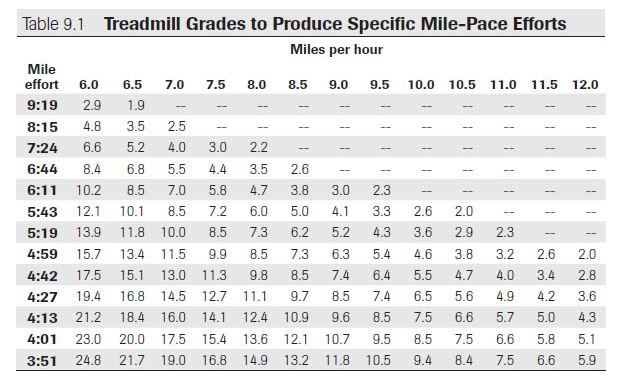
My first thought would be, was the treadmill was calibrated correctly? Based on the below I would say no, particular at higher speed. If that checks out (did you where a watch or pod) then I would look to weather. Was it particular hot for your outdoor run and cool for the treadmill run? Unfortunately, I believe the answer lies somewhere in there rather than with you being awesome.
No air resistance on a treadmill. There is noticeable air resistance even at ~8 mph.
Anyway, running on a treadmill is usually easier for the same pace than running outside. It isn’t just you. I’ve been taught to incline the treadmill to 0.5 or 1 degree to more closely replicate the feeling of running outside.
Roads don’t magically move underneath your feet, t-mill belt does, assisting leg turn over. Beyond certain speeds I can also ‘cheat’ a treadmill by modifying my gait to essentially increase my air time, letting the belt whirl by underneath me. Increasing stride length outside generally makes you go faster as well, but it’s not the same.
Lot of other factors that have probably been mentioned, like air resistance, temperature. Everyone is different and 1% isn’t some universal constant where t-mill = road, if you find the disparity too large then increase the grade.
But how do I know if the treadmill is calibrated correctly?
I was wearing my Garmin 920XT on “Indoor Running” mode and noticed that it showed me going ~:20-30 slower per/mile than what was indicated on the treadmill. But I developed mistrust with my watch given that my watch gave DIFFERENT paces per mile, even though my pace on the treadmill did not change.
Roads don’t magically move underneath your feet, t-mill belt does, assisting leg turn over. Beyond certain speeds I can also ‘cheat’ a treadmill by modifying my gait to essentially increase my air time, letting the belt whirl by underneath me. Increasing stride length outside generally makes you go faster as well, but it’s not the same.
Lot of other factors that have probably been mentioned, like air resistance, temperature. Everyone is different and 1% isn’t some universal constant where t-mill = road, if you find the disparity too large then increase the grade.
But my HR correlates quite closely from road to treadmill. Granted I do my outdoor runs in California and temps are around 80’s mid-day. I do feel like the heat elevates my HR.
Let me put it another way: Isn’t 170 HR effort on a treadmill the same as 170 HR effort on the road?
Assuming that the treadmill is properly calibrated, I would hypothesize a combination of two factors:
normal day-to-day variability; and
the softer treadmill bed.
With respect to #2, I’m finding that my leg spring stiffness (calculated based on data provided by a Stryd Pioneer) is ~20% higher when running on a treadmill vs. on concrete. That implies a significant difference in, e.g., rate of loading under the two conditions, to which my body then adapts to minimize energy costs.
This is about on a par with my treadmill experiences. I can’t explain the science, but in my mind when I’m actually running I’m having to move my mass, whereas on a treadmill the “road” is already moving and I just have to keep up with it.
Treadmill is a perfectly decent training tool but speeds at any given effort simply don’t translate particularly well to the road. As long as you’re doing enough road running to have a good handle on how treadmill speed translates to road speed so that you can pace your training and racing accordingly, that’s fine. Personally I prefer to do most or all of my running outside, partly because I think it’s better training, partly because it’s more interesting and partly because I don’t have space for a treadmill at home. That said, I am fairly injury-prone when running, so if I had convenient access to a treadmill I probably would experiment with doing more training on it to see whether I could get the same miles under my belt with lower incidence of injury.
But how do I know if the treadmill is calibrated correctly?
If you have a calibrated speed sensor on your bike, you can put your bike on the treadmill to verify. I did that one time just to make sure my treadmill was going the speed it said it was going. (It was)
But how do I know if the treadmill is calibrated correctly?
If you have a calibrated speed sensor on your bike, you can put your bike on the treadmill to verify. I did that one time just to make sure my treadmill was going the speed it said it was going. (It was)
Not sure how the folks at 24HR Fitness will feel about the test…
I think this has something to do with it - you were most likely running slower than you think (your watch is closer to actual pace). I belong to a gym that has two locations. They moved the older treadmills to the newer location and got new ones for the original gym where I go most of the time. Based on my watch I get 3 different paces for 7.0 at each of the gyms and my home treadmill (three different types of treadmill). I’m not sure which of the 4 is correct (treadmills or watch) so I’m choosing the watch since it’s the only thing that stays the same.
Also - your watch will give you different paces as your cadence changes slightly even though you leave the pace the same on the treadmill. It’s going by your steps and the length of your stride (I believe).
Assuming that the treadmill is properly calibrated, I would hypothesize a combination of two factors:
normal day-to-day variability; and
the softer treadmill bed.
With respect to #2, I’m finding that my leg spring stiffness (calculated based on data provided by a Stryd Pioneer) is ~20% higher when running on a treadmill vs. on concrete. That implies a significant difference in, e.g., rate of loading under the two conditions, to which my body then adapts to minimize energy costs.
Andrew, thank you for chiming in! Please help me understand. I know that elite athletes train on the treadmill. Heck, I remember @ SMU (Texas) when the girls were ranked 11th in the country, they were doing 800 repeats on the treadmill because it was 110 degrees outside. And they were getting faster!
So if it is possible to get faster on the treadmill, how do you do it? I remember reading the Javier Gomez puts the treadmill at 2%. Thus, given that 6:10 pace was “ez”, maybe I should have at it at a steeper grade? My logic was that ‘if my heart rate matches up to outside running, then I am getting the same speed fitness’.
So if it is possible to get faster on the treadmill, how do you do it?
I run almost exclusively on a treadmill. I find monotony soothing.
I ran a 1:35:22 half on Saturday, which I offer as evidence that one can obtain reasonably good run times from primarily treadmill running.
I always use at least a 1% incline.
I need to run outside more - as someone else pointed out, there’s the air resistance thing - and I think your calves get babied a bit on the treadmill.
I’d like to point out that in comparing these two workouts, you’re neglecting a lot of other compounding variables. How something “felt” has many influences - were your legs in the same condition? Equal levels of fatigue leading into the workouts? Hydration? etc.
It does sound like the treadmill was not correctly calibrated, but don’t forget the other things at play
Bad data:
My Garmin 920xt- does not give reliable distance measurements where I live. This messes up speed and pace calculations. Plus there is wind, heat, topography and my own variability to account for.
My Garmin vivo- has the same problems plus it gives off bad heart rate data as well.
The treadmill is also completely unreliable. It tells me I am MUCH much faster than I really am.
Worse yet people claim 3/4 of the races I do are “short” or “long.” Ironically, they make these claims based on Garmin.
Seems like the only meaningful data comes from running the same loop twice, or using the same machine (and just compare with previous identical efforts).
Or use a track or pool.
So if it is possible to get faster on the treadmill, how do you do it? I remember reading the Javier Gomez puts the treadmill at 2%. Thus, given that 6:10 pace was “ez”, maybe I should have at it at a steeper grade? My logic was that ‘if my heart rate matches up to outside running, then I am getting the same speed fitness’.
Roughly speaking, every 1% increase in grade increases the metabolic cost by 4%. Thus, to account for wind resistance in theory you should set the treadmill to 1-2%, depending on how fast you are.
As you rightfully reasoned, though, your true goal isn’t too match your pace to running outdoors, but to apply sufficient overload to induce physiological adaptations. From that perspective, heart rate is a reasonable basis for comparison, at least as long as you stay sufficiently cool indoors. IOW, yes, within reason simply matching heart rate using whatever combination of speed and/or grade does the trick should be work. Unlike, e.g., cycling, though, the biomechanics of exercising at different intensities changes significantly when running, so based on the specificiity principle you wouldn’t want to deviate too far from what you might do outdoors.
No treadmills are ‘perfect’ correlation of real world. They are usually close (yours is a bit off, granted), but they are ALWAYS taken with a grain of salt, and are almost invariably ‘easier’ than real world running when set at 0-1%.
Even if the TM was ‘perfect’, the outdoor situation with subtle grade changes, turns, weather, wind, heat, road impact, all make for situations that TMs cannot exactly replicated even if the TM was the ‘gold standard.’
Your best bet having the data you do is to correlate as best you can your TM speed/HR to outdoor speed/HR and work from there. Usually you can find an incline that closely mirrors outdoor pace - usually it’s 1%, but it looks like it might be 2% in your case.
The only reason you reason need the speed setting on the treadmill is for repeat training at same or slightly faster paces, which even a miscalibrated TM can usually deliver quite well. But def don’t expect to run a 19:30 5k at 1% on the TM and then hit it on the nose outdoors - not gonna happen (it should be close, but even a 15sec difference at 5k speed is make or break between total meltdown and PR.)