Here is a screenshot of my month when I ran my 70.3 PR on the 30th of this month and actually won it overall. The weekend before this month, I did an 11 mile am run and a 5 mile pm run for 16 miles on the day. I never did intervals because they caused niggles for me, but instead I ran in Hoka Cliftons for cushion and ran rolling hills. I say I didn’t do intervals, but one thing I always did was stayed strong running up the hills then relaxed going down. Hard to explain, but I didn’t sprint going up the hills, but more just held flat ground pace going up which I feel built strength and durability. I felt like I could go run 14 miles any day of the week and feel fresh and strong afterwards. I also set a run PR for my full distance in November of the same year.
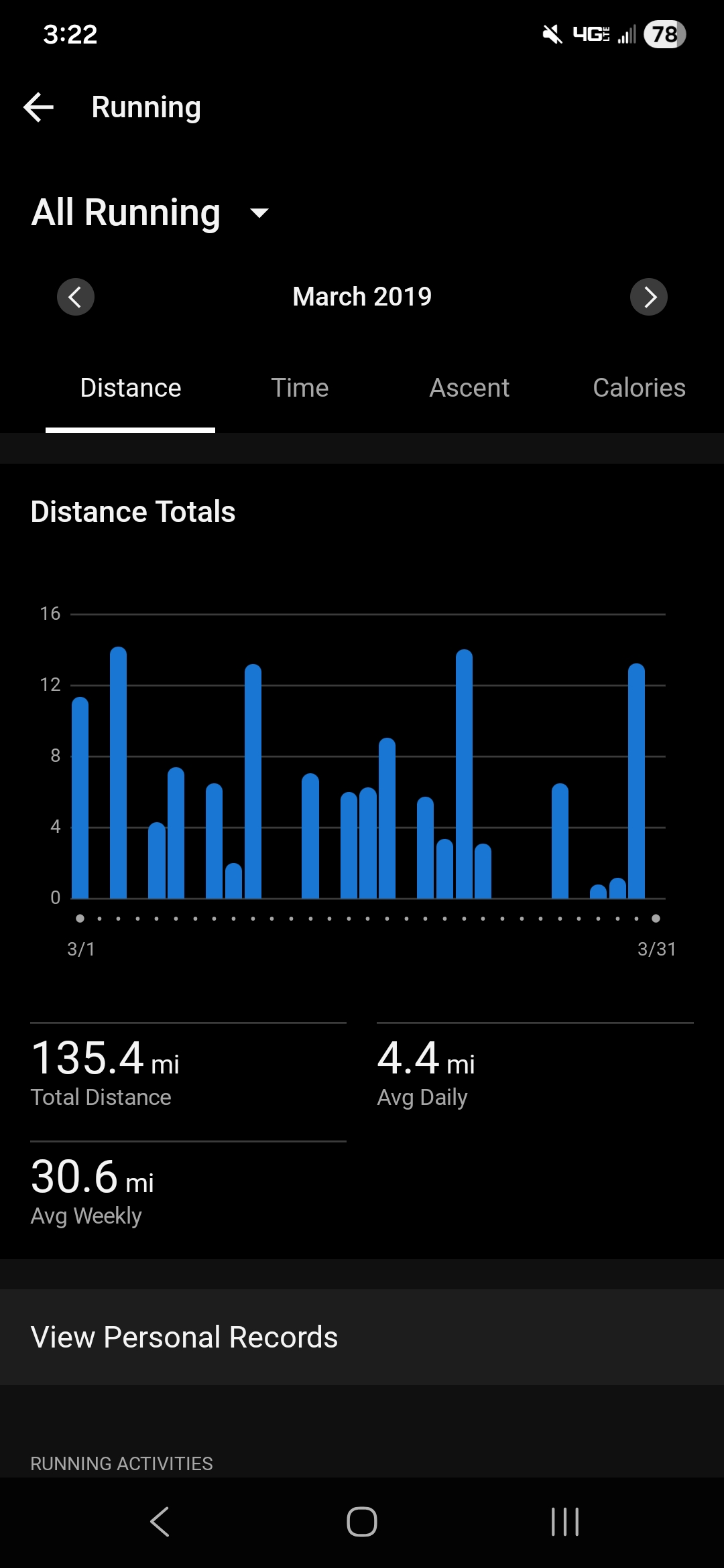
What would be the equivalent bike or swim workouts?
This is interesting to reiterate again because I ran rim to rim grand canyon about 6 weeks before my best ever 70.3 race and I backpacked the grand canyon rim to rim 5 weeks before my stand alone marathon PR.
Neither effort was done with those races necessarily in mind, and I was fine skipping the training on both as I viewed it as good work in general so I wasn’t stressed about “detraining”.
But I do like the idea of some long trail runs (or even arduous hikes) being added to training! Thanks for bringing this back to my mind.
Sounds like you need to run more, bike more, and lift more. Doing bricks doesn’t get you fitter.
Dear Tim,
So bike wise, honestly I cannot settle on one particular session or session structure. With the biking I think a needs analysis and context are important decision frameworks.
Swim wise, based on a few decades of coaching elites and many front pack/first out swimmers, it is not so much one session but rather a session structure I keep returning to for building workouts. The Main set works like this….
(5x200 freestyle pace “X” with recovery “Y”)…. this only for faster swimmers
4 x 50
4x200 freestyle pace “X” with recovery “Y”
4 x 50
3x200 freestyle pace “X” with recovery “Y”
4 x 50
2x200 freestyle pace “X” with recovery “Y”
4 x 50
1x200 freestyle pace “X” with recovery “Y”
4 x 50
You manipulate pace X and recovery Y and what you do on the 50’s to suit your session goal. I’ll give you a few examples:
70.3 “Technique under load” (thank you Tim@Magnolia Masters for engraining that teaching phrase in me)
Here I would aim to hold goal 70.3 pace for 200’s with a relatively short recovery and then use the 50’s to swim easy or easy Pull or different stroke to recover and reset.
“Sharpen the Saw”
Here I would aim to hit “critical swim speed” on the 200’s and aim for decent amount rest so as to lessen lactate accumulation. Then on the 50’s focus on one specific skill/drill that is important in improving my stroke with plenty recovery.
“Stroke Quality”
Here I’d use the 50’s to go super super hard with relatively short rest with or without paddles or a parachute to sky rocket lactate. Then roll into the 200’s loaded up but then aiming to hold an aerobic to IM pace effort on the 200’s with say 20secs recovery.
Ultimately I just like this framework as it always allows you to flip flop between “work” & “focus” and engrain good motor control patterns.
Hope that helps.
Thank you. Appreciate the insights
I agree
In my experience, Bricks are most useful for training the transition from bike to run
They are not intended a fitness tool
YMMV
I know that the “object” (if one could call that?) of the 100/100 is to build a consistent running routine through the Winter Months, with no regard to distance, other than the 3mile/30 minute minimum
However, I’ve mentioned “The Gary the Vale Ultramarathon Training Program” before, which might be something of a mileage build-up challenge, if you’re looking for one?
The Plan goes like this: Every week, you add ONE mile to your long run; ideally, by going 1/2 a mile further on an out-n-back route, so you can look 800yds down the road and say to yourself “Self. We’re going down to there next week. Just a little further, that’s not so bad, right?”
Now, be warned … to my knowledge, no one has actually started at zero and stuck with it for an ENTIRE year, culminating in a 52-mile run