Looks pretty dead on! Did Mount Palomar virtual on rouvy, and today decided to do the real thing. It was pretty dead on! Not sure why it says 3.4w/kg for the rouvy ride, was more like 3.7. Anyways, any other rouvy riders on here have virtual vs real comparisons?
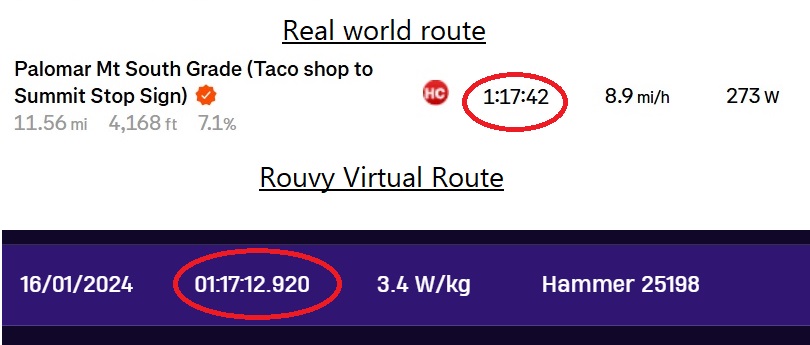
1 Like
I find I am faster on Rouvy than in real life. I am 5’6" and 65 kilos if it makes a difference in their modeling. I find I go downhill way faster on Rouvy than in real life and in real life I descend faster than most of my larger friends due to my tuck too !!! Uphill I find I go a bit faster too. Not a lot but a touch. My times up Snow Canyon in St. George Utah in real life vs my weekly rouvy solo TT is around 3-5% faster, but I chalk that up to zero altitude effect in my basement vs some in real life. In real life sea level climbs things appear to be quite similar. For Palomar if you were around same time in real life and Rouvy, then Rouvy is theoretically too hard as your Rouvy time should be faster than real life due to zero altitude effect, but this could be negated by wind and of course a lot of this depends on the rolling resistence assumption of your tires and wheels in real life vs what Rouvy assumes, plus Palomar in real life I assume you carried at least one bottle if not two bottles, but Rouvy does not factor the weight of any bottles into its modeling. If you were just as fast in real life on Palomar as on Rouvy, carrying extra bottles and dealing with oxygen effects, then it seems Rouvy is penalizing you. You should be faster on Rouvy with no bottles and more oxygen.
Congrats on the climb. I’ll have to go ride Palomar on Rouvy. I rode it the day after Oceanside 2013 and let’s just say that’s not the optimal legs to do a climb like Palomar on! Maybe I will ride it today at 50% reality level to just get familiar (as I don’t feel like a full on 100% effort). It’s still going to be 2000 ft over 12 miles at 50% reality so that’s plenty for today!
Do I understand this correctly? You did a real world ride and an indoor simulation of that ride, and the fact that they took pretty much the same time tells you that the simulation was “dead on?”
hmm, i road 8w more in the real climb and did have large water bottle. I use the stock bike set up on rouvy, no fancy wheels or gear. I dont think palomar has real altitude effect, it doesnt go above tree line, although the watts did drop down a lot near the end.
yes…?
Do you have it set to 100% realism?
I don’t have a perfect 1:1 comparison (no power data on the outside ride) but the Chattanooga 70.3 course & Rouvy feel pretty similar at 100% realism. There’s also similar rolling roads close to where I live that feel like Chatt / Rouvy, based on my power data on those rides / my butt dyno.
another thought, I notice in “just ride” mode just like free riding in zwift world is a bit forgiving. Is that what you used to time trial mode?
If I know I may stop in the middle of a ride (example, often it is minus 10C outside and I don’t want to let cold air into my basement, and then I stop first to turn on my fan, then I stop a bit later to let cold air into the house), then I use “just ride”. If I am not going to stop at all and just go hard then I’ll use TT
Sorry but not been on ST in quite some time, so apologies for being so late to the party, but I am thinking that where applicable, the apps (BiGRingVR/BKool/Fulgaz/Rouvy) model based on standard conditions - 29.92 inHg Atmospheric Pressure, 68 Temperature, 0-wind. Since riding outdoors at with these exact conditions is statistically problematic, I would imagine there will always be a variance between indoor and outdoor rides. Performance when ascending Mt. Ventoux on the trainer will probably always be better when comparing to doing it in real life when it is really hot or really cold and windy. Are there ever any good days ascending Ventoux?
Also trainers don’t take into account where the person’s trainer is. As the majority are close to sea level and for example if you climb Stelvio, that entire ride is between 4500 and 9000 ft above sea level, so the trainer times SHOULD be faster. Having said that depending on your wattage and heat clearance in your building, if someone is climbing at 300W they are generating 1200W of heat if someone is climbing aht 200W, they are generating 800W of heat. Adding 400W of heat to your room for 1.5 hrs may have a significant impact on performance at the back end relative to a rider doing it at lower brute watts. If I do a ride at 150W vs 250W (rare, but I can do that for a short time), my room just becomes a sauna at the higher wattage. It’s just heat transfer physics at play in the room