The pool I normally swim at is closing for the next two weeks for the annual scrubbing the walls (I think they’re replacing the filter system, too - the new one will be able to filter out toddler pee), so we’ve been given permission to go swim at a nearby gym that’s much much nicer, and consequently, has a much nicer pool.
The pool in the nicer gym is saline instead of over-chlorinated tap water, which is great, except for one thing.
My HRM doesn’t work in the saline pool.
I stand up so my torso’s out of the water? I get a heart rate reading. I sink into the water? Nothing. Double zeros.
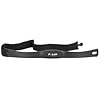
I’ve got an older Polar F6, and I had the strap replaced, so instead of the old hard plastic front type I’ve got the newer “wearlink” strap:
Interestingly enough, the old style strap would get a reading in saline water. This kind:
I’ve got a newer model Polar and never had a reading in water: not in chlorine pool, lake, ocean with or without wet suit and just assumed it was not designed to give a reading in water. Is it supposed to give readings. Would love to know because I race and train with a “hard” HR limit, so I never know in the swim and then I always have to stop and restart the monitor during T1 to get readings for the rest of the race.
Old hard plastic strap is far better for swim - it’s complete waterproof and should give better contact between skin and pads (with less comfort). And the second thing clean water is a very bad conductor, toddler pee is not that bad after all when you look at it’s conducting properties :).
Old hard plastic strap is far better for swim - it’s complete waterproof and should give better contact between skin and pads (with less comfort). And the second thing clean water is a very bad conductor, toddler pee is not that bad after all when you look at it’s conducting properties :).
That’s what’s confusing me. Saline should be a great conductor, no?
The modl I have is designed to be waterproof and certainly keeps time and stop watch functions in thewater but just does not pick up a reading frm the transmitter strap. I think the model is the RS 800.
WearLink shouldn’t be used for swimming (anything with less than 50 m waterproofness shouldn’t be) the only transmitter that can be used without worries is T31 or T31 coded and the T31 worked for me with both my polar watches F6 and S625X but I’ve stopped using HR-monitor in the pool.
Edit:
The another thing is WIND transmitter or other that works at 2.4 GHz won’t work in water due to huge signal absorption, to get HR reading you need to use HR-monitor that works with 5 kHz band (old ones or the ones listed below).
The list of water-friendly HR-monitors from Polar:
FT80, 60, 40, 7, 4, 2, 1
CS300
RS400, 300X
two cycling only
and any old one that is not WIND compatible.
The salt content may be too high, as in some is good, more is NOT better. I can not explain this since I do not have a degree in chemicals or electronic’s, but I did a goggle search for you. Sorry, the best I can do
T31’s are fine for swimming and Wear Links are ok as well. We have some top US college swim programs using both straps, mainly womens programs since the swimsuits help maintain the postion of the Polar transmitter.
WearLink shouldn’t be used for swimming (anything with less than 50 m waterproofness shouldn’t be) the only transmitter that can be used without worries is T31 or T31 coded and the T31 worked for me with both my polar watches F6 and S625X but I’ve stopped using HR-monitor in the pool.
Edit:
The another thing is WIND transmitter or other that works at 2.4 GHz won’t work in water due to huge signal absorption, to get HR reading you need to use HR-monitor that works with 5 kHz band (old ones or the ones listed below).
The list of water-friendly HR-monitors from Polar:
FT80, 60, 40, 7, 4, 2, 1
CS300
RS400, 300X
two cycling only
and any old one that is not WIND compatible.
You forgot the rcx5 :0)