Originally published at: Off-Season Training: Maintaining Run Fitness into the New Year - Slowtwitch News

The end of the year is quickly approaching, and whether you’ve run your last race of 2025 already, or still have it on the horizon, you’re going to be in the thick of your off-season pretty soon. With the off-season comes planning for next year, and you’re likely keen to build from your current fitness as you enter 2026.
When it comes to running, there are a lot of ways you can improve throughout the winter, from taking a year-end break to cross training and more. Here are a few options you can try out to help you refocus and get dialled in once more ahead of yet another season of triathlon training and racing.
Take a Break
This is a tough one for triathletes (convincing some people to take a single rest day each week is hard), but the end of the season is time for a much-needed break. You might feel like you’re going to lose all of the fitness you’ve gained and built up over the past year, but that’s not the case at all.
In fact, taking a couple of weeks off from training (particularly running, which is much harder on your body than swimming and cycling) is only going to make you healthier and help you get even fitter in the coming months.
“I usually have about 10 to 14 days completely off of training at the end of a season,” says Tamara Jewett, the winner of multiple 70.3s and one of the fastest runners on the pro IRONMAN circuit. “During that time, I may do some short 30-minute swims, but otherwise I’m just moving a little bit to feel good only as I feel like it.”

Jewett is routinely among the fastest runners at 70.3 races, and she ran a 2:40:05 marathon at IRONMAN Lake Placid earlier this year. Photo: Kevin Mackinnon
Jewett says she used to “skimp on this kind of down time” when she ran in high school and university. “It never served me well — generally just fuelling the injury cycle I was in. [Now] I really value the change of pace and think it’s essential to setting up the next season well.”
Assuming you took a break at the end of last season and got back to training in early January, you’ve been consistently training for around 48 weeks (unless you were sick, injured or took time off for another reason in the middle of the year). That’s a long time without an extended break, especially when it comes to the everyday pounding and wear and tear running puts your body through.
That’s why it’s so important to ease off the gas a bit for at least a couple of weeks at the end of the year. It’s the perfect point in the season to do it, too, as you’re likely not racing for the next little while. This way, you can give your body (and mind) the break it needs, and when you do get back to training, you’ll feel re-energized and ready to tackle a new season.
Take It Easy
Matt Hanson is another running star on the IRONMAN tour, and like Jewett, he is ranked seventh in the PTO run standings. In addition to racing as a pro, Hanson runs a coaching business — Matt Hanson Racing — and he says a key for the off-season is to ease back into training after your break rather than diving right back in where you left off.
“Listen to the body and don’t force a specific pace,” Hanson says. “For your aerobic base miles, you should be able to carry on a conversation, whistle, sing a few bars […] without panting. If you can’t, you are probably running too hard.”
Another tip Hanson has for athletes is to switch to thicker-soled shoes for their off-season aerobic runs. This will be easier on your body, helping you get back into the swing of things without putting too much strain on your joints and muscles.

Hanson is an amazing runner, which he put on full display with 2:30 and 2:28 marathons just a month apart this past summer at IRONMAN Cairns and Challenge Roth. Photo: Eric Wynn
Hanson adds that it’s important to “have a plan and know the direction you want to take your training” as you work through the off-season and move toward another year of racing.
“Don’t be afraid to have a coach or a mentor to help guide the plan,” he says. Working with a coach will help you nail down exactly when you should be ramping things up, rather than doing what many triathletes are guilty of and going too hard and too fast too soon.
Hit the Gym
The off-season is also the perfect time to hit the gym. You’re not running as much as you normally do but you’d like to keep active, so the gym is a great option. As Hanson says, this is a great opportunity to “build that habit” of going to the gym, too, as many triathletes find themselves skipping strength sessions more often than they should.
“Again, having someone to guide you here is great,” Hanson says, noting that there are also many apps available with minimal or no costs that can walk you through gym routines.
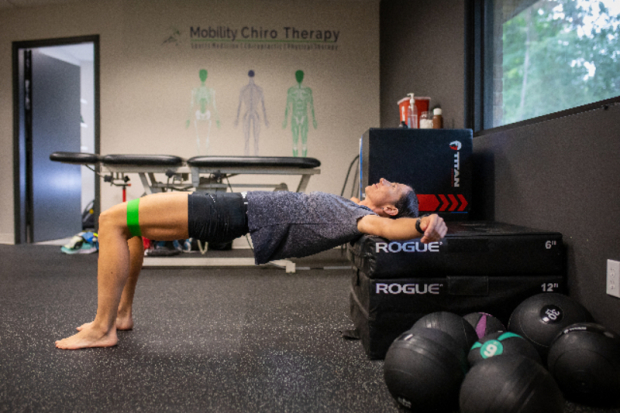
As with swimming, cycling or running, a key for the gym is to not overdo it. This can be tough, but you need to remind yourself that this is your off-season, not the main show, so you’re simply building a base. You don’t want to push too hard (AKA engage in ego-lifting) and end up getting hurt and delaying the start of your season.
How do you refrain from pushing too hard in the gym? For starters, don’t go for PRs in each exercise. You’re not in the business of one-rep maxes — you need to focus on lifting lighter weight, perfecting your form and performing each movement with purpose. Whether you’re doing lat pulldowns, dumbbell curls, squats or any other exercise, be sure to find a weight that you can rep 10 to 12 times over three or four rounds. This will yield the best results, and, as Hanson said, it can help you build the good habit of hitting the gym.
Mix It Up
Jewett says she likes to use the off-season as a chance to try out different activities. She picks things that will keep her in shape, just not her go-to swim, bike and run routines.
“It can be a good time to have a yoga or pilates class,” she says. She adds that “a hike or easy gravel riding” are another couple of great options.
Even jumping into completely different sports like tennis, basketball or anything else is a good way to keep fit and physically engaged during the off-season. You don’t have to be a superstar at any of these activities, you just need to find something that will keep you busy and entertained until it’s time to start building your triathlon schedule back up in 2026.