Interesting read
It is a subset of many forms of thermal storage:
(if you want more reading)
I know we have one plant in the U.S. doing molten salt storage. I don’t know if we have any - yet - with what your article described.
Yes, very interesting. Have been involved in pumped hydro projects but there’s not many to date and can be constraints to making them work, ie. financial or more practical engineering challenges. Happy to hear air projects are being vetted. All power projects in most every country have some level of subsidy, acknowledged or not, so great to see them giving air storage a go.
Interesting ideas in this article, thanks for sharing.
My first thought was that the efficiency of the system is quite low compared to batteries (article says optimal is about 70%, whereas utility scale batteries are ~85%). So there must be a huge cost savings on the capital investment to batteries, because my intuition says the operational costs cant be lower than a solid state battery.
Interesting the financial analysis later on in the article as well saying this would be about a 1/4 as expensive over the lifespan of the project as compared to batteries. I think the advantages would come out in the Gigawatt-hr grid scale applications of energy storage. Where batteries costs scale linearly with capacity, liquid air would likely scale logarithmically until you reach a storage tank size limit.
The drawback with batteries is they have a finite lifespan. So you have to figure replacement / recycling into the costs.
Right, about 10 years for battery life. But during those ten years this liquid air system would also be degrading, requiring regular maintenance and constant operational supervision. Its a really interesting cost structuring exercise, and I guess in their analysis that initial cost and turnover of the batteries is much higher than the operational costs of the liquid air plant.
It’s not really degradation in a materials sense though. I consider it closer to wind turbines - they can be fixed on the spot.
Batteries are closer to total replacement when the time comes. And in the U.S. we’re typically importing to do it - lithium, rare earths, whatever.
Edit: I do agree with your comment about gigawatt-scale applications being the place where it makes sense. I don’t think lithium based batteries can achieve the massive scale the world needs to supplement solar / wind power plants. Individual home solar - that’s a different story.
Is rapid replacement and product obsolescence a “bug” or a “feature”?
I also think that liguid air storage systems might be amenable to small scale capitalism and local control.
But, again is that a “bug” or a “feature”?
I am pretty sure that China, MAGA and Big Tech all view these things as “bugs”.
That’s probably why this technology has been ignored.
It’s simpler than that. U.S. subsidies and lobbying for oil / gas / coal have led the way for so long that there hasn’t been much need for energy storage systems. Even where solar and wind energy are built, they can rely on nuclear or fuel based power plants as their buffer.
1 Like
Its not exactly Liquid Air Energy Storage, but China is not only using batteries. World's largest compressed air energy storage facility commences full operation in China - Energy Storage
I don’t think that any technology is mature enough to be deemed ‘ignored’ especially at a government level. Governments generally have some incentives to reach a target level of energy storage, without mandating the technology used. In the US, that is more state driven at the moment. Currently, batteries are the most mature tech that can be rapidly and easily deployed at scale, which leads to there ubiquity.
There is also an issue of use case. Batteries are good for short to medium term storage of energy (overnight), whereas larger mechanical systems like liquid air or compressed air are better for long term storage (days).
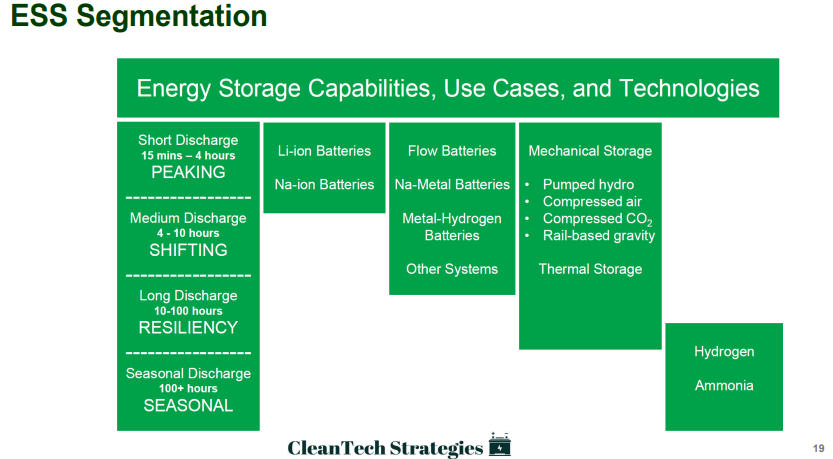
You can add flywheels to that list (maybe that’s “other systems”). They are mainly limited in how much they can scale. The biggest installations in the world are 20-30MW.
There was a cool article on the same site as the liquid air article about recycling batteries. It seems pretty complex and involves fun stuff like sulphuric acid (pink!). Liquid air seems to involve less toxic stuff at the end. I guess everything has its pros/cons I don’t think there is much battery recycling going on yet.
Yes it seems like liquid air you could use as a local level and at the end you don’t have complicated stuff to recycle/dispose of. I like that. I don’t know what you do with old solar panels which likely have some toxic stuff in them? Fossils fuels are putting out toxic stuff all the time I guess
I did read it
From a scalability perspective I think liquid air is better you just need one compressor to fill an unlimited number of tanks and I imagine you can store it effectively in perpetuity (if I understand things correctly)