Warning:I built one of the AI-coaching things, so feel free to roll your eyes, but this is a data post and not a pitch. The finding holds whether you self-coach, use a coach, or follow a canned plan.
It starts with the oldest problem in triathlon training. The block says threshold bike off a long run brick on Tuesday. Then you sleep five hours, the kids are up, the heat lands, and your overnight HRV comes in well below normal. The plan does not care. It was written three weeks ago and it has no way to know what last night did to you. So the swim moves because your shoulders are cooked, the brick gets fudged, and the whole week dominoes.
The standard answer is “a good coach adjusts.” True. But a coach can’t read your overnight HRV at 6am every day and rewrite Tuesday before you wake up. The static plan is a forecast written weeks early that assumes an average week, and nobody in this sport gets an average week.
So I built something that reads recovery daily, plugged it into the usual wearables, and let it run for a few months across 120-odd athletes. Then I went to check the claim we make out loud: that the plan adapts to your recovery. Easy to say, so I measured it.
When your overnight HRV drops, the load comes down.
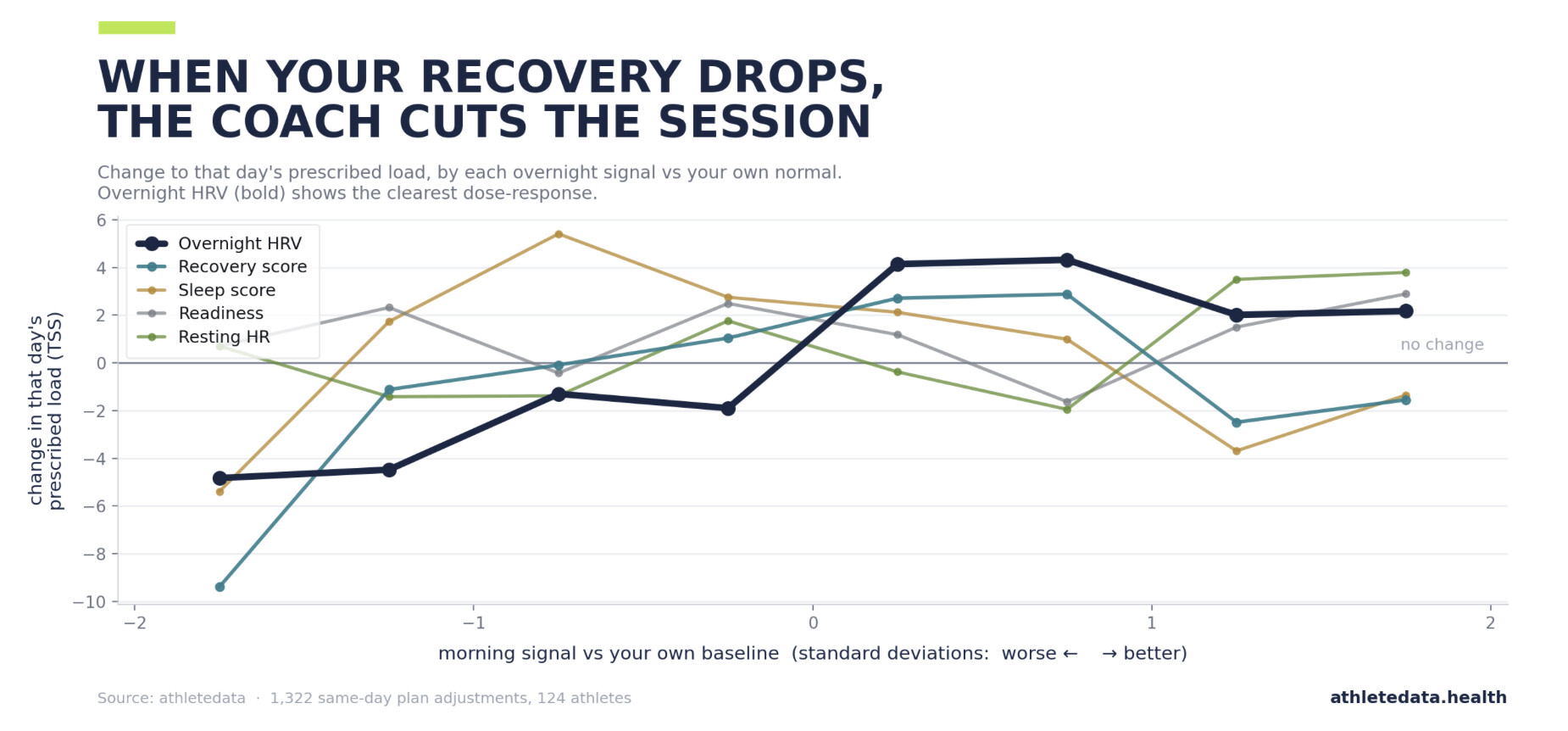
For every session the coach adjusted on the same morning it was due, I attached that athlete’s overnight HRV, scored against their own 60-day baseline so that zero is a normal night for them, and looked at how the prescribed load moved.
When an athlete’s overnight HRV came in below their own normal, the coach made that day about 5% lighter on average. When HRV was above normal, it added about 6%. And the worse the recovery, the more often it dropped the session outright: 32% of those edits on the lowest mornings, against 20% on the highest. That is 1,322 same-day adjustments across 124 athletes.
And it mostly happens before you ask.
Of roughly 53,000 coaching exchanges, 54% were started by the coach reacting to incoming data, not by the athlete writing in, and about a third of those were set off by an overnight recovery reading. With a static plan, you are the part that adapts. You read the plan, read your body, and reconcile the two yourself every morning. Move that read onto the coach and the plan becomes the thing that flexes.
The honest limits.
HRV is one input. The coach also weighs sleep, resting HR, readiness and training balance, so the effect is clear across the group and noisier for any single athlete on a given day. And none of it argues with the science: the work on HRV-guided and autoregulated training finds readiness-based plans match or modestly beat fixed ones, mostly in adaptation. The fixed block was never the mistake. It was the best a coach could do seeing you once a week.
Curious where this lands with the multisport crowd, since you juggle three sports and a brick schedule:
- When your watch says HRV tanked overnight, do you actually pull the hard session, or run it and judge by feel?
- Where is your line between a plan that adapts usefully and one that won’t sit still long enough to commit to a block?
Happy to share more of the raw breakdown.
In case you want to check out athletedata - the proactive coaching solution I built
