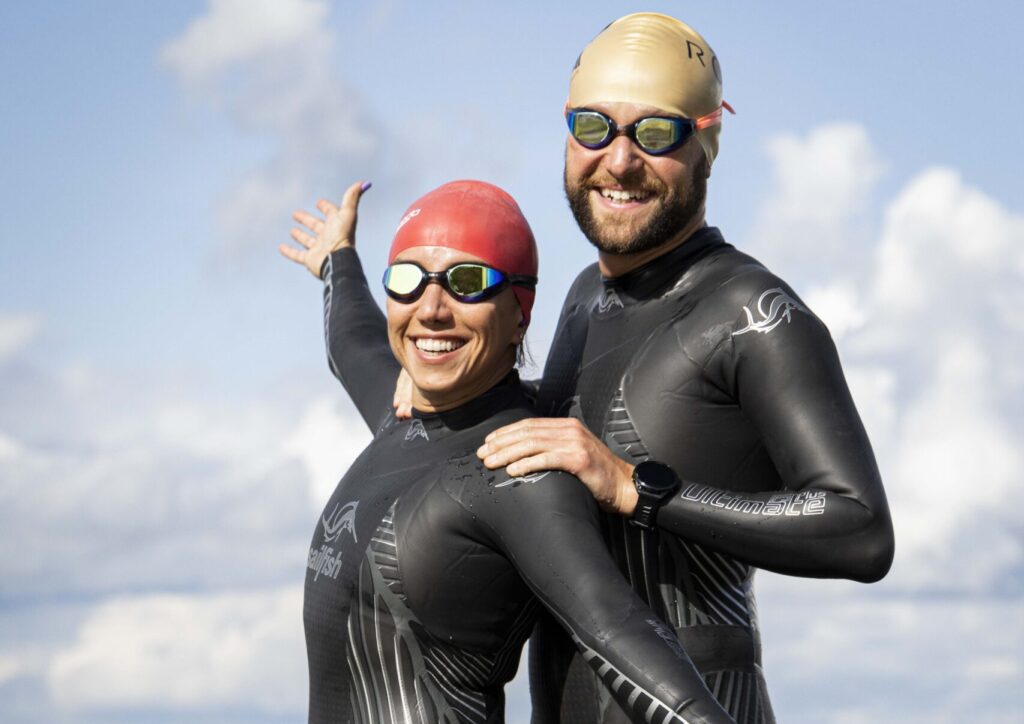
 Do couples who IRONMAN together stay together? Let's find out. Photo: Ayda Kachineh
No matter what you do, life is busy. If you just work, you’re busy. If you work and have a partner or family, you’re busier. If you work, have a partner or family and train for triathlon, you’re busiest — especially if you’re into long-distance triathlons.
How are you supposed to fit it all into the day? More importantly, how are you supposed to get your training done without dropping the ball where it matters most — at home as a partner and parent? Slowtwitch spoke with three IRONMAN couples to get some answers for the rest of us and to help determine the secrets of balancing everything. So, here it is: how to not get divorced as an IRONMAN triathlete or couple.
Training and Racing Together
It’s likely a rare occurrence to have a triathlon couple with two athletes who are exactly the same speed. One of the two members of the pairing is probably going to be quicker than the other, but that doesn’t mean they can’t train together.
Our first couple is California-based Ayda Kachineh and Guglielmo Schiavone, whose relationship has centred around triathlon since the start. Kachineh and Schiavone met at a race after they both won their age group, they got engaged in Kona and they now run a triathlon community, Full Time Champs, together.
They’re both great athletes, but they don’t have the same race pace — and they quite often aren’t training for the same distance, as Schiavone is currently training for the IRONMAN World Championship and Kachineh is focused more on 70.3s. They don’t let this stop them from training together.
“Gu is much stronger and faster than me since, you know, he’s a high-level elite athlete who won an IRONMAN and whatnot,” says Kachineh, referring to her husband’s overall win at IRONMAN Maryland in 2025. “But we still find time to schedule some workouts together, like when he has a light spin on the bike, or when we can work out in our pain cave.”
The next couple Slowtwitch spoke to is Danielle Hirt and Cody Hodgins, newlyweds from Washington, D.C. Hirt echoes Kachineh’s words, saying, “Cody and I do the sport at very different levels.”
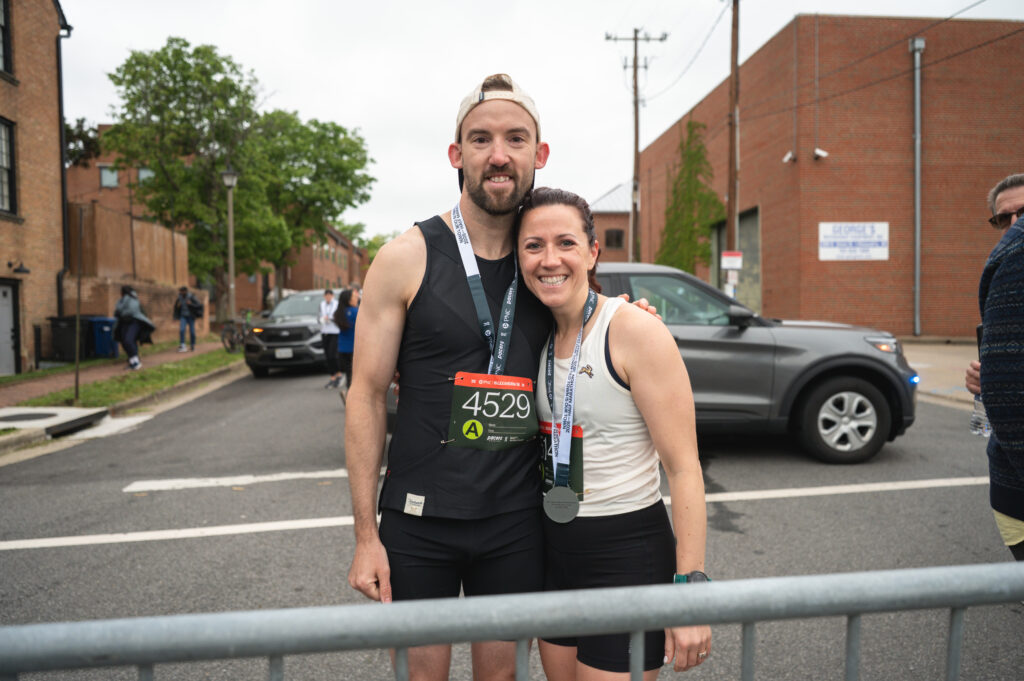 Hirt and Hodgins at the 2026 Alexandria Half Marathon in Virginia. Photo: Swim Bike Run Photo/Ralph Navarrete
Hodgins has his eyes on a pro card while Hirt is chasing personal bests, but that doesn’t prevent them from training together. They have their trainers set up in their apartment and they say they are keen to train side by side as often as their schedules allow. They’re also set to line up at the same race for the first very soon at 70.3 Happy Valley on June 14.
“I will still be on the bike when he finishes,” she says. “But I don’t feel bad that I’m slower than him. There’s no shame in that.”
The third couple who sat down for a call with Slowtwitch is Christina Candio and John Zsigovits. This husband-and-wife coaching duo balances work, parenting their five children and training for triathlon in their hometown near Philadelphia. Although Candio and Zsigovits don’t always race together, they have toed the same start line on multiple occasions. They haven’t, however, raced the same full-distance IRONMAN before — nor have they both even raced an IRONMAN in the same season, which brings us to two more keys for triathlon couples: scheduling and communication.
Scheduling and Communication
Zsigovits did his first (and, to date, only) IRONMAN in 2019, followed by Candio’s full-distance debut four years later in 2023. Zsigovits says he didn’t have plans to do another when Candio was training for hers, but even if he had felt the itch, he knew it simply wasn’t feasible for them both to be in the thick of IRONMAN prep with their work and family duties.
“We both have careers, we both coach on the side as well, we have kids,” he says. “So, we knew the impact of it.”
Zsigovits says it worked out well to have one person on IRONMAN training hours and the other at home. If Candio was going for an hours-long bike ride, or had to complete two workouts in a day, Zsigovits stepped up to prep dinner, handle the kids and do whatever else was needed around the house.
With only one of them training for a full-distance race, they weren’t left being “absentee parents,” Candio says with a laugh.
It’s the same with Hirt and Hodgins. Hodgins isn’t training for an IRONMAN, but he says his weekly workout load is close to what it would be if he were going for the full-distance. Pair that with Hirt’s training and work schedule, and they have quite a busy household. They say that they both have their standard chores, but if Hodgins is too busy to do his one day, Hirt will pick up the slack — and vice versa.
“A marriage is never 50/50,” Hodgins says. “It always changes. Sometimes it’s 60/40, sometimes 70/30. We just work well together to communicate and know that on some days, one of us may have to pick up more training hours and the other will need to do a bit more at home.”
Hirt adds to that, saying, “We make sure the other person knows what workouts we need to get done on any given day so there are no surprises.”
Perhaps most important, Hirt says, is that they have a “no guilt-tripping” policy. If Hirt needs to run and didn’t have time to do the laundry or walk the dogs or do whatever other chore, she simply lets Hodgins know and he takes care of it.
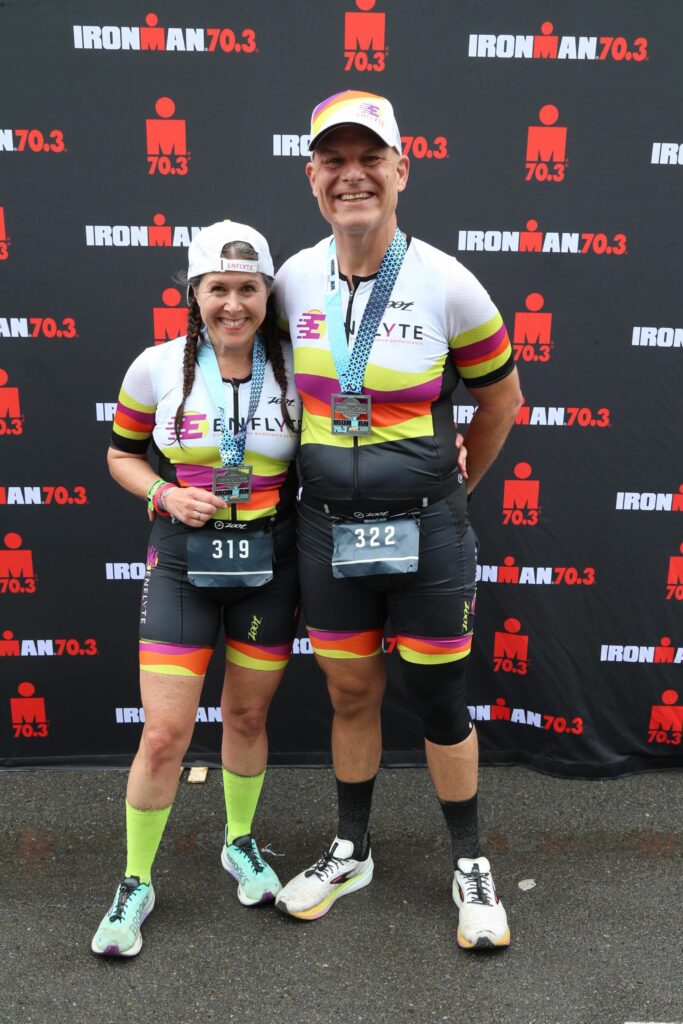 Candio and Zsigovits pose for a shot after 70.3 Happy Valley in 2025. Photo: Christina Candio
“There’s no shame in it and there is no guilting one another,” Hirt says.
Of course Schiavone and Kachineh juggle chores and trade off duties at home as well, but they also point to another form of scheduling that they say is very important for their relationship: time to unwind together.
Kachineh says she likes triathlon, but it’s not her main focus. Schiavone, on the other hand, loves it.
“He’s definitely more passionate and dedicated than I am in triathlon,” Kachineh says. Because of this, Schiavone has a stricter and more intense training schedule, but he doesn’t let that impact their social life together.
“There are a lot of times when Gu’s just done his training for the day and I ask if he wants to go see my parents or grab a drink together,” Kachineh says. “And he doesn’t hesitate. He’s just like, ‘Let’s go.'”
Every triathlete has to be good at scheduling, whether you’re single, dating or married. It becomes even more important, however, as you add more people to your life, whether that’s a partner or kids. Each of these couples have shown not only that it’s possible to fit it all in if you try, but that it’s also a huge part of finding success in both training and relationships.
Supportive Partners
Any successful marriage — whether it has a triathlete in it or not — features a well-trodden two-way street of support. Both partners have to support one another in their various endeavours, whether that is with work, in their hobbies or, if they’re into the sport, in triathlon.
That is why the three relationships included in this article work. Each of the husbands support their wives, and the wives support their husbands.
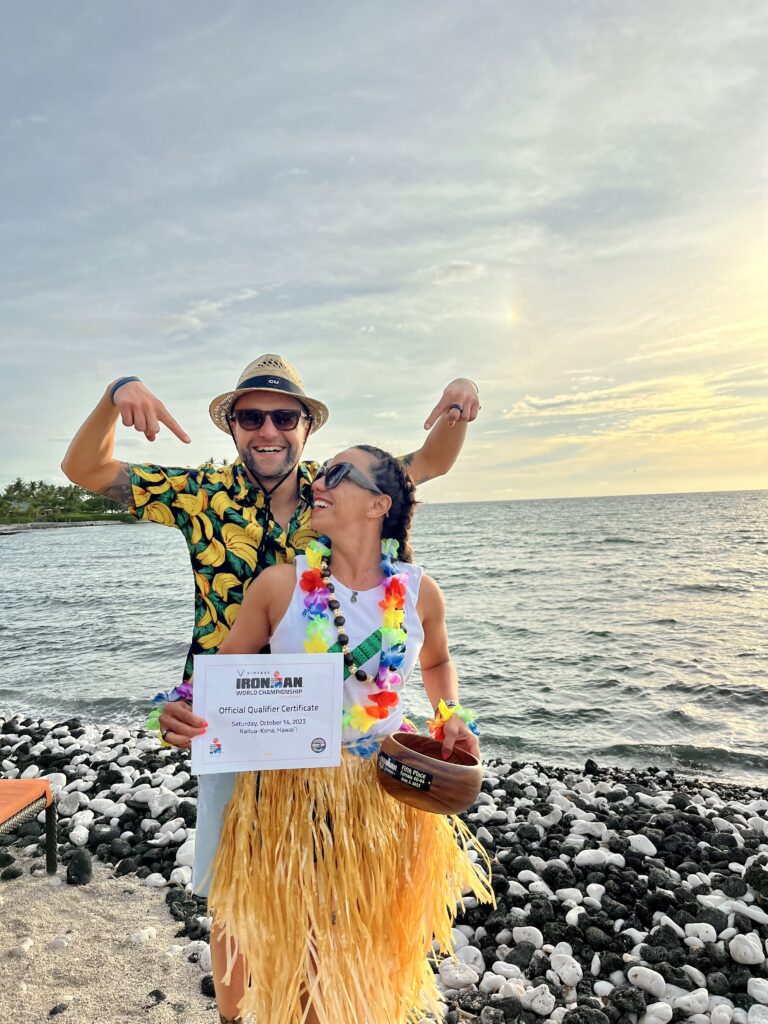 Schiavone and Kachineh celebrate Kachineh's Kona-qualifying result at 70.3 Hawaii in 2023. Photo: Ayda Kachineh
Zsigovits and Candio say they enjoy lining up to race the same event, but there have been many times (including their two individual IRONMANs) when only one of them is competing and the other is the race sherpa for the day. But it goes even further than that, as they actually enjoy supporting one another on race day. It’s not a chore for them, it’s fun.
The same goes for Hirt and Hodgins and Kachineh and Schiavone — they have all supported one another in the lead-up to and at races on many occasions.
“It’s one of my favourite parts of triathlon,” Hirt says. “The sport is amazing, but when you’re with somebody you can share it with and support, it’s just so much fun. When you’re invested in what they’re doing, it makes the journey even better for you.”


 ones recently - the question from Mr Smith who had a crush on a swim-mate; and the couple that broke up because they loved triathlon more and neither seemed willing to compromise but one wrote in wanting to get back together.