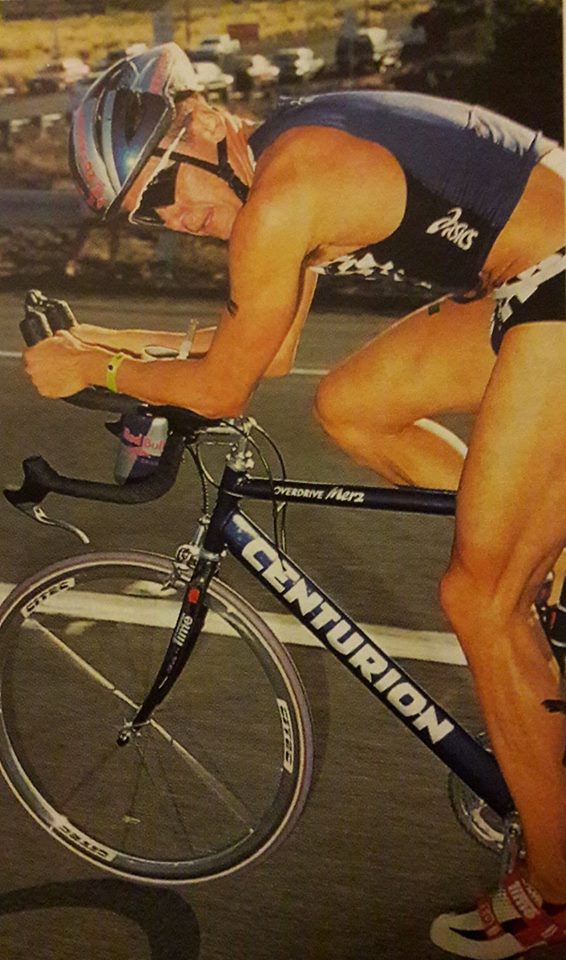
5 minutes sounds perfectly attainable with a more aero bike and helmet. He did have an excellent position which wasn’t obvious from side shots but looked very compact from the front. Amazing that his results from 20 years ago have stood the test of time. The sport might have made dramatic progress from 76 to 96 but this was still before power meters and wind tunnels.
Fascinating and totally dedicated guy who’s still living the tri-life today, fortunately hasn’t suffered with cardiac problems like some of the other high milage guys 'cos my understanding was that Hellriegel was always trying to out-train his competition.
Interesting and ironic that this was the year that Dave Scott had a great “come-back” race. I’m guessing this is still the “masters” record at Kona - 8:28:31 for Kona.
I think it was Dave Scott himself that ounce said, it was not the current bike times vs from days ago that surprised him, it was the run times, that he thought should be faster. If the bikes are not absolutely faster by time, they are saving watts (energy), AND with the more strategic racing that we see in Kona, less of an all-around go-for-it attitude than in days past, all of that should mean more energy left over for faster runs - but we’ve not seen that. Run times today for the top 10 - 15 men are similar to what they were 15 - 20 years ago.
Was the old running course certified, measured like you do for a marathon?
How accurate were the running courses in the 80s and 90s?
I know it would have been easy to follow the same protocol as running races ans marathons did, but did the Ironman organizers do that?
The whole debate on who would have been best is like a dog changing its tail. An athlete can only compete against the athletes in their time.
5 minutes sounds perfectly attainable with a more aero bike and helmet. He did have an excellent position which wasn’t obvious from side shots but looked very compact from the front. Amazing that his results from 20 years ago have stood the test of time. The sport might have made dramatic progress from 76 to 96 but this was still before power meters and wind tunnels.
Fascinating and totally dedicated guy who’s still living the tri-life today, fortunately hasn’t suffered with cardiac problems like some of the other high milage guys 'cos my understanding was that Hellriegel was always trying to out-train his competition.
SteveMc
I always found Hellriegel’s arm pad postion pretty “wide” on the Syntace bars. We went from narrow elbow placement on the first gen of Scott DH to wide on Syntace, back to the current trend of narrow. Through this entire time, bike times have not budged that much between narrow and wide (as in less than hip width).
Thomas definitely out trained everyone else. I first met him at the World Military Games Triathlon in 1995. The race was non drafting olympic tri and the day before the race he cranked out something like 4K swim and 90K ride and a short jog. He beat Stadler (1994 World Duathlon Champion), Dmitri Gaag (1999 ITU World Champ) and Olivier Marceau (2000 ITU World Champ). What people forget about Hellriegel is he was fast at Olympic tri. He was 6th at ITU Olympic Tri worlds in 1992. The guy had the amazing combo of work ethic, big engine and sucker for out training the competition. It works at beating the competition until your break yourself.
I get his facebook feed and he’s still on the full training lifestyle doing all kinds of cool stuff both in Germany and the Canary Islands. After 1995 World Military Games in Sep he went for an intensive training camp in the Canary Islands and then showed up in Kona and destroyed the entire field including Mark Allen on the bike and came to T2 with a 13 minute lead.
From the Peak Aero report we can guess a good position back then vs that same position now is maybe 8-12w difference. I’d argue >2:59 <5:15
The game has changed
Brian, are you saying on the same position as back then, but with better bike, wheels, helmet, suit, rubber between 2:59 and 5:15 savings. So at best that 4:24 goes to 4:19? Seems reasonable.
From the Peak Aero report we can guess a good position back then vs that same position now is maybe 8-12w difference. I’d argue >2:59 <5:15
The game has changed
Brian, are you saying on the same position as back then, but with better bike, wheels, helmet, suit, rubber between 2:59 and 5:15 savings. So at best that 4:24 goes to 4:19? Seems reasonable.
So shallow rims, no aero tri suit, a 21 year old rount tubed bike, no aero helmet, a far worse front end and probably worse tyres adds up to between 1-2s/km?
It might well be true, I mean times now aren’t much faster than then, but that would indicate that we are sold a lot of crap and it really is all about the fit and the legs.
So shallow rims, no aero tri suit, a 21 year old rount tubed bike, no aero helmet, a far worse front end and probably worse tyres adds up to between 1-2s/km?
It might well be true, I mean times now aren’t much faster than then, but that would indicate that we are sold a lot of crap and it really is all about the fit and the legs.
He had a semi aero frame, some depth to his rims and a tidy bike set up. I cannot recall him ever having bike mechanical issues in a race, which suggests he had certain things dialed in.
He could also stay in the aero position comfortably for ages. There was a reason why Peter Reid called him The Cyborg.
We’re definitely sold a lot of crap on the basis of what works in a tunnel and shown to work well in short time trials.
Luc almost matched Thomas in 1996 on a round tubed frame, and he was prehaps the ultimate mutant the sport has seen.
Peter Reid went through a large number of aero frames in his early days (Softride, Hotta) but had his best race(s) on a less aero custom specialized. However like Hellriegel, he got all the details right.
These three were the ironmen of the late 90s, the wind tunnel has clarified aero, but there is so much more to an optimal ironman, espeically in Hawaii where the competition is fearsome.
Thomas definitely out trained everyone else. I first met him at the World Military Games Triathlon in 1995. The race was non drafting olympic tri and the day before the race he cranked out something like 4K swim and 90K ride and a short jog. He beat Stadler (1994 World Duathlon Champion), Dmitri Gaag (1999 ITU World Champ) and Olivier Marceau (2000 ITU World Champ). What people forget about Hellriegel is he was fast at Olympic tri. He was 6th at ITU Olympic Tri worlds in 1992. The guy had the amazing combo of work ethic, big engine and sucker for out training the competition. It works at beating the competition until your break yourself.
I get his facebook feed and he’s still on the full training lifestyle doing all kinds of cool stuff both in Germany and the Canary Islands. After 1995 World Military Games in Sep he went for an intensive training camp in the Canary Islands and then showed up in Kona and destroyed the entire field including Mark Allen on the bike and came to T2 with a 13 minute lead.
He carried some run speed into his early ironman success but then I think the huge training load caught up with him. The Club La Santa pre-Hawaii pro training collective was intense back then. I cannot remember the source but the years Torbjorn Sindballe was at his peak he could outbike Hellriegel. A handfull of top riders attempted to hammer around Lanzarote and one by one they dropped off until Sindballe was the last man stomping. I guess one has only so many years where the body and mind are willing to go into that dark place where ironman greatness emerges…
Thomas definitely out trained everyone else. I first met him at the World Military Games Triathlon in 1995. The race was non drafting olympic tri and the day before the race he cranked out something like 4K swim and 90K ride and a short jog. He beat Stadler (1994 World Duathlon Champion), Dmitri Gaag (1999 ITU World Champ) and Olivier Marceau (2000 ITU World Champ). What people forget about Hellriegel is he was fast at Olympic tri. He was 6th at ITU Olympic Tri worlds in 1992. The guy had the amazing combo of work ethic, big engine and sucker for out training the competition. It works at beating the competition until your break yourself.
I get his facebook feed and he’s still on the full training lifestyle doing all kinds of cool stuff both in Germany and the Canary Islands. After 1995 World Military Games in Sep he went for an intensive training camp in the Canary Islands and then showed up in Kona and destroyed the entire field including Mark Allen on the bike and came to T2 with a 13 minute lead.
He carried some run speed into his early ironman success but then I think the huge training load caught up with him. The Club La Santa pre-Hawaii pro training collective was intense back then. I cannot remember the source but the years Torbjorn Sindballe was at his peak he could outbike Hellriegel. A handfull of top riders attempted to hammer around Lanzarote and one by one they dropped off until Sindballe was the last man stomping. I guess one has only so many years where the body and mind are willing to go into that dark place where ironman greatness emerges…
SteveMc
From what I recall him saying the Club LaSanta pre Kona camps was around 20K swim, 1000K bike, 100K run per week and it was all pretty intense stuff. Basically 35-40 hour week. In terms of the savings, 5 min seems in range in that I don’t think Hellriegel would be faster than a 4:19 guy in Kona today. Maybe I am wrong, but no one in Kona is riding faster today. I don’t think Hellrieigel was any faster a rider than the top riders today. I think the top 4-5 guys (Reid, Zack, Hellriegel, Van Lierde, Stadler) could ride with anyone today, but I don’t think they would be any faster (other than that one ride in 2006 from Stadler). When you went to the next 15 racers, today the next 15 are a lot faster than back then in terms of depth of field.
What is interesting is that Peter Reid only broke 8:20 ONCE (with a 8:19) from what I remember in Kona. He was 7:5x in Austria, but Peter never put down a low 8:1x or high 8:0x. Would have been interesting to see what Peter could do with all of today’s tech given his techno geek profile. Hellriegel just tried to out train/out last everyone and he had around 4 good years before he fell apart. Peter also went to the extreme training and body composition, but I think he was a thinking man’s athlete, trying to shave time everywhere in the race through finesse and the best technology available to him.
I had the pleasure to meet him on the Canary Islands two years ago. He is really still Film into the lifestyle with daily rides, swims and runs.
I got to hear some stories from back in the days two. Like when he did pace change intervalls on the Frack with Zäck and none would give even an inch. Until they ran something like a half marathon with alternating ks between 3:30 and 3:00.
I had the pleasure to meet him on the Canary Islands two years ago. He is really still Film into the lifestyle with daily rides, swims and runs.
I got to hear some stories from back in the days two. Like when he did pace change intervalls on the Frack with Zäck and none would give even an inch. Until they ran something like a half marathon with alternating ks between 3:30 and 3:00.
Too bad we don’t hear legends of pros doing this type of silliness anymore. I don’t care if it is true or total BS, it’s still amusing to follow. Same type of things the early day American pros did in San Diego and Boulder. Probably all the legends are over inflated. Zack was telling us about his weekly 5 hour 200K ride outside Cologne. Apparently the goal was to break 5 hours every week on Wednesday. Monty might be able to share part of that legend because from what I gather he lived with Jurgen in Germany some summers racing in the triathlon version of Bundesliga. Basically every Wed was the hammerfest 200K ride and every weekend was a league race (sprint or Olympic) and around that he’d fill in a bunch of other shorter frequency x volume, but he had 2 intensity days per week (Sunday race, Wed hammerfest ride).
Interesting and ironic that this was the year that Dave Scott had a great “come-back” race. I’m guessing this is still the “masters” record at Kona - 8:28:31 for Kona.
I think it was Dave Scott himself that ounce said, it was not the current bike times vs from days ago that surprised him, it was the run times, that he thought should be faster. If the bikes are not absolutely faster by time, they are saving watts (energy), AND with the more strategic racing that we see in Kona, less of an all-around go-for-it attitude than in days past, all of that should mean more energy left over for faster runs - but we’ve not seen that. Run times today for the top 10 - 15 men are similar to what they were 15 - 20 years ago.
What are the chances that the cumulative effects of the sun, heat, wind, humidity, etc. place a limit on just how fast these guys are able to run in Kona, regardless of how much is “saved” on the bike with newer equipment, etc.?
Give them a cooler, cloudier, less windy day and see what happens.