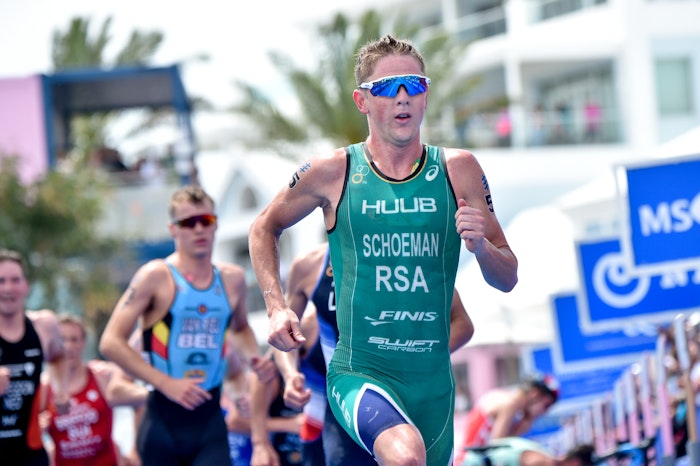
 Photo: World Triathlon
He didn’t exactly “burst” onto the scene when he took the bronze medal at the 2016 Olympic Games behind Alistair and Jonathan Brownlee, but he wasn’t exactly a household name before that breakthrough achievement. Later that year he would take the World Triathlon Championship Series Grand Final in Cozumel (the famous “Alistair helping Jonny cross the finish line” race), cementing his status amongst the world’s premier short course athletes. A few years later he would take the Commonwealth Games title, but his subsequent Olympic efforts have been disappointing for the South African. He broke his ankle during the race at the Tokyo Games, and was coming off an injury that slowed him down in Paris three years later.
Schoeman has enjoyed some long-course success over the years, including a win at IRONMAN 70.3 Philippines and sixth at the 70.3 worlds in Taupo in 2024, but hasn’t had the breakthrough performance many feel he’s capable of.
We caught up with Schoeman the day before Challenge Sir Bani Yas at the beginning of the month. A week earlier he’d enjoyed a huge day at the Samla 100 adventure race, which left him pretty beat up heading into the competitive Sir Bani Yas race – he would drop out of that race. It was an enlightening conversation, though.
Slowtwitch: Henri, we’re back at Challenge Sir Bani Yas again. A little different scenario this year – we’re sitting on a cruise ship. How are you feeling heading into tomorrow’s race?
Henri Schoeman: Yeah, I’m feeling good. It’s my first triathlon of the season – I’m just recovering from my previous race seven days ago, The Samla 100 in Qatar, which was a brutal race, so it took a little while for my body to come around. I’m really excited to be here in Sir Bani Yas for the second year. The cruise ship option is pretty awesome and and I’m really looking forward to experiencing the whole atmosphere and the vibe with all the athletes … It almost feels like a type of Olympics where everyone is together, so it’s quite quite a cool vibe. I’ve had a very good off season with training. I’ve built up some good volume so I’m excited to see how the body fares.
Can you talk a little bit about the race last weekend? You came second to your countryman Bradley Weiss.
It was three kilometers swimming, 21 kilometers of running, 22 kilometers of mountain bike, then we kayaked four kilometers, and then we biked 22 again, and then we run 28 kilometers – all of it in the desert. So it was a lot, and I would say 80% of the course is on soft, soft sand … It’s like the sand pulls you in. I got onto a hard compact surface and thought … this feels amazing, and then you just get
sucked in again.
But it was a good experience because you have to carry all your own nutrition … And they only give you water at checkpoints every five kilometers. So it’s like you’re out there by yourself, and you need to make sure you navigate with enough nutrition on yourself and all of that.
I got second, so I was pretty happy with that. It was good money, so it’s a good payday, a good start to the year, so I couldn’t be more happy.
I’ve always felt like one of your big challenges going to the longer distances has been strength on the bike, so if you’re coming second in that that’s got to bode well with the training.
Yeah, it was a six and a half hour day out, so it’s … closer to an Ironman, so the endurance capacity is obviously there. I’m confident in that it shows that I’ve had a good off season as well. This week is all about just trying to bring up an extra gear, fine-tuning for a half-distance. The muscles are still a little bit sore … but I’m taking it day by day. I think I should be all right.
I guess you’re a full-fledged, long-distance athlete now, or are you still thinking Olympics?
I haven’t put the Olympics behind me just yet. I would really love if my daughter sees me on the TV at the Olympics and really takes it in because she’ll be six years old at LA28. If I can be at the Olympics and she watches me compete at the Olympics, It’ll mean a lot to me.
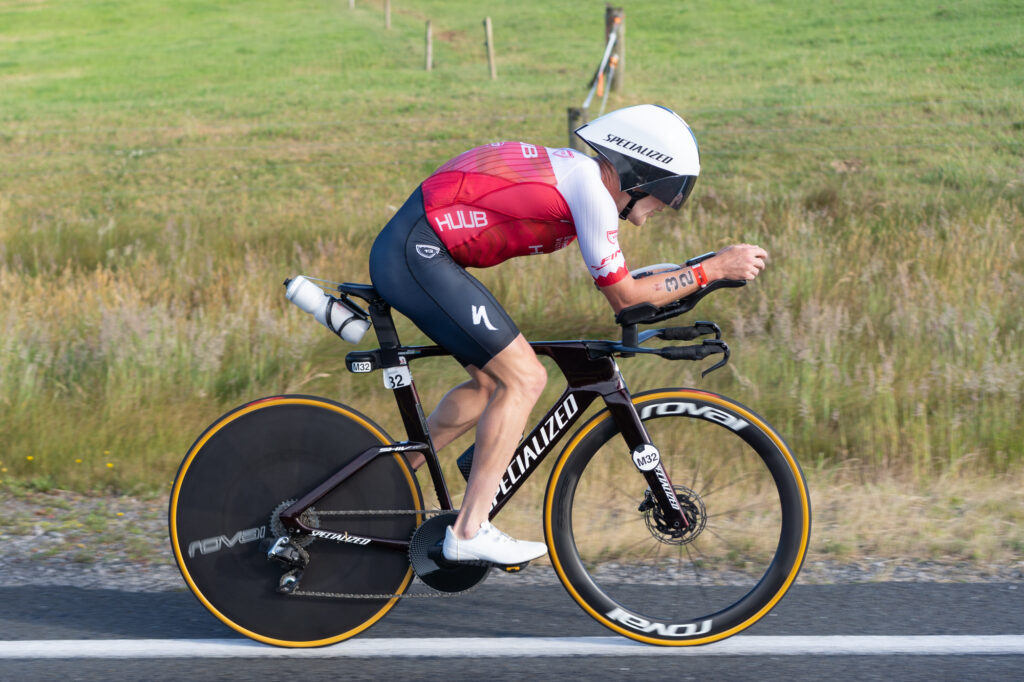 Schoeman on the bike on his way to sixth at The IRONMAN 70.3 World Championship in Taupo, New Zealand in 2024. Photo: Kevin Mackinnon
So, I mean, one part of me wants to go to another Olympics. I believe I can, but another part of me thinks, is it maybe wiser to just follow the long course route? Money-wise, funding-wise, that is a better route because there’s a lot that you have to invest into getting to the Olympics. There’s not a lot of support with our federation. So, a lot of it has to be paid by yourself. And then the long course route, you get these Challenge races where they invite you, they look after you. So, it really makes it a lot easier to compete and make a living. So that’s the two choices I have to make.
I’ve been riddled with a knee issue for two years since Paris 2024. And that’s kind of hindered my speed on the run. I haven’t been able to push that top end speed. That’s why I’ve kind of kept it at the middle distance, long course, because that’s the speed I can manage in training. But, I’ve had a very good off season and things have progressed so much better, so if I’m able to get that top end speed
I might just think hey, let’s give it a go.
I guess the worst case scenario you jump into a few WTCS races and see where you stand?
Exactly. I’m going to sit down with my team after this race and decide what’s the next plan going forward, so it will happen pretty soon.
You competed at Challenge Roth last year, but you were sick and didn’t have a great day. Was it at least a good enough experience that you haven’t been scared away from the distance?
Look, Challenge Roth was something really exciting because it’s a bucket list race. I mean, the support, crowds, everything – the atmosphere is amazing. So, even when you’re struggling, it was a good vibe just to carry on. But, for me, I enjoyed it, but it’s a different type of game I would say. It’s like you have to find your rhythm get through a long day out, whereas 70.3 (half-distance), you’re still spiking it. You’re still pushing quite a high intensity at some stages. The long distance is just like finding your pace, finding your strategy, and just getting to the finish line as fast as you can instead of racing some others.
Talking about the Olympics, you won the bronze medal in 2016. At some level, does that almost hang over your head because it’s been the pinnacle of your career so far. Do you feel like you’re still hunting for that next step?
That came on really early in my career, actually. I think I was on the circuit like three years, and then I got an Olympic medal and then it just seemed to get better because I got the Commonwealth gold two years later … I won the WTCS Grand Final (in Cozumel in 2016), I won a couple World Series races … and then it was COVID, and then injuries. I just felt like I didn’t get my opportunity to really, like, show what I had, because it was a whole COVID thing, and it, like, put a, like, a pause on my career.
I went into Tokyo super confident. I felt like I could have got a a medal for sure, and then I broke my
ankle in the race. Then Paris came around and I felt like I needed to have revenge … because I feel like I was worthy of a medal, and I pushed so hard and then I injured the knee, and then I just never ended up showing what I was worth. I’ve missed that opportunity over the last two Olympics. I would like to go there, but the young guys are coming up pretty fast now and they are changing the game again. So, I have to really make sure that I get my speed up if I’ll have any chance to stick with them. So, it’s pointless if I’m not getting that speed to go through and do it.
It’s interesting because athletes like you, Alistair Brownlee, Javier Gomez and Jan Frodeno – you were the ones who created that idea that you’ve got to be young and dynamic and fast to be able to win at the Olympics.
It’s sort of funny to see it come around in a big circle. Look, experience does play one thing, because I’ve got the experience of three Olympics, so I know exactly what to expect, but then you also get the young guys who are, like, full of excitement, which can be a positive or a negative for them and because it’s all new they can get overwhelmed sometimes. But the excitement can just push them to a new level sometimes, too. The olympics brings the best out of everyone, I think.
It sounds like you’re in this for a while.
No, I’m not packing up my bags. There’s no stopping. Even though I’ve had all these challenges, I’m still here fighting. I’ve got through so much over the last two, three, four years, and I find I’m actually finding myself again. I think I’m getting into some really good shape. I haven’t gotten slower, and that’s a big thing. So, as long as I’m not getting slower and I’m still improving, there’s no reason to to give up.
What do you see as the steps for you to be able to kind of move up that next level?
If I have to close the short course chapter on my career, I would say it’s (been) a very successful short course chapter. I have new challenges – I do have the goals of winning IRONMAN Kona, or the 70.3 world champs, Challenge Roth. But I have this lingering regret that I was pushed out of short course sooner than I would have hoped because of the injury. I didn’t get my last race where I was like, okay, that’s it.
So, that’s why I’m still like hanging around, like thinking, should I or shouldn’t I?