Heating contractors - natural gas furnaces?

can you explain what condensing means in regards to a furnace? and i’ve yet to witness a heat exchanger burn exhausted gas so that too if you will.

from the interweb, as it can explain it better than I can.

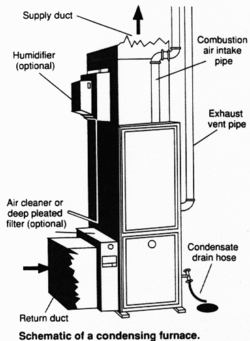
The higher- efficiency models are “condensing gas furnaces.” They run exhaust gases through a second heat exchanger to extract and use available heat that’s otherwise exhausted. These models pull out nearly all of the heat, sending cool exhaust out and leaving behind condensed water. This condensate, 5–6 gallons per day, is drained or pumped away.

the heat exchanger is not “burning” anything, just capturing the heat, not unlike, a heat pump.

Yeah, forgot about the exhausting, but it need not go through the roof.

where else? i’ve yet to see it go out of the side of a house and I’ve personally installed about 1000 furnaces in my over a decade now. vents such as a drier vent sure, carbon monoxide up through the roof.

maybe it’s just down here in Houston though, the a/c capital of the world?

My furnace vents out thru a 4" PVC pipe right out the side of my basement wall. A second pipe brings in fresh air.

The high efficiency furnaces, since the exhaust air is so much cooler, can vent horizontally thru PVC instead of going vertically up a chimney.

can you explain what condensing means in regards to a furnace? and i’ve yet to witness a heat exchanger burn exhausted gas so that too if you will.

from the interweb, as it can explain it better than I can.

The higher- efficiency models are “condensing gas furnaces.” They run exhaust gases through a second heat exchanger to extract and use available heat that’s otherwise exhausted. These models pull out nearly all of the heat, sending cool exhaust out and leaving behind condensed water. This condensate, 5–6 gallons per day, is drained or pumped away.

the heat exchanger is not “burning” anything, just capturing the heat, not unlike, a heat pump.

the heat exchanger you speak of is the evaporator coil, nothing to do with a gas furnace other than it uses the same fan from inside of the furnace and the coil is connected to the furnace with the use of a transition (pretty much butted up to the furnace or you can get a coil-furnace combo in which if that is the case then the coil is in with the furnace in one box and has a drain coming from it but it’s still only in regards to the the coil, nothing heat as far as calling for heat via the t-stat or in plain english nothing to do with when the heater is ‘on’ and calling for heat but yes, the extraction of heat from freon in the coil is how you get cool) but rather the cooling side in regards to freon which condensates and is drained. no gas furnace on earth will produce a liquifiable and drainable to mother earth liquid. read far down and you’ll see that gas to air is direct and so the burners are the heat exchangers so to speak.

HVAC air coils
One of the widest uses of heat exchangers is for air conditioning of buildings and vehicles. This class of heat exchangers is commonly called air coils, or just coils due to their often-serpentine internal tubing. Liquid-to-air, or air-to-liquid HVAC coils are typically of modified crossflow arrangement. In vehicles, heat coils are often called heater cores.
On the liquid side of these heat exchangers, the common fluids are water, a water-glycol solution, steam, or a refrigerant. For heating coils, hot water and steam are the most common, and this heated fluid is supplied by boilers, for example. For cooling coils, chilled water and refrigerant are most common. Chilled water is supplied from a chiller that is potentially located very far away, but refrigerant must come from a nearby condensing unit. When a refrigerant is used, the cooling coil is the evaporator in the vapor-compression refrigeration cycle. HVAC coils that use this direct-expansion of refrigerants are commonly called DX coils.
On the air side of HVAC coils a significant difference exists between those used for heating, and those for cooling. Due to psychrometrics, air that is cooled often has moisture condensing out of it, except with extremely dry air flows. Heating some air increases that airflow’s capacity to hold water. So heating coils need not consider moisture condensation on their air-side, but cooling coils must be adequately designed and selected to handle their particular latent (moisture) as well as the sensible (cooling) loads. The water that is removed is called condensate.
For many climates, water or steam HVAC coils can be exposed to freezing conditions. Because water expands upon freezing, these somewhat expensive and difficult to replace thin-walled heat exchangers can easily be damaged or destroyed by just one freeze. As such, freeze protection of coils is a major concern of HVAC designers, installers, and operators.
The introduction of indentations placed within the heat exchange fins controlled condensation, allowing water molecules to remain in the cooled air. This invention allowed for refrigeration without icing of the cooling mechanism.
The heat exchangers in direct-combustion furnaces, typical in many residences, are not ‘coils’. They are, instead, gas-to-air heat exchangers that are typically made of stamped steel sheet metal. The combustion products pass on one side of these heat exchangers, and air to be conditioned on the other. A cracked heat exchanger is therefore a dangerous situation requiring immediate attention because combustion products are then likely to enter the building.

Yeah, forgot about the exhausting, but it need not go through the roof.

where else? i’ve yet to see it go out of the side of a house and I’ve personally installed about 1000 furnaces in my over a decade now. vents such as a drier vent sure, carbon monoxide up through the roof.

maybe it’s just down here in Houston though, the a/c capital of the world?

My furnace vents out thru a 4" PVC pipe right out the side of my basement wall. A second pipe brings in fresh air.

The high efficiency furnaces, since the exhaust air is so much cooler, can vent horizontally thru PVC instead of going vertically up a chimney.

do all of you have some water based heating system such as boilers cause that is probably the only way i could imagine exhaust air being ‘cool’. on a gas furnace with a metal gas exhaust piep you can’t touch the pipe as it’s like touching a car’s tail pipe, that kind of hot. so hot infact that by city code there must be 1" clearance all the way around the pipe all the way through the roof and i think the roof has to be cut out even more as in two to three inches clearance all the way around the protruding pipe.

where else? i’ve yet to see it go out of the side of a house and I’ve personally installed about 1000 furnaces in my over a decade now. vents such as a drier vent sure, carbon monoxide up through the roof.

maybe it’s just down here in Houston though, the a/c capital of the world?

Fascinating. Pretty much every furnace up here in new construction or replacement is vented via PVC straight out the foundation of the house.

I wonder why it would be different from the midwest to Houston?

that’s what i’m trying to figure out as well. it is fascinating though. i’ve heard of pvc being used as exhaust pipes and i do believe it has something to with the colder climates but that’s all i know. perhaps if it’s ventable from the ground and it’s natural gas turned carbon monoxide then it has something to with that colder temperature doing something as in breaking down the particles which make up the exhaust gas quicker or something, I’m not sure and i’m fumbling. :wink:

or it could just be that your ozone is in better condition that down here so the US isn’t so worried about it. :wink:

Look at the wiki article, it also shows a condensing gas hot air furnace. Its not just for hydronic systems, the heat exchanger pulls all of that heat out of the exhaust pipe. Its the only way you’ll get into the high 80s and 90s for efficiency. Maybe people in Texas hate the earth :slight_smile:

http://en.wikipedia.org/wiki/Furnace

Not sure what your codes are in Texas but just about 100% of new home construction and the vast majority of new furnace installs around here vent through the side walls near the ceiling of the basement. Remember, most homes above the mason/dixey line have BASEMENTS, where the furnaces are installed. With a high efficiency furnace 95% of the heat generated is heating your home, I can hold my hand up to the pvc exhaust and it’s barely warm. I’ve seen pictures of houses down south with the air handlers/furnaces installed up in the rafters, insulated flex ducts in every direction, what a mess. To the OP, get 3 or 4 estimates from reputable contractors before you make your decision.

99.9% are up in the attic, either vertically or horizontally located and must have 30" of decking on the service side plus all accessibility to and from unit and entrance to attic by way of decking. the other .01% are what are known as closet units installed vertically in, well, closets. no homes have basements.

Look at the wiki article, it also shows a condensing gas hot air furnace. Its not just for hydronic systems, the heat exchanger pulls all of that heat out of the exhaust pipe. Its the only way you’ll get into the high 80s and 90s for efficiency. Maybe people in Texas hate the earth :slight_smile:

http://en.wikipedia.org/wiki/Furnace

Household furnaces http://upload.wikimedia.org/wikipedia/commons/thumb/2/2a/Condensing_furnace_diagram.png/250px-Condensing_furnace_diagram.png http://bits.wikimedia.org/skins-1.5/common/images/magnify-clip.png A condensing furnace
A household furnace is a major appliance that is permanently installed to provide heat to an interior space through intermediary fluid movement, which may be air, steam, or hot water. The most common fuel source for modern furnaces in the United States is natural gas; other common fuel sources include LPG (liquefied petroleum gas), fuel oil, coal or wood. In some cases electrical resistance heating is used as the source of heat, especially where the cost of electricity is low.
Combustion furnaces always need to be vented to the outside. Traditionally, this was through a chimney, which tends to expel heat along with the exhaust. Modern high-efficiency furnaces can be 98% efficient and operate without a chimney. The small amount of waste gas and heat are mechanically ventilated through a small tube through the side or roof of the house. “High-efficiency” in this sense may be misleading, because furnace efficiency is typically expressed as a “first-law” efficiency, whereas the energy efficiency of a typical furnace is much lower than the first-law thermal efficiency. By comparison, cogeneration has a higher energy efficiency than is realizable from burning fuel to generate heat directly at a moderate temperature. However, as the vast majority of consumers (as well as many government regulators) are unfamiliar with exergy efficiency, Carnot efficiency, and the second law of thermodynamics, the use of first-law efficiencies to rate furnaces is well-entrenched.
Modern household furnaces are classified as condensing or non-condensing based on their efficiency in extracting heat from the exhaust gases. Furnaces with efficiencies greater than approximately 89% extract so much heat from the exhaust that water vapor in the exhaust condenses; they are referred to as condensing furnaces. Such furnaces must be designed to avoid the corrosion that this highly acidic condensate might cause and may need to include a condensate pump to remove the accumulated water. Condensing furnaces can typically deliver heating savings of 20%-35% assuming the old furnace was in the 60% Annual Fuel Utilization Efficiency (AFUE) range.

the condensate comes from the moisture that is in the air, not the fuel. that image shows a forced hot air system, there’s no water other than what is condensing out of the air.

from the wiki portion of condensing boilers (but this part is the same for furnaces)

One of the hot gases produced in the combustion process is water vapour (steam), which arises from burning the hydrogen content of the fuel. A condensing boiler/furnace extracts additional heat from the waste gases by condensing this water vapour to liquid water, thus recovering its latent heat. A typical increase of efficiency can be as much as 10-12%.

The only thing i can guess as to why we don’t have any form of vapor/condensate is well, humidity down here because i have never come across two heat exchangers and never anything like pictured through wiki here in Houston or Austin with a combustion air intake specifically for heating reasons. There are fresh air intakes on rooftop package units but that’s for exactly as it sounds, fresh air. I don’t know, I’ll have to ask the school instructors but thanks for bringing all of this to my attention. purrty neat, all in all.

I gotta say that condensing furnaces seem to me to act like a vehicle which the exhaust produces water via the meeting of hot and cool air.

this is the basic residential system without regard to cooling that we have here. as you can see, the return air is part of re-circulating the air that is in the home already, the flue pipe is the exhaust pipe for the natural gas, no extracting moisture from any hot exhaust gas as there simply just isn’t any, no air intake and the burners are called the heat exchangers.

http://www.airductcleaning.info/forcedair.gif

99.9% are up in the attic, either vertically or horizontally located and must have 30" of decking on the service side plus all accessibility to and from unit and entrance to attic by way of decking. the other .01% are what are known as closet units installed vertically in, well, closets. no homes have basements.

Up north where it actually gets cold in the winter, we put our furnaces in the basement - and - they vent through the wall. You must be down south were real men would not even need a furnace so your just putting in some whimpy ass things to take the chill off on a 50 degree morning in January.

90+ efficiency furnaces vent through PVC pipe coming out the side of the house. These furnaces are so efficient that the exhaust gasses are too cool to create a sufficient draft to draw them up and out a chimney. They actually need a fan to get the exhaust out.

You now are free to go ahead and make fun of the whimpy ass air conditioners we put in up here to stay comfortable on those 3 or 4 killer days in August when it gets up into the low 80’s :wink:

99.9% are up in the attic, either vertically or horizontally located and must have 30" of decking on the service side plus all accessibility to and from unit and entrance to attic by way of decking. the other .01% are what are known as closet units installed vertically in, well, closets. no homes have basements.

Up north where it actually gets cold in the winter, we put our furnaces in the basement - and - they vent through the wall. You must be down south were real men would not even need a furnace so your just putting in some whimpy ass things to take the chill off on a 50 degree morning in January.

90+ efficiency furnaces vent through PVC pipe coming out the side of the house. These furnaces are so efficient that the exhaust gasses are too cool to create a sufficient draft to draw them up and out a chimney. They actually need a fan to get the exhaust out.

You now are free to go ahead and make fun of the whimpy ass air conditioners we put in up here to stay comfortable on those 3 or 4 killer days in August when it gets up into the low 80’s :wink:

Houston, Texas bub and everything is bigger in Texas.