As I sit down to write this, I just received an email from IRONMAN’s customer marketing team, reminding me that it’s been nine years since I finished my first IRONMAN Lake Placid. It’s been fifteen years since I’ve been racing triathlon. And though my batting average at these things is atrocious, I’m giving it another go this season because, well, it’s part of who I am.
But I came into the sport through running. Really, I came into the sport via retail. This year marks 20 years since I entered the sporting goods industry, walking into City Sports on Commonwealth Avenue by Boston University as a way to pay for books and beer while at Emerson College. It didn’t take long before I was hooked. I loved how products evolved, how it meant you needed to learn something different each month, how that might mean something different for one customer or another.
That job eventually paved the road to me being here at Slowtwitch. And my first love will always be running. When given a choice, I’d rather try to get a run in than anything else. I always enjoy reviewing shoes. And I’m fascinated by the research on where things are headed with what is now being dubbed by the medical industry as “advanced footwear technology” — otherwise known as the carbon-plated racing market.
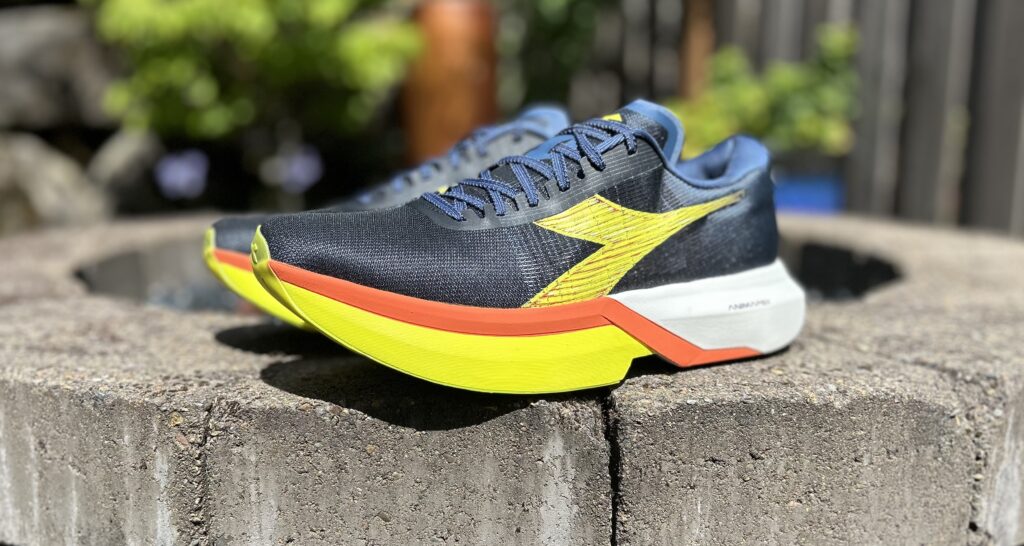
It’s into that market that Diadora has released the third generation version of its racing shoe — the Gara Carbon 3. It’s an awfully compelling package for a carbon-racer, with all of the ingredients there to make a fast, fun shoe. And it gets almost all of the ingredients right to make it almost perfect for triathlon racing.
Almost.
The Tech Stuff
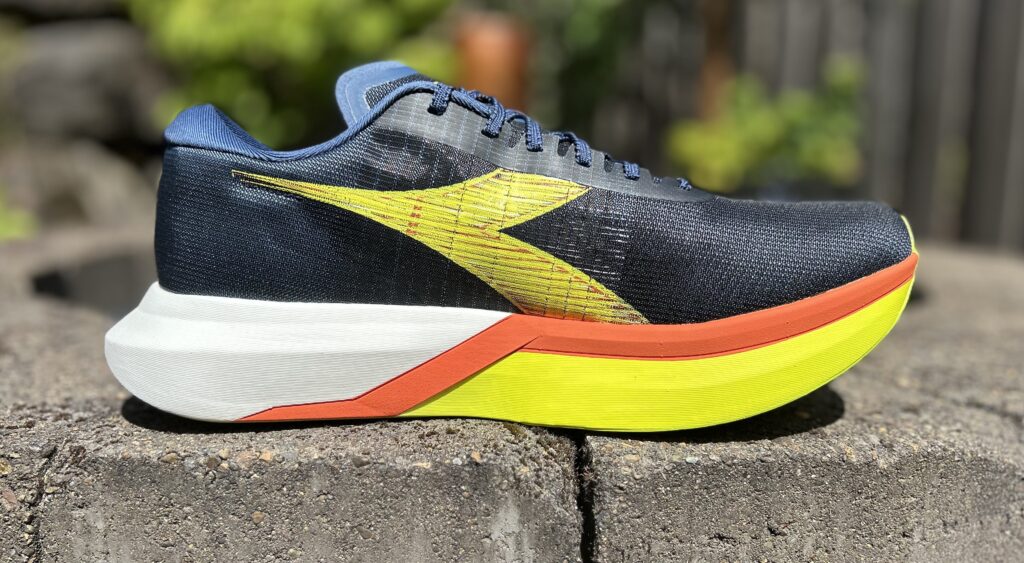
By now, you should probably have it down pat as to what key ingredients are necessary for advanced footwear technology. You need a carbon-fiber plate. You need a lightweight and responsive foam. And you need to sit under the 40 millimeter maximum stack height permitted by World Athletics, because what on earth is the point of having one of these shoes if it’s then technically not legal to race in?
The carbon part of the Gara Carbon 3’s name comes from its LEVA Carbon plate. It runs the full length of the shoe, though it’s difficult to see that anywhere on the shoe minus in the mid foot cut-out on the outsole. The biggest change that Diadora made in this generation of shoe comes in that carbon plate. Instead of being flat throughout its geometry, the new version has curvature directly underneath the metatarsophalangeal (MTP) joints in the foot. That’s where the long metatarsal bones meet up with your toes, essentially acting like the knuckles. Putting curvature here means that the shoe should be easier to flex and get to toe-off.
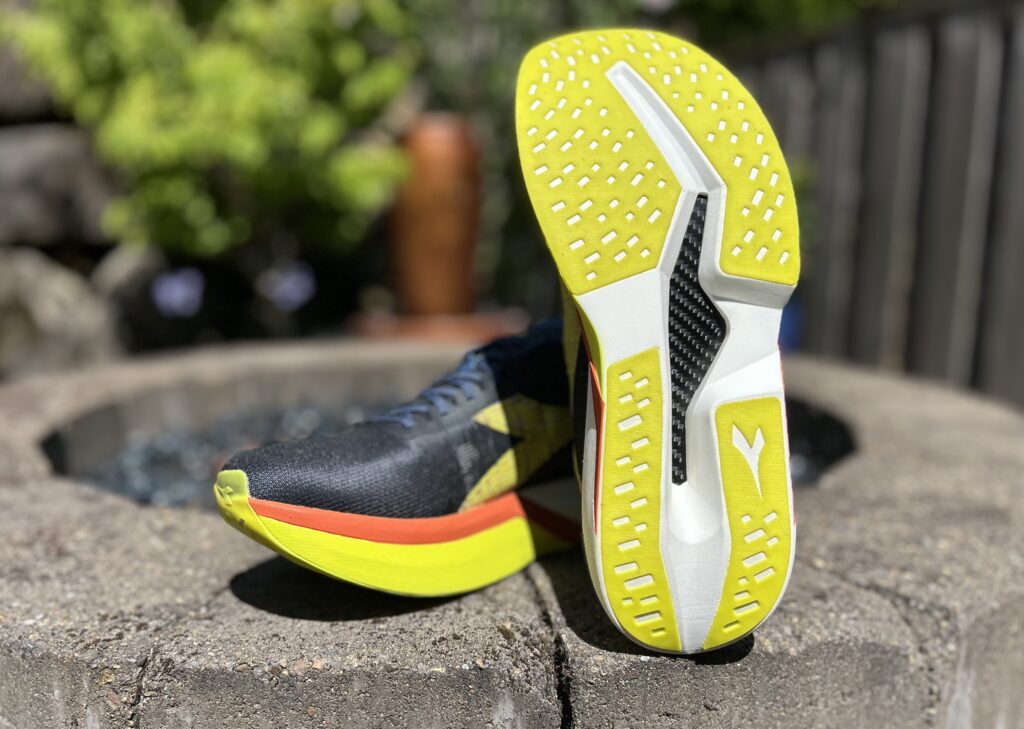
The theoretical drawback is that you wouldn’t get as much pop from the plate. To counteract that, Diadora also revised the midsole foam for the Gara Carbon 3. The ANIMA PBX midsole is Diadora’s take on supercritical foam, and it has gotten lighter over the prior generation, allegedly 40% lighter than before. According to Diadora, it’s also been engineered to provide 55% more energy return than before.
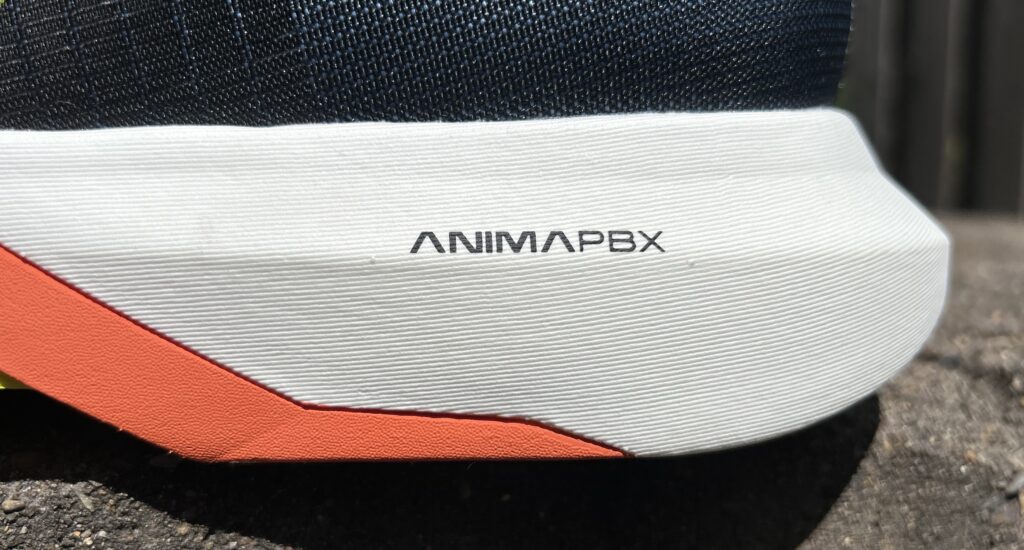
Some other changes come with the outsole. Diadora eschews traditional construction here. There’s not rubber, but instead TPU stamped into a tread pattern. It basically paints the perimeter of the sole, leaving a little exposed midsole in the center. There’s also a sizable gap in the midsole to the midfoot, which both saves some weight and also gives the shoe some room to deform laterally when running, theoretically improving cushioning.
Believe it or not, there’s also carbon in the upper. Diadora calls the upper on the Gara Carbon Matrix. It’s engineered to have zones of structured support in the midfoot, which is where it uses those carbon strands. Then there’s lightweight, relatively open mesh in other places, like the forefoot. It’s much more open and thinner to the touch than the prior iteration.
All of these changes add up, as a men’s size 10 weighs 7.2 ounces / 205 grams, a full ounce lighter than the prior generation of the shoe. My size 13’s appear to track to that, and feel much lighter than the Carbon 2.
Running in the Gara Carbon 3
The short version: there’s an awful lot to like here.
Let’s get one of the negatives out of the way: this is not a shoe that immediately feels like it should retail for $320 USD. The upper materials remind me a little bit of the original generation Nike Flyknit releases; they aren’t smooth. I don’t really foresee this shoe being worn sockless, if only because those carbon strands in the upper will probably rub your foot.
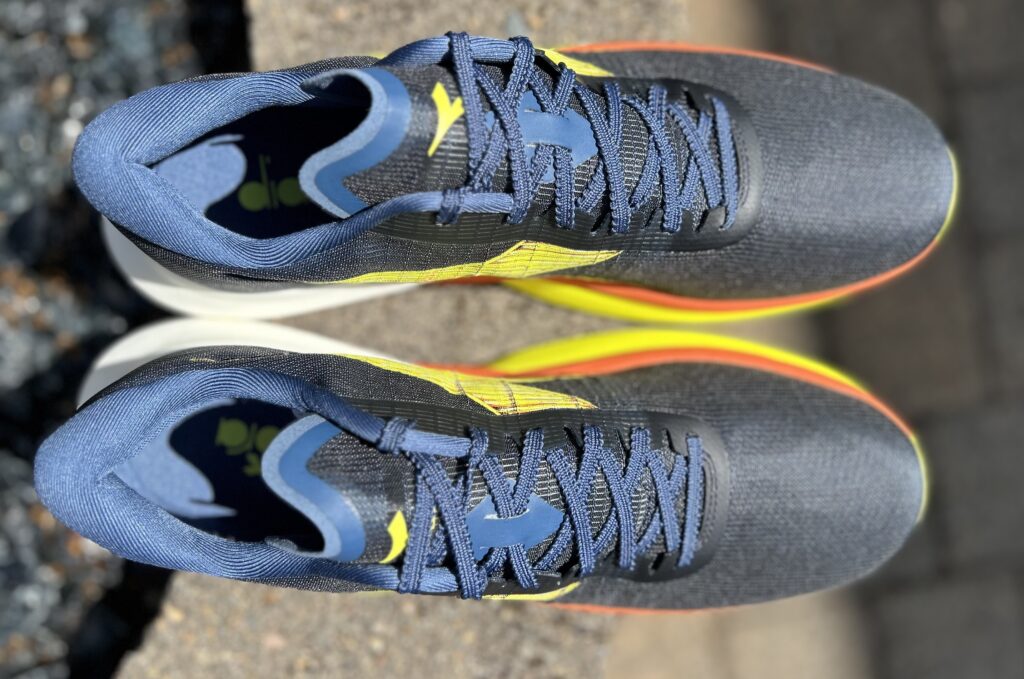
But, assuming that you’ve put a great pair of socks on, you’re treated to a pretty plush cushioning experience. You can feel that large cavity under the foot giving the shoe plenty of room to deform and then rebound. It’s a shoe that pretty adequately locks you into place once laced up. And it does feel quick.
That translates pretty quickly into the running experience. Unlike some other models in the marketplace, the Gara Carbon 3 is the odd racing shoe that is comfortable at any pace. It’s not like, say, a HOKA Cielo X1 that you have to be pushing the pace on for it to make sense. The Gara Carbon 3 is plenty happy just eating some miles up as it is when you ask it for more.
And, oh, what a good shoe when you start trying to activate that carbon plate with some speed. It is simultaneously smooth in transition and powerful. It’s bouncy without feeling like you’re trying to run on a trampoline. It’s a shoe that just wants you to please, keep moving forward, and stay right on this pace. That new geometry on the carbon fiber plate means that a shoe that was already good at running uphill is now even better at it, and it encourages a speedy turnover without resorting to some other strange geometric gimmicks to get the job done.
This shoe is also shockingly stable. It’s not a particularly wide platform underfoot; in fact, it probably skews a little on the narrow side overall. But because of how much midsole deformation that you get due to that cavernous carveout, it stays very well planted. It’s also a 5 millimeter offset shoe, so not a particularly aggressive ramp. Factored together, and it winds up being a shoe that feels lower slung than it actually is, all with plenty of cushioning for the miles you’ll tackle together.
Given that it’s so good at holding a variety of paces comfortably, and that it holds up well across whatever terrain you can throw at it, I think that makes it a pretty compelling IRONMAN racing shoe, barring one key issue: the traction stinks in the wet. It is far less grippy than the prior iteration of this shoe. When it’s wet, this gets squirrelly. So depending on the weather or just how many crushed wax cups are underfoot, I might be leaning in a slightly different direction.
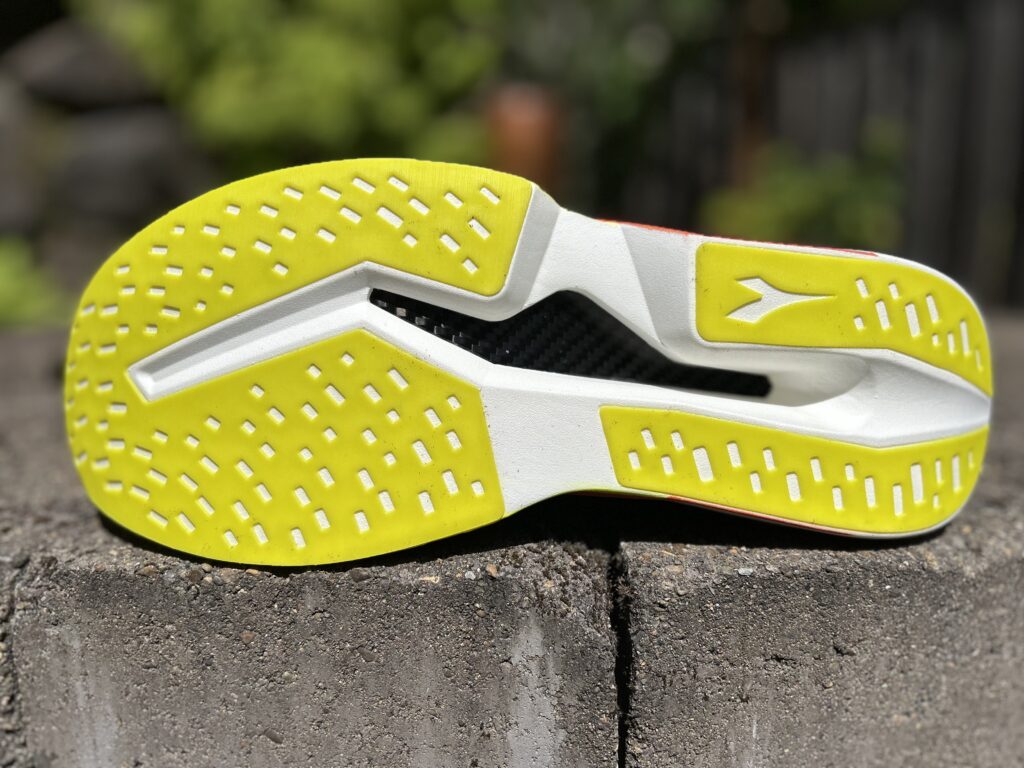
For example: I’ll probably use this shoe in October in California, as the turns there will likely be slow, and it’s also likely to be quite dry. But I wouldn’t, say, do this for a 70.3 run with a lot of curves in it, or if it looked like it was going to be wet that day. It’s a big drawback for a shoe that otherwise handles so much of what IRONMAN and 70.3 racing asks out of us.
And at $320, that’s a hard bargain to drive. Not when you have the Saucony Endorphin Pro at $240, or the HOKA Rocket X3 at $250. But those shoes come with their own compromises, too; the Endorphin Pro is higher offset and not as well cushioned, whereas the Rocket X3 is not as compliant in the forefoot. I just don’t know if it’s worth the $70-$80 premium for the Gara Carbon 3, unless you know the exact conditions your run will be in.
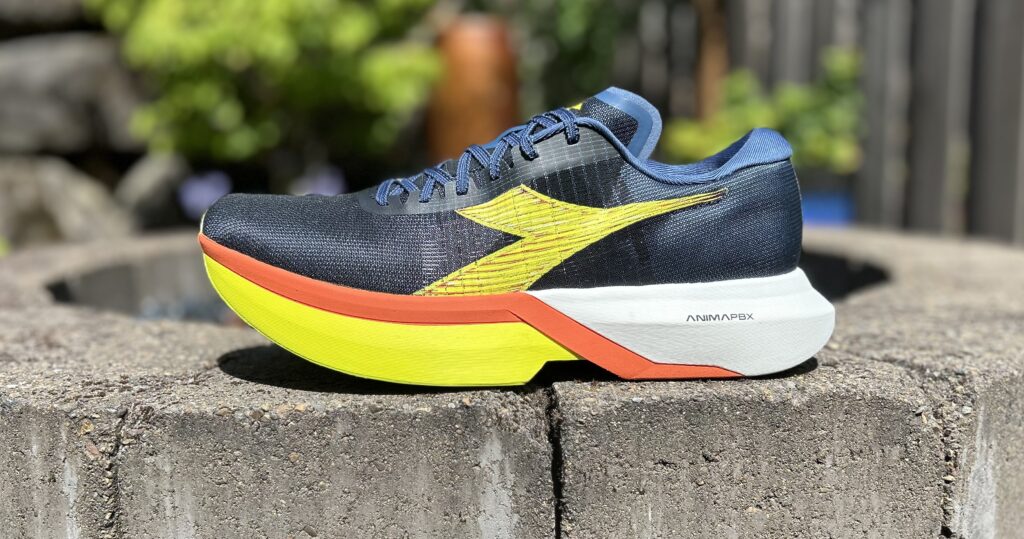
Diadora Gara Carbon 3
Price: $320 USD
Availability: Now
Unisex Sizing – Shop Here