If the past month of running performances across IRONMAN events and World Marathon Majors has proven anything, it is that there is no denying the performance benefit of carbon-plated running shoes. At IRONMAN Texas, we saw Kristian Blummenfelt nearly break the 2:30 barrier in the marathon, with four other men joining him under the 2:35 mark. John Korir obliterated the course record at the Boston Marathon, running 2:01:52; the other podium finishers (Felix Simbu and Benson Kipruto) also would have broken the prior course record of 2:03:02.
And then, of course, there was this past weekend in London, where Sabastian Sawe and Yomif Kejelcha smashed through the two hour window for the marathon. Sawe set the new world record, running an astonishing 1:59:30; Kejelcha followed a mere eleven seconds later. They did it wearing the $500 Adidas Adizero Adios Pro Evo 3 – the latest and greatest version of the three-stripe brand’s super shoe.
It has been an arms race with shoes for the past decade. Nearly every brand has some staple racing shoe that follows along the formula that Nike innovated with the Vaporfly: light but rebounding foam; carbon-plate; upper that holds you to it as best as it can. And by every brand, I quite literally mean it; new brands are sometimes starting with their racing shoe and then moving to the everyday footwear. I’m in the process of testing a couple of pairs from Mount to Coast, where innovation started in their racing platforms before moving to their training shoes.
But is that innovation coming at a price? According to a lawsuit filed by two-time world champion and four-time NCAA champion Abby Steiner, the answer is yes — that price can be catastrophic injury.
https://www.instagram.com/p/CqV4S6tLidV/?utm_source=ig_web_copy_link&igsh=MzRlODBiNWFlZA==
Steiner, who won gold at the 2022 World Athletics Championships as part of the 4 x 100 and 4 x 400 relay teams, filed suit against Puma and its subsidiaries on Friday, April 24th, in Massachusetts Superior Court. The suit alleges that Steiner was “seriously injured by products designed, engineered, tested, developed, manufactured, advertised, marketed, promoted, imported, sold and distributed” by Puma. Specifically, the suit calls out “running shoes that had carbon fiber plate…and/or NITROFOAM…technology.” The suit gives examples as the Deviate Nitro Elite 2 and 3, the evoSpeed Tokyo Nitro, and the evoSpeed Tokyo Nitro 400M.
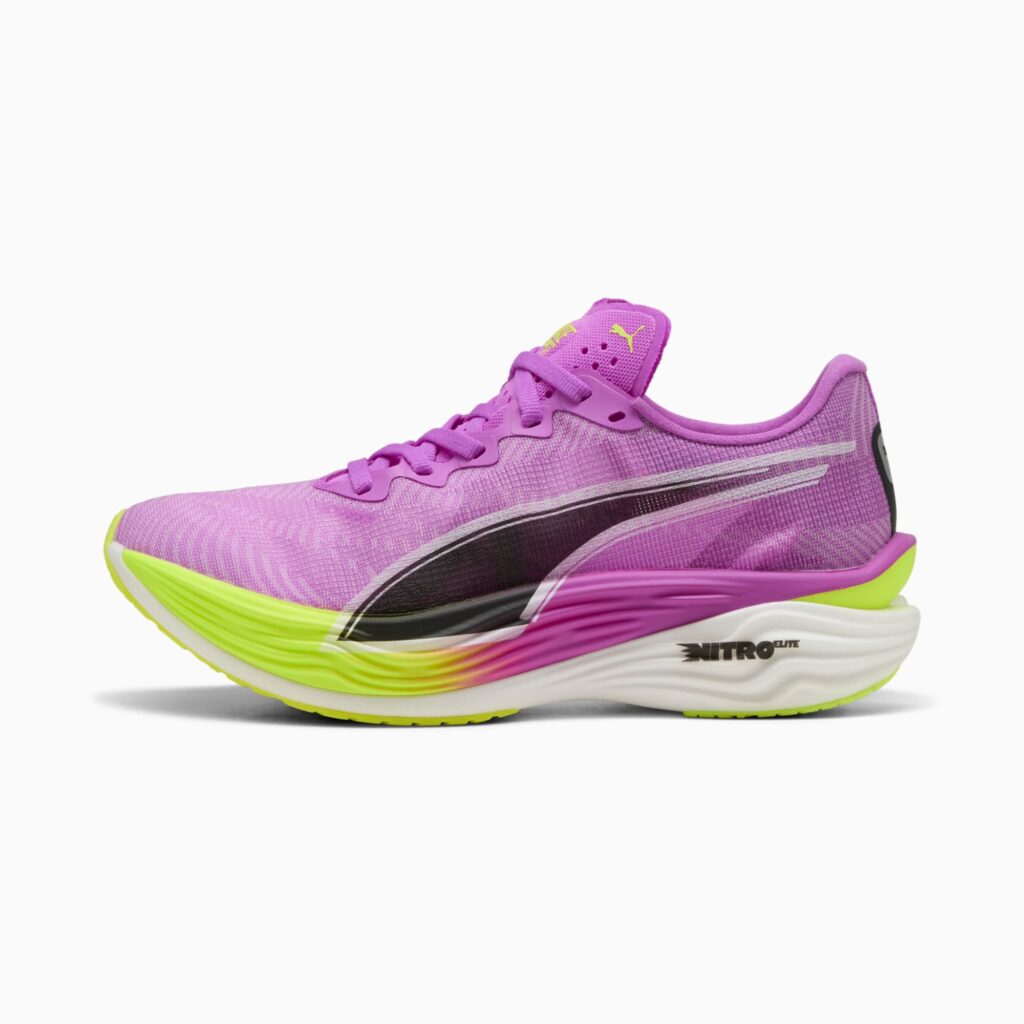 Puma's Deviate NITRO Elite 3, one of the shoes in question as part of Steiner's lawsuit. Image: Puma
The suit alleges that Puma was “aware that the…shoes had defects that made them unsafe, unreasonably dangerous, defective and capable of causing injury and harm to consumers during ordinary, anticipated and foreseeable uses” and that they were under obligation to report these defects to the U.S. Consumer Products Safety Commission.
Steiner signed with Puma following her breakout 2022 campaign, where she earned the double gold in relays at the world championships. She’d also taken two golds at the NCAA Championships that year, and added another win in the 200 meters at the USA Outdoor Track and Field Championships. The deal was reported to be valued at the time in the vicinity of $2 million.
Shortly thereafter the signing with Puma, Steiner suffered her first foot injury and surgery. She attempted a return for the 2024 Olympic Trials, where she would finish sixth. Shortly thereafter, though, she would undergo additional surgeries for bone a torn Achilles, a Haglund’s deformity, and other injuries. The suit alleges that “her use of the Puma Shoes for training and in competition” resulted in “severe and permanent injuries resulting in multiple surgeries, rehabilitations, and recovery.”
The suit cites eleven different factors that make Puma’s shoes defective. They are:
- They alter the biomechanics of runners predisposing them to risk, injury and harm;
- They alter the manner in which the stresses of running impacts the human body;
- They cause bone stress injuries;
- They increase the risk of suffering injury, harm and damage;
- They cause extreme, abnormal and irregular stresses and strain on the body and feet of runners;
- They change a person’s foot and ankle mechanics resulting in an increased risk of injury, harm and damage;
- They cause extreme strain and stresses on the feet, bones and connective tissue in the feet;
- They cause fractures, stress fractures, inflammation, the development of bone spurs, Haglund’s and other injuries;
- Any alleged benefits of their design are outweighed by the risks and dangers associated with the design;
- Safer alternative designs existed that do not present the same risks associated with the Puma shoes; and
- The likelihood that runners were aware of the risks associated with the…design is low given they were designed, developed, marketed, promoted, advertised and sold to be appropriate for running and had no warning or indication these risks existed…
Steiner is the largest name to have sued a shoe company over their carbon-plated footwear. Former Division I athlete Heather Cerney sued Nike in November, alleging injury over her use of that brand’s AlphaFly shoe. That case was referred to private alternative dispute resolution in February of this year, with a trial date set for May 10th, 2027 if a resolution is not otherwise reached.