Do you happen to know the degree bend on the standard aluminum Zipp Vuka Ski-Tip bars?
I don’t care if high hands were slower… I’d do it for the comfort.
But yes, you make a great point, we are not constrained by UCI rules.
Most people think that the important thing about the UCI fact is that the bikes are limited but really the key point is that the body position is limited.
Aye, the biggest of which is saddle setback. Moving my bike from the fast-and-comfy tri position to a UCI-legal one means a shorter stem, moving the saddle back some 5cm and shortening the reach on top of that. Which is both slower and less comfortable.
The UCI have relaxed the regs a bit on arm position, you’re allowed 10cm of difference between top of the arms and the bottom - not full-Mantis, but enough tilt to make it decently comfortable.
I don’t really see any advantage in carbon for extensions.
Carbon isn’t automatically a better material for all applications. Also, as others said, it’s certainly not safe to assume carbon products have a non-directional lay-up or cross section. If it did that’s even more reason not to bother with them. It gives up much of the benefits of carbon composites.
Anyway. I currently use these Specialized extensions in the conventional configuration, bend furthest from the pads. I might try reversing them and think they would work well. However it will mean re-cabling the shifters and stripping the tape which I don’t fancy for a quick trial that I may not adopt. I’m so lazy.
I don’t really see any advantage in carbon for extensions.
Shaping? Zipps newer EVO have a bit of shaping to them and others have done similar in the past. Depending on how you grip your extensions this could matter or it might not.

+1 to tilting for comfort. It seems to make me more slippery as well.
At the risk of picking nit, though, none of the above look like a true Praying Mantis position – more like 12-15* tops. That’s about what I do too.
Not close to full Mantis but have played around with it and feel less pressure in my neck when doing so. Feel less comfortable in bike handling skills though the higher the pitch. Im probably angled a little less than half of full mantis and this gives the best comfort on both issues for me.
.

There was a discussion on here about a year or so ago with some basic data from ERO. I still have the ERO link: http://ero-sports.com/index.php/aeropositioning/78-are-you-angling-for-more-comfort-speed
I’d love to hear ideas how everyone is angling the pads as well. Washers under the front?
I’d love to hear ideas how everyone is angling the pads as well. Washers under the front?

Now Landis demonstrates the real Praying Mantis position. Most of the shots here are just slightly upturned arm positions and definitely not the same thing. I experimented with this steep angle quite a few years ago and really disliked how it affected handling and didn’t pursue it further. That was before I had a power meter and had done any field testing so can’t say for sure if it was faster although subjectively I didn’t notice any obvious improvement.
By the way, over the years prior to doing any field or tunnel testing just by trial and error I managed to evolve a position that was faster than the vast majority of triathletes, but that’s not saying much! I now use VE field testing and it’s helped refine what was already a pretty good position. I ride with a modestly upturned arm position, which I find comfortable, my field testing suggested a very slight aero improvement over level arms, but barely more than the margin of testing error.
I’d suggest that if you’re going to experiment with a real praying mantis position you should be prepared to invest significant time in adaptation to this position.
Why would anyone experiment with the “real” praying landis position?
Now Landis demonstrates the real Praying Mantis position. Most of the shots here are just slightly upturned arm positions and definitely not the same thing. I experimented with this steep angle quite a few years ago and really disliked how it affected handling and didn’t pursue it further. That was before I had a power meter and had done any field testing so can’t say for sure if it was faster although subjectively I didn’t notice any obvious improvement.
By the way, over the years prior to doing any field or tunnel testing just by trial and error I managed to evolve a position that was faster than the vast majority of triathletes, but that’s not saying much! I now use VE field testing and it’s helped refine what was already a pretty good position. I ride with a modestly upturned arm position, which I find comfortable, my field testing suggested a very slight aero improvement over level arms, but barely more than the margin of testing error.
I’d suggest that if you’re going to experiment with a real praying mantis position you should be prepared to invest significant time in adaptation to this position.
My mate measured the angle I needed, then printed these out for me 

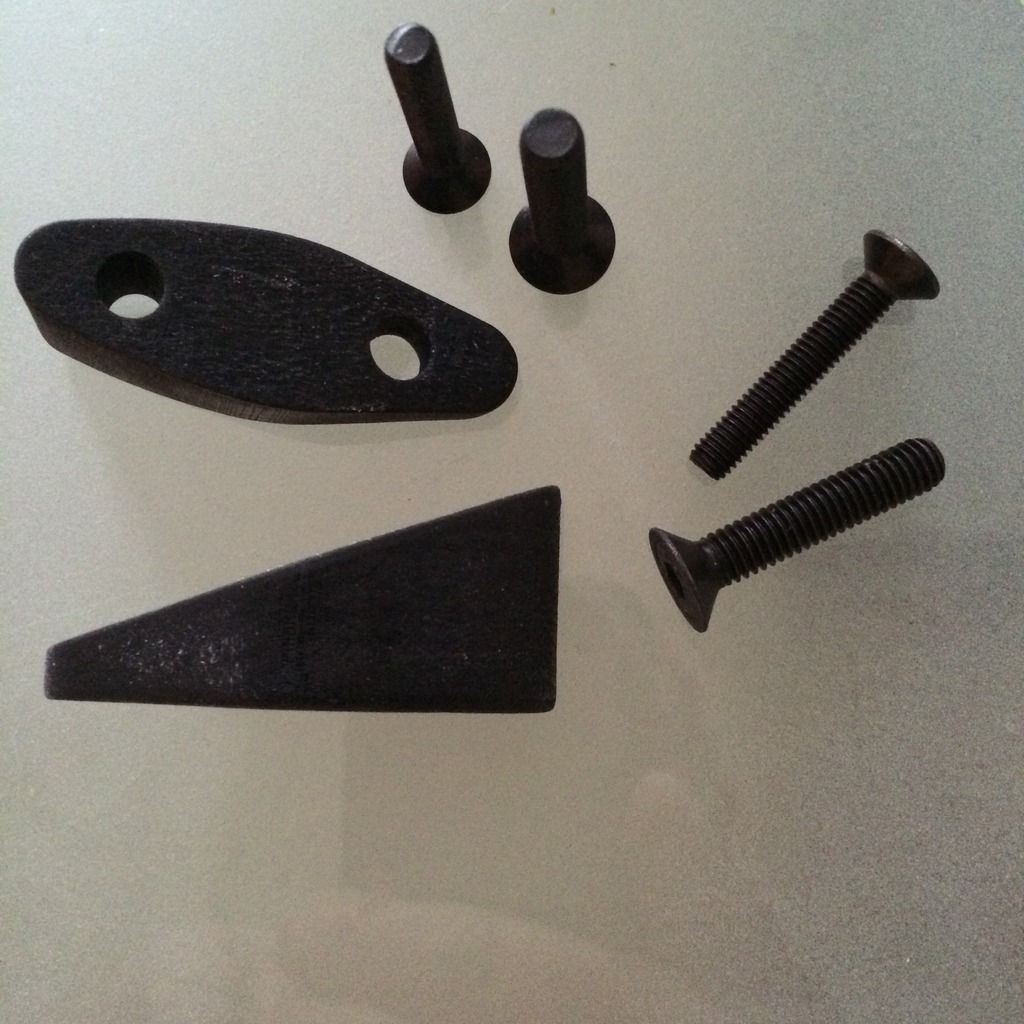
.
Bring a batch next time you’re on holiday in the states. Will trade for cash money.
Just for fun I’m trying this next. Got the alloy Zipp Ski bends in today.
I use firm rubber washers instead. They deform and give a more uniform contact surface. I was using metal but became concerned that there was too much pressure being put on a small contact area. A multi size pack of washers on amazon is a few bucks and let’s you play with different angles.
I use firm rubber washers instead. They deform and give a more uniform contact surface. I was using metal but became concerned that there was too much pressure being put on a small contact area. A multi size pack of washers on amazon is a few bucks and let’s you play with different angles.
Got a link to the pack you bought?
Firm rubber, worked great making a “gasket” for adding pedal straps to my shimano pedals. Lots of sizes and cheap.
Harbor Freight
I experimented with this steep angle quite a few years ago and really disliked how it affected handling and didn’t pursue it further.
that’s my experience too. Mostly it was ok, but then in extremely windy conditions (or very fast descents) I felt much more exposed than with a regular s-bend.
Lucky for me, it also tested slower in the wind tunnel