The Neo vs KICKR debate almost always comes down to people saying I’m not paying $200-$300 more for the Neo. The issue, at least with the vast majority of my discussions, is that people don’t really pay attention to why it costs 20% more and what are the long and short term benefits.
Example above. Dude makes reference to Neo’s flywheel having no clue it doesn’t use a flywheel. Tried to convince a friend last week to go with the Neo and to them is was only $1400 vs $1100. I know calibrations, warm ups, spin downs, and future maintenance and belt replacements are going to cause this person more than $300 worth of stress and agita.
GMANT I had 2 kickrs (bought firs years back when NEO didn’t even existed) and few months ago bought NEO (I love Made in Netherlands sticker and I like precision of it)
Do you have one? Because you sound like the one without clue about NEO ( Zero moving parts?) Are you sure there are no moving parts in NEO? What is that big heavy metal round plate with magnets on the inside, I call it flywheel, it is installed on some kind of bearing, that bearing depending on type, might or might not like wobble of the rocker.
The only part I do not like about NEO is that little $hitty fan installed for no reason inside, my will get clogged with dust for sure, having said that NEO is way above Kickr.
Cool, did you cut the plywood yourself or take it to a CNC shop?
I was having some saddle sore issues from zwifting so much. I built a Rockr Plate about 2 weeks ago. And haven’t had any problems since.
I ordered the DYI kit from SBR and found the board design on the Rockr Plate Facebook site. Actually created a template of the boards with holes pre-drilled and then transfered the template to the final boards so as not to make a mistake. 3/4 in. birch boards. Will probably coat the top with Truck bed liner paint or just some carpet/rubber matting.
The benefit of the DYI kit was all the HW was included, including the mounts for my Kickr. You could get it yourself and maybe save $50. I spent about $200 all in.
I thought I might lose some power on it, but that hasn’t been the case at all. It is a little bit louder than before, but the carpet or coating should solve that part of it.
I also want to know this. I’m thinking of getting the DIY kit, but I don’t have the tools to do the boards.
I’m always wondering if movement like that would have negative effect on longevity of Kick or Neo flywheel bearings, as well if it affect accuracy, after all flywheel will move like giant gyro.
Neo does not have a flywheel
It does have heavy round metal plate with magnets attached to it I call it flywheel. Once you start rocking that plate left and right it might or it might not affect the bearing. I guess u r not an engineer…
Cool, did you cut the plywood yourself or take it to a CNC shop?
I was having some saddle sore issues from zwifting so much. I built a Rockr Plate about 2 weeks ago. And haven’t had any problems since.
I ordered the DYI kit from SBR and found the board design on the Rockr Plate Facebook site. Actually created a template of the boards with holes pre-drilled and then transfered the template to the final boards so as not to make a mistake. 3/4 in. birch boards. Will probably coat the top with Truck bed liner paint or just some carpet/rubber matting.
The benefit of the DYI kit was all the HW was included, including the mounts for my Kickr. You could get it yourself and maybe save $50. I spent about $200 all in.
I thought I might lose some power on it, but that hasn’t been the case at all. It is a little bit louder than before, but the carpet or coating should solve that part of it.
I also want to know this. I’m thinking of getting the DIY kit, but I don’t have the tools to do the boards.
You can probably rent the needed tools for $30-40 from someplace like Home Depot. You should be able to get by with a drill and a circular saw.
The no moving parts wasn’t to be taken 100% literal. Yes, it has a an electronic brake/motor that spins around with your pedal stroke. My point was that it has no physical transmission mechanism (like a belt or chain) to drive the trainer. So no hard or fast moving part to make it all work.
There’s zero maintenance, zero calibration, zero moving parts, zero parts that wear, zero warming up, nothing.
There is maintenance, parts that move, and long term wear on the Neo trainer. It’s a hell of a lot longer between servicing than other trainers due to design, but it’s not a solid state device. It also technically has a flywheel… The disc/plate used with the magnets glued on the inside has some solid weight to it.
Cool, did you cut the plywood yourself or take it to a CNC shop?
I was having some saddle sore issues from zwifting so much. I built a Rockr Plate about 2 weeks ago. And haven’t had any problems since.
I ordered the DYI kit from SBR and found the board design on the Rockr Plate Facebook site. Actually created a template of the boards with holes pre-drilled and then transfered the template to the final boards so as not to make a mistake. 3/4 in. birch boards. Will probably coat the top with Truck bed liner paint or just some carpet/rubber matting.
The benefit of the DYI kit was all the HW was included, including the mounts for my Kickr. You could get it yourself and maybe save $50. I spent about $200 all in.
I thought I might lose some power on it, but that hasn’t been the case at all. It is a little bit louder than before, but the carpet or coating should solve that part of it.
I also want to know this. I’m thinking of getting the DIY kit, but I don’t have the tools to do the boards.
I cut the wood myself. Created a template of thin wood first, Drilled all holes and assembled to confirm everything was right. Then used the template on top of final wood to draw the shape. Then used jigsaw to cut. Sanded the edges and then put the thing together.
Same for me… 2 pieces of 2x x 4’ birch from Lowes… drew a template around the kickr and used a jigsaw to cut it out. Routered the edges (not necessary) and sanded it. Ordered the pillow block bearings and shaft from Zoro.com. Got a couple of small yoga balls from amazon. Maybe cost $100.
Nice! …is that drawn in Working Model?
No idea. Shamelessly stolen from the internet (Wikipedia)
Another option for a high front pivot would be to mount the front forks to a pendulum hanging from a pivot suspended directly above it. (imagine hanging your front wheel from a hook supporting the rim.)
Or maybe pivot at the midpoint of the front axle.
Would have to investigate to see how this feels.
I came to see if anyone had previously described my rocker plate mods, and when reading the thread wondered if what was desired was an overhead swing system where the plate the bike / trainer sits on is suspended off the floor.
Anyway, re moving the front wheel independent of the back, my idea is to use the bearing system of a lazy susan, so on standing efforts I can work on keeping the front wheel straight vs my trainers’ block firmly holding it in one orientation. I’ve got the device but confess I haven’t tried it yet
I came to see if anyone had previously described my rocker plate mods, and when reading the thread wondered if what was desired was an overhead swing system where the plate the bike / trainer sits on is suspended off the floor.
Imagine mounting your trainer on this:
It shouldn’t fall over because the pivot is above the centre of gravity, but I’m not sure it wouldn’t feel really weird.
Anyway, re moving the front wheel independent of the back, my idea is to use the bearing system of a lazy susan, so on standing efforts I can work on keeping the front wheel straight vs my trainers’ block firmly holding it in one orientation. I’ve got the device but confess I haven’t tried it yet
That might do something (interested to hear your results), but I’m not sure what that something would be, unless there is a feedback system between the steering angle and the leaning process.
I’ve come to the current conclusion that the most realistic thing to do (I mentioned on page 1) would be to support the front wheel on a motorised roller. And the back end (trainer) on a single balljoint at about ground level. That way leaning and steering should be reasonably natural. With careful setup it may be possible to make it reasonably stable/self-centering/less likely to fall off than a set of rollers). But I’m working in theory only. Getting me on a trainer is hard enough as it is…
I just finished one myself based on a couple of designs I saw on the Facebook Rocker Plate Forum.
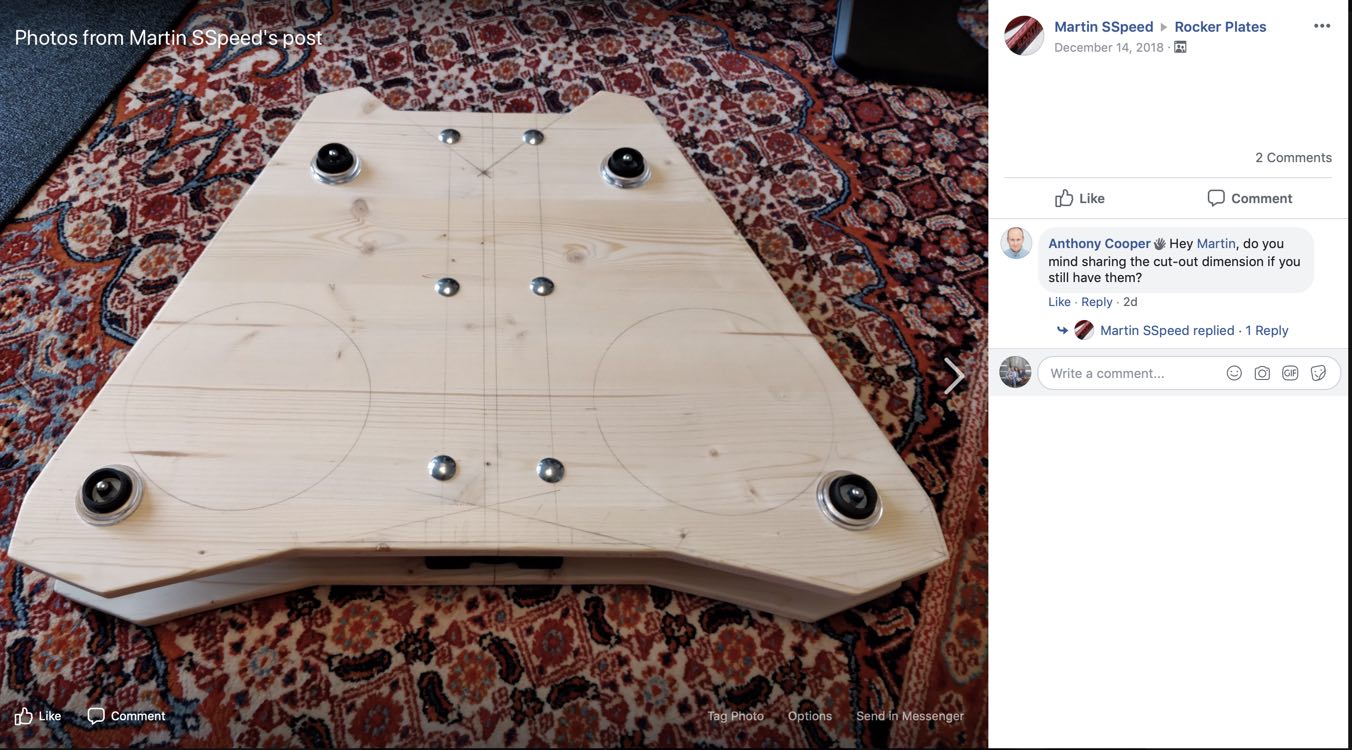
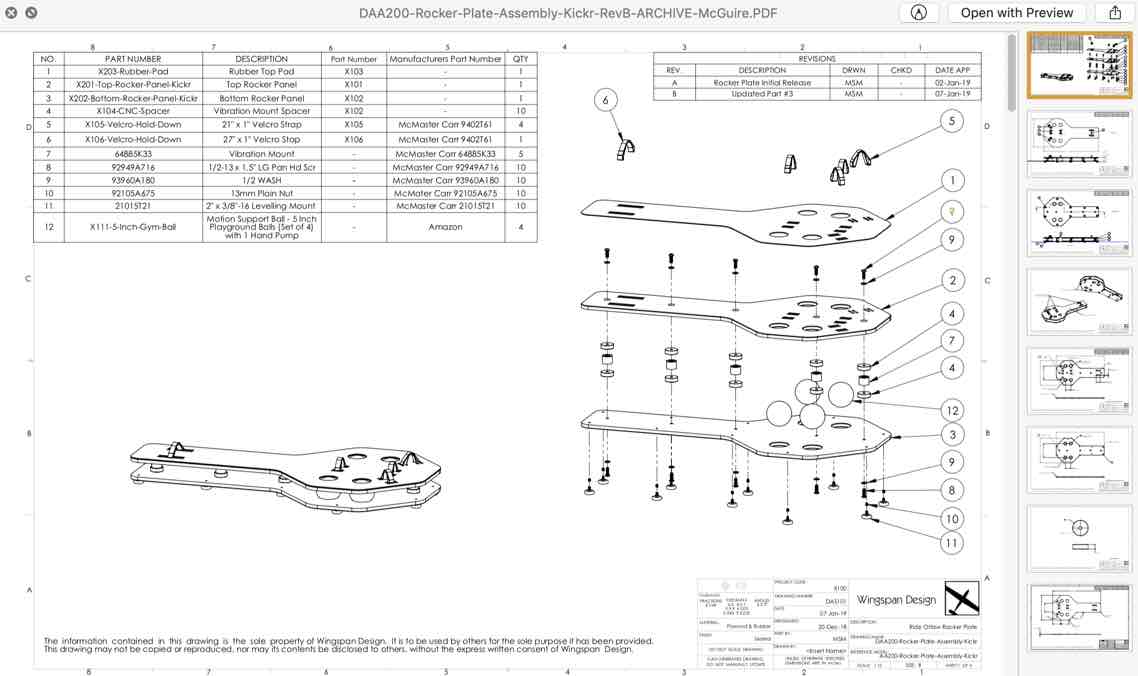
Just to give credit where it is due, here’s a link to the forum, and I’m not posting pictures of mine, but rather the ideas that I took from ‘Martin SSpeed’ and ‘McGwire’ Forum users. Here’s their two inspirations:
Martin SSpeed used pillow bearings, inflatables on either side to balance and fixed cups to hold the trainer in, and the unit is only built to the size of the trainer.
I liked that it’s not a full size unit (less parts = less cost). It can be constructed from two 2’x4’ pieces of plywood.
-The idea of Pillow bearings is cool, but man that get’s expensive fast! It costs around $10-$12 a pillow bearing (from princessauto.com) of which you need four of them. Next, you need a rod to run through the pillow bearing and that costs about $30 for an 8 foot pole. And let’s not forget nuts bolts and washers and that all seem to cost about $1 each at home depot.
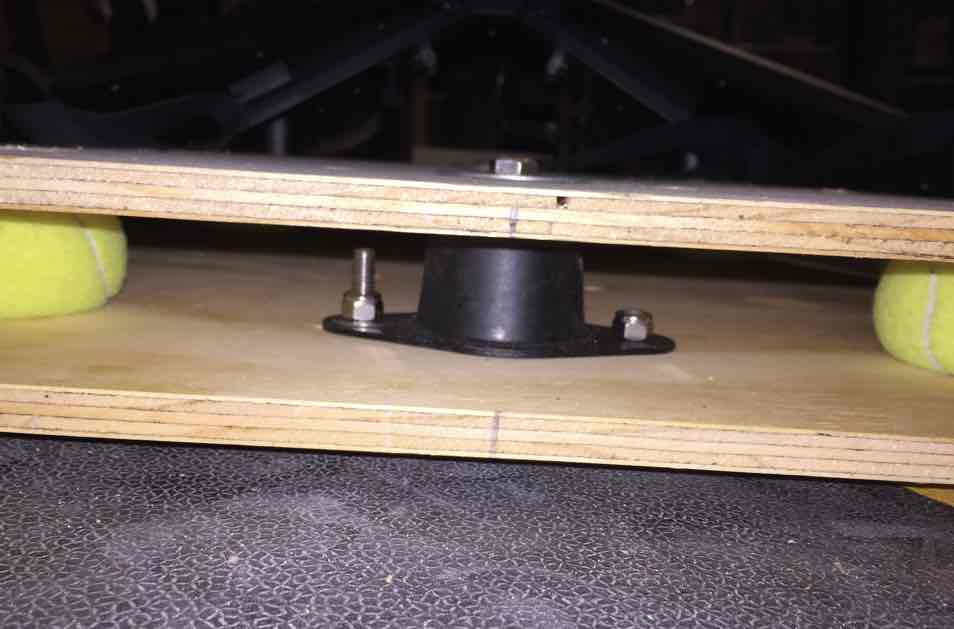
The McGwire board was different in that it didn’t rely upon pillow bearings, but rather vibration dampeners. A two pack costs $20 and it’s all you need to support you and the trainer (it has a load capacity of 2220lbs).
So, I decided to make a hybrid of the two. Smaller unit that uses vibration dampeners. Instead of inflatable balls on either side, I stuck with beginner tennis balls (orange dot and green dot) with different levels of squishiness that I stole from my kid (he’s in a tennis academy).
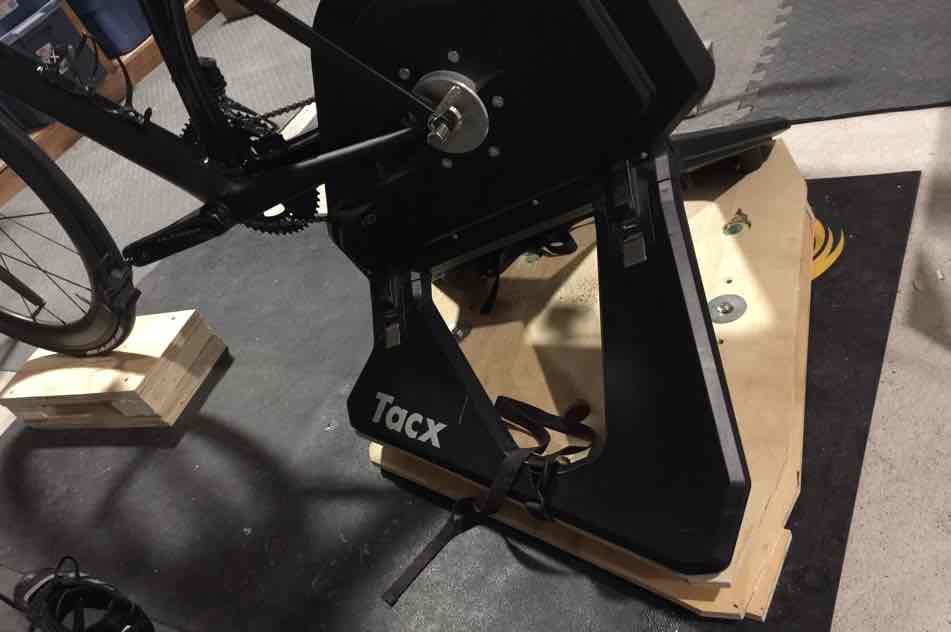
This is my version 1.0. with 1/2" plywood. I’ll likely make another version out of 3/4" plywood and make the cuts/holes nicer. The movement seems pretty good, but the improvement in comfort hasn’t quite been as dramatic as some have reported. I’ll likely do more research on what others are doing differently.
My first guess is the vibration dampeners work “too well”. But obviously I don’t know. Finally decided I want to build something like this so I’ll be keeping an eye out for these threads and the FB group.
Thanks for sharing.
While I can’t exclude that the vibration dampeners are worse than the pillow bearing approach, I get a lot of side to side movement/flex with the dampeners (so I don’t think it’s the difference between pillow bearings vs. dampeners).
Even with the dampeners, I still have to use some kind ball/cushion on the side to help stabilize the rocker. I’ve been using tennis balls (three per side), and I suppose I could mess around with how many I use to see if I can’t get a better ‘feel’ with fewer balls on either side
Maybe this is not an issue for much of the readership here, but I’ll share this. Love the minimalist idea of a plate that is only as big as needed for the trainer. However, as a person of shorter stature, I think I’d have a challenging time getting on / off my bike without the full length board under it. The trainer already puts it a couple inches higher. The trainer plus rocker would add, what, 6 inches to the hight needed to clear the saddle?
So just to add to the conversation and with the caveat that today is the very first day of my research.
I’ve noticed there’s a huge difference in the dampening capabilities of the dampener. From say 10lbs to hundreds of lbs. I’ve seen several builds with dampeners from different sources so I’m hoping to understand more how much force different people’s completed builds dampen. I know there’s more than one measurement. I think one is static and one is shear force.
Anyways I understand that’s not your issue but this may help anybody as uninitiated as me.
Full length boards are cool, but I’m not sure a full length board would be much help for a shorter person. I’ve always just clipped in with my left foot and swung my right foot over. No need to straddle the bike before clipping in.
I think I’d rather keep the rocker itself minimal. Less rocker inertia definitely seems preferable to me. Plus I’d prefer less bulk. I also think a stationary platform is going to be a better for mounting. Why not just make up a little step? A standalone step is simple, all you would need but you could attach it to the rocker base if you wanted to ensure it doesn’t move. Surely that’s a better solution than a big, heavy, unnecessary platform?