Originally published at: A Year in Triathlon: The Biggest Wins of 2025 - Slowtwitch News
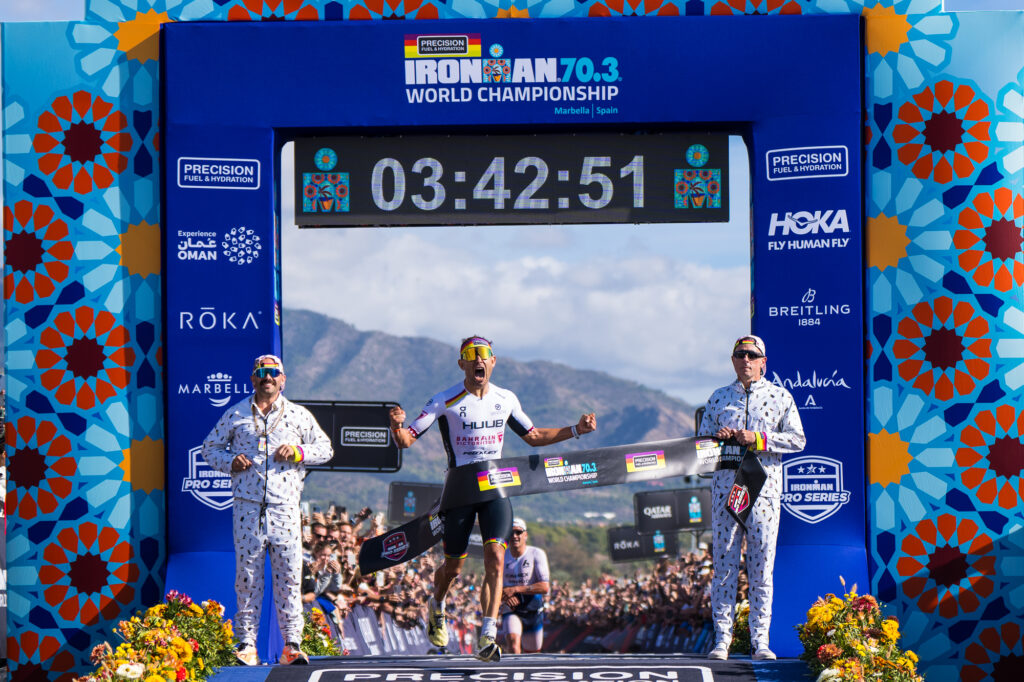
Jelle Geens wins the IRONMAN 70.3 World Championship in Marbella, Spain. Photo: Kevin Mackinnon
The 2025 triathlon season saw a lot of big wins from multiple athletes. There were world champions crowned in dramatic fashion, mid-season battles and dominant performances around the globe. With races straight through from January to December, there are too many big wins to list, so we’ve narrowed it down to just a few.
Matthews and Blummenfelt Crush Texas
Great Britain’s Kat Matthews and Norway’s Kristian Blummenfelt won the 2025 IRONMAN North American Championship in Texas in April, both setting new world-best results for IRONMAN-branded events. Matthews won the race by 10 minutes, crossing the line in an amazing time of 8:10:34. She climbed out of the water in sixth in 56:24, but she faced a deficit of nearly six minutes to early leader Taylor Knibb.
Knibb went on to ride a 4:19:46 split — the fastest ever recorded by a woman in an IRONMAN race. While this is mind-boggling, what was more impressive was Matthews’s ride-run combo, as she was only 22 seconds slower than Knibb on the bike (she rode 4:20:08) but proceeded to throw down a blazing 2:49:19 marathon to blow by the American on the run course and take the win and IRONMAN best.

Blummenfelt wins IRONMAN Texas. Photo: Eric Wynn
Blummenfelt had an equally impressive performance, but he didn’t face as much stress on the race course as Matthews did. The Norwegian got out of the water with the leaders after a 48:34 swim and quickly moved to the front of the race, after which point he never looked back. He rode 3:57:14 and followed it up with an unbelievable 2:34:03 to cross the line in 7:24:20. This is arguably the fastest time in IRONMAN history, Blummenfelt has gone faster (7:21:11 in Cozumel in 2021), but the down-current swim means that many don’t recognize it as the fastest IRONMAN time ever. (IRONMAN has said that it recognizes Blummenfelt’s time in Cozumel as the “world best.”)
Philipp Tops Matthews
Just over a month after Matthews set the IRONMAN best time in Texas, she lined up in Hamburg for another race. This go around, Germany’s Laura Philipp (the reigning IRONMAN world champion at the time) was also on the start list, too. Matthews managed to smash her record from Texas, crossing the line in 8:05:13, but Philipp beat her to the tape, setting a new IRONMAN best of 8:03:13.
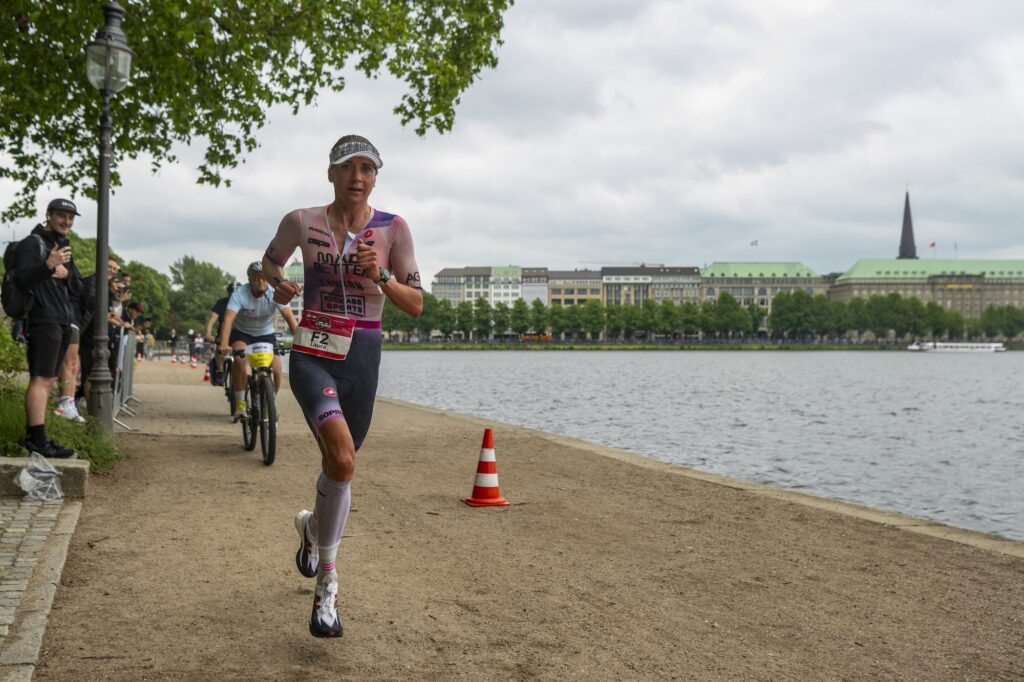
Philipp on her way to a world-best IRONMAN time in Hamburg. Photo: Jurij Kodrun/Getty Images for IRONMAN
Philipp swam a 54:40 split, rode 4:23:38 and then produced an amazing 2:38:27 marathon to catch Matthews on the run. Her result stands as the fastest IRONMAN-branded time to date, but her compatriot Anne Haug still owns the fastest full-distance time ever with her 8:02:38 finish from Challenge Roth in 2024.
Geens and Charles-Barclay Win in Marbella
The IRONMAN 70.3 World Championship saw two very different storylines from champions Lucy Charles-Barclay and Jelle Geens. Charles-Barclay was looking for redemption less than a month after her heart-breaking DNF in Kona, while Geens had his eyes on becoming back-to-back world champion after his win at the same event in New Zealand in 2024.
The women raced first and, as expected, Charles-Barclay led out of the water after a 25:05 swim. She had a great bike, covering the hilly 56-mile course in 2:29:41, but Knibb caught her and hit T2 with a slight lead.
Charles-Barclay chased the American down in the first few miles of the run, and although Knibb didn’t let her get away easily, the Brit was soon all alone at the front of the race. Charles-Barclay ended up running a race-best 1:17:14 half-marathon to cross the line in 4:14:54, taking the win and completing her redemption arc just weeks after pulling out of the IRONMAN World Championship in Kona.
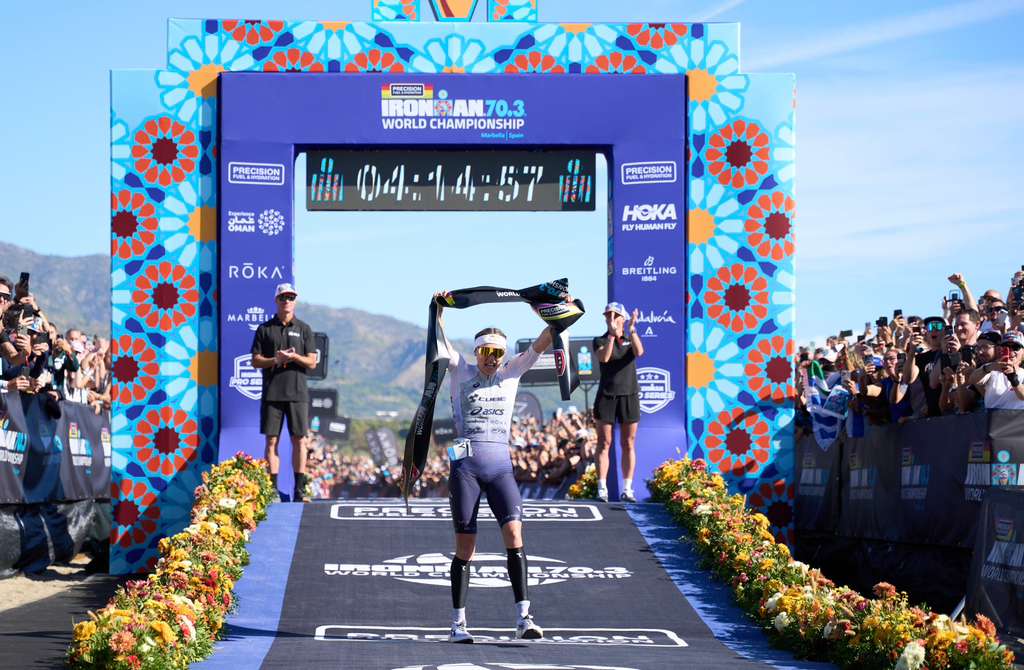
Charles-Barclay wins the 70.3 World Championship. Photo: Kevin Mackinnon
The next day was the men’s race. Unlike Charles-Barclay, Geens did not get out of the water in first place. His 23:19 split left him sitting in 22nd place as he entered T1, and he faced a hiccup early on in the ride as he crashed his bike. He managed to get back up and catch the leaders on the ride, but the accident left his TT bars askew and banged up his rear derailleur. After bridging the gap to the lead group, he pulled to the side of the road to fix a mechanical issue before hopping back on his bike, and from there, it was smooth sailing into T2.
Geens had a lot of company heading into transition, with eight other men nearby. Blummenfelt had a slight lead over Geens early on the in the run, but after three miles, they were together at the front of the race, where they stayed until the very end.
The two men ran together for miles, neither able to break the other. As they approached the final few hundred yards of running, Geens made the decisive move, getting a lead over the Norwegian before a hairpin turn that led to the finishing chute.
That gave the Belgian the gap he needed to take the win, and he crossed the line in 3:42:52, three seconds ahead of Blummenfelt. Geens ran a race-best 1:07:35 half-marathon to defend his world title.
Tertsch Comes in Clutch
Germany’s Lisa Tertsch had a Hollywood kind of comeback in the final race of the WTCS season in Wollongong this year. Going into the race, she was fourth in the WTCS rankings — sitting behind Cassandre Beaugrand, Beth Potter and Jeanne Lehair — and although it was possible for her to jump to first, it wasn’t all that likely.
In order for her to win the WTCS title, she not only had to have a perfect day in Wollongong, but Beaugrand, Potter and Lehair all had to have bad showings. Going into the race, it didn’t seem possible that those three women — especially Beaugrand and Potter — would all perform poorly enough to lose their hold on the podium.
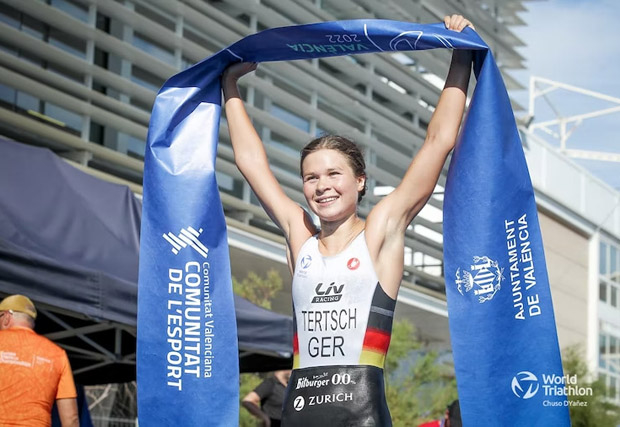
Tertsch won her first world title in 2025. Photo: World Triathlon
That is exactly what happened, though, as Potter finished 16th, Lehair crossed the line in 21st and Beaugrand recorded a DNF. Tertsch’s rivals stumbling wasn’t enough for her to win, however, and she stepped up when it mattered most, taking the win on the day and securing an unlikely world title.
Taylor-Brown’s World Best
Great Britain’s Georgia Taylor-Brown raced 22 times in 2025, competing in T100 events, short-course races, 70.3s and gravel cycling rides. One of the last races of her season came at 70.3 Bahrain, which she won in 2024. She not only defended her title this season, but set a new world-best 70.3 time as well.
Taylor-Brown swam a 25:17 split and followed it up with a 2:06:48 ride. After closing the day out with a 1:16:11 half-marathon, she crossed the line in a blistering final time of 3:51:19. This result beat Knibb’s previous world best time from her 70.3 World Championship win in Lahti, Finland, in 2023, when she stopped the clock in 3:53:02.
Løvseth and Stornes Win Worlds
After the 2025 season, it seems like any Norwegian racing the IRONMAN World Championship for the first time in their career is guaranteed to win the title. Blummenfelt won his first crack at the worlds in 2021 (held in St. George, Utah in May, 2022), then his compatriot and training partner Gustav Iden did the same in 2022.
Going into Nice, France, for this year’s world champs, Iden and Blummenfelt were a pair of favourites for the win, but their friend Casper Stornes ended up taking the world title in his first time racing the event. Just a month later, in Kona at the women’s race, Solveig Løvseth did the same as her male counterparts, winning the IRONMAN world crown in her debut.
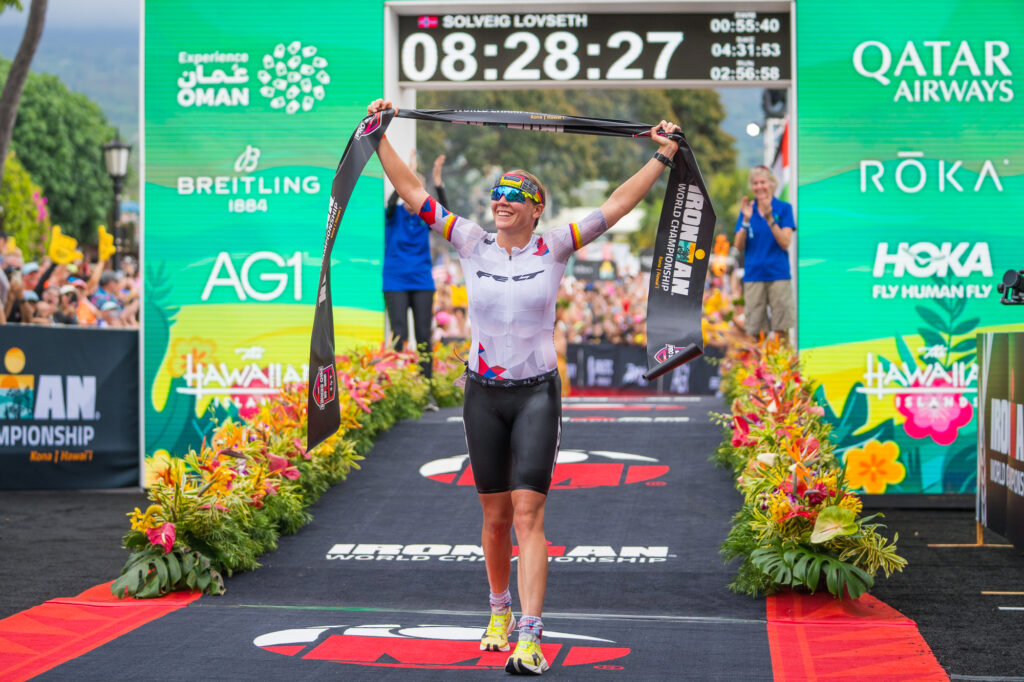
Løvseth takes the win in Kona. Photo: Kevin Mackinnon
Stornes won his world title in impressive fashion, running patiently and letting Iden and Blummenfelt break away from him before slowly reeling them in. He ultimately ran a 2:29:25 marathon to steal the win.
In Kona, Løvseth was sitting comfortably in third on the bike and during the early stages of the run. Knibb and Charles-Barclay were up the road ahead of her, but they both succumbed to the heat of the Big Island and pulled out. That left Løvseth in first place, and she didn’t falter, flying to the line to capture the victory and carry on what has become something of a tradition for Norwegians in winning world titles.