I have a few age group athletes going. I see a pretty hilly course. Would anyone consider racing on a road bike with a few modifications vs a proper tri bike with all the climbing and descents.
I asked ChatGPT to run a pretty detailed analysis comparing a rental bike (Scott Foil) and my tri bike (QR PR4) and it concluded my tri bike would still be faster on the Marbella course by 2-5 min. And this is despite the Scott Foil weighing 6.5lbs less than my tri bike. I won’t be very competitive, and comfort and simpler travel logistics are more important to me, so I chose the rental road bike. And I feel comfortable losing a few minutes.
Can you share the results ChatGPT gave you? ChatGPT is a large language model, it can sucks at math (the one thing computers are very good at  normally).
not really. I mean this is a level where the differences are not that huge anymore but still tri bike is faster for 98 percent of the people .
maybe for a 42 kg female that pushes 140 watts the weight savings of a road bike could work or somebody that is realy horrified on their tt bike at high speeds and decent much faster on a road bike.
but otherwise tt bike
to add I would focus on the right gearing on tt bike
I know Patrick Lange and his team took both bikes to Nice in 2023 to do a bunch of testing and found that the TT bike was still the better option by far. Having said that, Gustav Iden was on his roadie with clip-ons when he won his first 70.3 WC in Nice.
I know Nice is not Marbella and the profiles are very different. Assuming the descents are not very technical you’d still be better off on the TT imo.
Sure, see below. If I were seriously choosing between the two bikes, I’d use something like bestbikesplit.com.
Short answer: unless you can make the Scott quite aero, you’ll probably give up a few minutes to your PR4—even though the Scott is ~6.4 lb (2.9 kg) lighter.
Here’s the intuition and some numbers:
- #1: Weight (helps the Scott): Lifting 2.9 kg over ~1,829 m (6,000 ft) of climbing costs ~52 kJ. At 220–280 W, that’s roughly 3.1–4.0 minutes saved on the climbs for the Scott vs. the PR4.
- #2: Aero (helps the PR4): A tri bike + aero position typically has a meaningfully lower CdA than an aero road bike without clip-ons. That costs minutes on flats and descents.
I modeled a hilly 70.3 bike leg (approx. 90 km with ~30 km of 6% up, ~30 km of 6% down, ~30 km rolling/flat), assuming a 70 kg rider, good tires (Crr ~0.0045), sea-level-ish air density, and steady power. The table I shared shows the estimated time difference (Scott vs. PR4) across realistic power and position scenarios:
- With a typical road position (CdA ≈ 0.30): about +5 minutes slower at ~250 W.
- With clip-ons / very good road aero (CdA ≈ 0.27–0.28): about +1.8 to +3.0 minutes slower.
- If you can get the Scott extremely aero (CdA ≈ 0.25): it could actually be ~0.5–1 minute faster overall thanks to the weight advantage.
(I put the scenario grid in a small table you can explore.)
What to do if you rent the Scott Foil RC20
- Add clip-on aerobars and set up a true aero position if allowed. Even a small CdA drop pays back more than the weight ever will.
- Aero bits matter: fast tires, deep wheels (if crosswind-safe), an aero helmet, snug suit, clean cable/bottle setup.
- Fit first: you’ll only get the aero gain if you can hold the position comfortably for ~2.5 hours.
Bottom line
Your hunch about weight is right (the Scott gains ~3–4 min uphill), but on a 70.3 course aero usually dominates the total. Expect ~2–5 minutes slower on the Scott unless you make it quite aero; with excellent aero on the Scott, you can narrow it to ~0–2 minutes—or even flip it slightly in your favor…
1 Like
Interesting outcome. It doesn’t look like complete nonsense. Whether it did the actual math to come up with the time difference or just scraped the internet (over exageration of how an LLM works) remains to be seen. I completely agree with using BBS to get a good estimate.
A lot of this also depends on the rider and their ability to hold position. A TT bike + great position is fantastic but the amount of people who don’t or can’t keep themselves in the skis don’t realize how much this can impact their overall bike time.
1 Like
Gearing is far beyond my knowledge (“push harder, go faster”).
Aside from the switchbacks after Ojen (~17km), I think of it like climbing 2nd half of Pink Lake.
OK climbing the second half of Pinks lake (for those in the know in Ottawa area) is a helpful comparison. I assume that is for the climb on the way back to Marbella, not the way out.
On the way back the steepest stretch of what is a gradual climb (430m in 17km so average 2.5%) is the first 2.2km pull at 8%.
Thanks 8% is not that bad, but it is late in the game and over 2.2 km that’s nearly 200m of vertical gained, so it will sting for a bit. I guess it is worthwhile to check what aid stations are before and after to lighten up a bit before and stock up after. I think I will go with the 34x32 small gear option vs showing up with the 34x28. It’s always nice to have a bail out gear to keep cadence high enough and keep power low enough.
When I tried the course on rouvy.com, that section did not seem too bad, but I’ll have to go and revisit. Right now the weather is too good around where I live to spend time riding indoors!
Thanks for the guideance. Second half of pinks lake is not so bad, but on the way back and for a 2.2 km duration it will still feel painful (maybe along the lines of Snow Canyon at the tail end of St. George).
The first full aid station is in the town of Ojen ~10 miles in, right between the first two steep climbs. I plan on riding only with a small bottle filled with carbs and my aero bottle to the first aid station where I’ll get 1-2 bottles of PF&H.
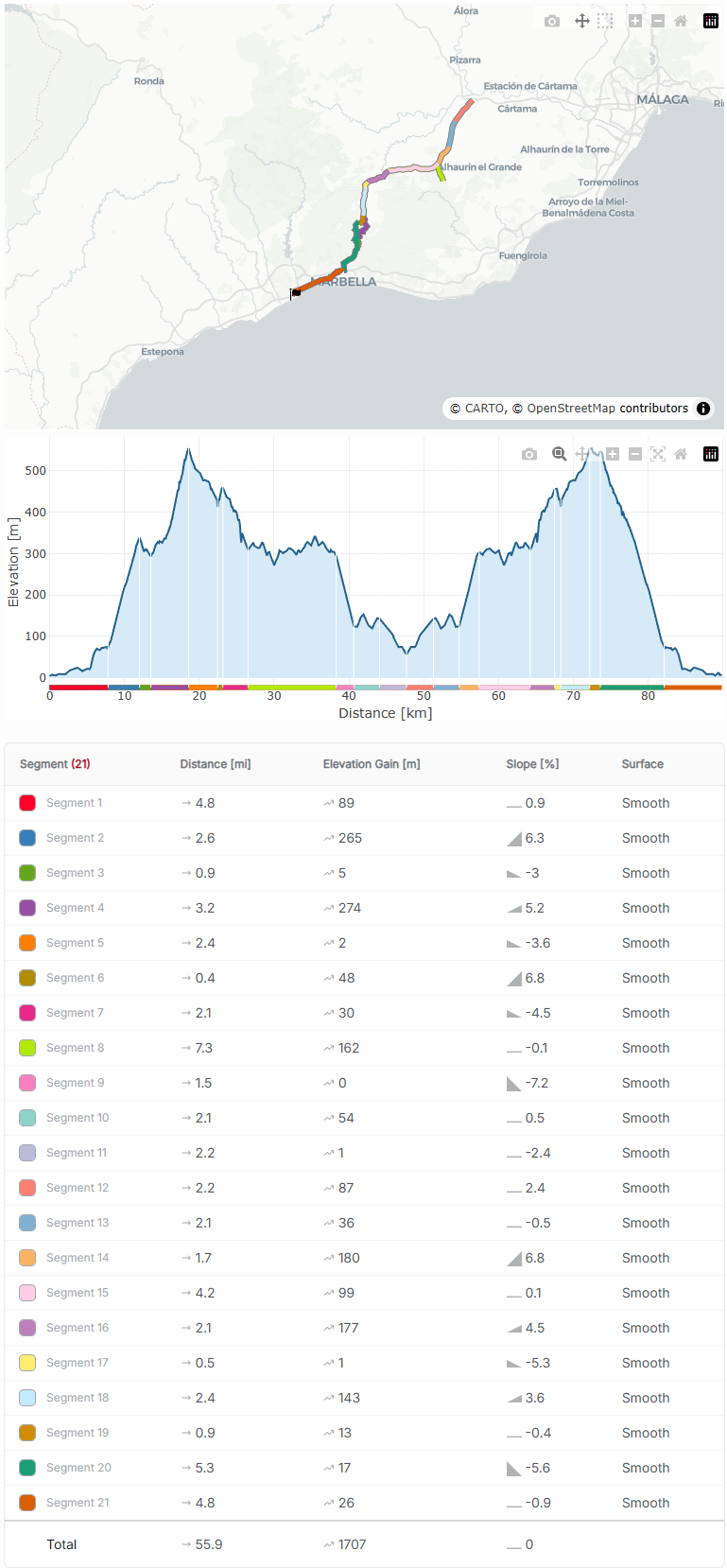
1 Like
I think using a road bike makes most sense on technical descents, where you might have more control of the breaks and be a bit less front-heavy. I rode the old course in 2019 and the descend wasn’t technical just scary.
What is the consensus regarding a disc wheel? It might be a few more grams and I find the disc a bit less responsive on hairpins due to its rotational moment or the nocebo effect… Judging from 2019 wind will be an issue on the last descent but the rear wheel shouldn’t play a big role here.
Not sure there will be a consensus on anything lol
I’ll take the TT bike. I might use a front derailleur this time because it seems 1x with a 56 front chainring could turn out to be too ambitious for me. About the disc wheel, I think I might leave it at home and use the 80 rear instead because I like the handling better on downhill sections. But I’m still debating on this. Disc looks cool, even more so on 15% hills.
After speaking with my coach, I will move to an 11/32 cassette on my disc wheel using my TT bike. We reviewed the course and feel there are some aero gains on the course that I can take advantage of. He likens Marbella to StG but without Snow Canyon.
I’ve got rim brakes on my bike and I’m a little nervous for the descents, just because I know I won’t be able to drag them the same way as someone with disc brakes can. Not that I’d want to be slowing down…but it’s a little nerve wracking to knowing I won’t be able to stop if I want to haha!
1 Like
Do we know if the 2025 IM 70.3 WC course in Marbella is actually the one on Rouvy. The only one I could find as of yesterday was from the classic course with 4900ft of elevation gain. Did I miss something ?
Download the gpx from the primary ‘course’ page and load into an app of your preference.
Loaded into RwGPS this gives 1526m climbing.
Think this is the one on Rouvy:
Key difference is the main climb is split by going through the village. Read this thread for detail.