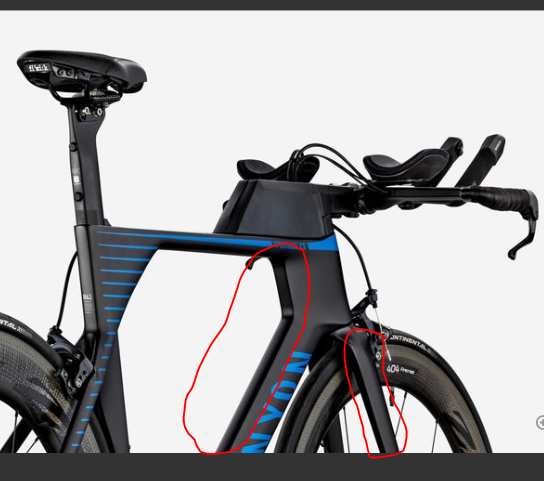
I’m a glider pilot and I’ve noticed lately that TT frames get more and more squared designs. Look at for example the 2019 Cube Aerium and the Canyon Speedmax. Why are the designers introducing more drag in the frame design? The frames should have more of a droplet design (e.g an aerofoil as in airplane wings), in order for the air to pass smoothly.
Coming from flying, these modern bikes with squared angles look terrible from an aerodynamic point of view. Or am I missing something in terms of new aerodynamic laws of physics?
Look up Kamm tails, and with that, to be UCI compliant generally frames have to meet a 3:1 ratio, so a Kamm tail within the 3:1 rule can be faster (perhaps at yaw) than a 3:1 full airfoil.
Gliders are somewhat different in that there are no depth restrictions to airfoil shapes and the high wind speed over the wings means that they do not experience the same yaw as bike frame.
No changes to the laws of physicss. Aerofoils are great for generating lift. But that’s not the aim of a bicycle, if anything it’s something to be avoided where possible.
Aerofoils are great for generating lift. But that’s not the aim of a bicycle,
Airfoils at zero angle of attack are also great for minimizing translational drag, which is the aim of a bicycle. That’s why so many bicycles use either full airfoil or Kamm shapes. Not to create lift, but to minimize drag.
Yeah, as others have said with uci rules. Kamm tails are pretty much the norm now on most road bikes. True uci illegal tri frames are the last holdouts.
Other reasons for not having deeper airfoils:
side surface area (too much and side winds can blow you over, or make a very dangerous bike)
stiffness/weight: the kamm tail allows a balance of stiffness and weight (while still being pretty aerodynamic)
If you go look at the Trek whitepaper for the Speed Concept I think they mention that their Kamm tail is roughly equivalent to a 9:1 airfoil. The general rule if that weight is a secondary concern, but a 9:1 airfoil would be both heavier and the vertical compliance would be horrible.
I’ve heard rumors that the Cube is VERY fast.
Now when I ask where they person got their info they send me to person A who sends me to person B who sends me back to the original person who told me.
Several sections of kamm style foils, just less than some others, and in different places.
For sure though, even with 3:1 rules, real airfoils are faster than other shapes at low yaw angles. Finding the balance of where to put them, and what percentage of each type is a million dollar question that each manufacturer answers a little differently.
Yes the P5 has full foils on the down tube, head tube, fork, and seat stays. Only the seat tube uses a kamm tail. Same holds true for the new Cube.
I agree a bike with kamm tails everywhere like the Canyon just look slow.
Meanwhile Look uses NACA full foils on every tube. That bike looks super slick in person with those shapes and narrow head tube. I would love to see a shoot out of the Look, Cube, P5, SC, and Canyon.
Another important thing to consider is the structural support of the airfoil sharp. Sharp corners are stress risers…Truncation allows this to be more easily managed.
Additionally, there is a minimum radius that can be efficiently maintained during bladder molding of carbon fiber components. Very tight corners require increased wall thickness because a bladder cannot properly compress or “fill” those corners. This means that the “full airfoil” can end up much heavier (size depending of course). A lot of “full airfoil” shapes are made using foam or another filler while the structural fibers are within. This allows the external to be shaped with less weight penalty, but still not as efficient as a proper truncation in most scenarios.
I’m a glider pilot and I’ve noticed lately that TT frames get more and more squared designs. Look at for example the 2019 Cube Aerium and the Canyon Speedmax. Why are the designers introducing more drag in the frame design? The frames should have more of a droplet design (e.g an aerofoil as in airplane wings), in order for the air to pass smoothly.
Coming from flying, these modern bikes with squared angles look terrible from an aerodynamic point of view. Or am I missing something in terms of new aerodynamic laws of physics?
Honest question: How many watts can you save on aerodynamics anyway? I am new to the sport, bought an 8 year old tri-bike entry level for 300€ and just had my first race this weekend. I ended up with a bike split in the top 5 percentile. Regular wheels, aluminum frame, manual shifting, regular helmet and sunglasses. So it makes me wonder why an amateur would spend so much money just to get a tiny bit faster when training more efficiently seems so much more promising?
I’ve heard rumors that the Cube is VERY fast.
Now when I ask where they person got their info they send me to person A who sends me to person B who sends me back to the original person who told me.
I like the looks of fwiw
It also comes in red stripes, which are surely the fastest. Seriously, they had a stand at IM Frankfurt with a few builds of these, it’s one beautiful bike. Personally, it’s a “Canyon Done Right” - a lot of the same elements but it seems to work better, visually.