Ganna: I trust Ronan and he said he couldn’t find out what crank length Ganna was using (despite other news outlets publishing 170mm) on the adjustable Wattshop crank that has available adjustment between 160m and 175mm. Looking at the many close up photos, Ganna has his pedal very far forward suggesting longer than 170mm:
article: https://velo.outsideonline.com/...ng/ganna-bike-check/
Very interesting, and certainly makes sense, given Ganna’s height. This photo supposedly are the cranks removed by the UCI right after the run, making sure there was no motor. Sure looks like the 175mm position to me -
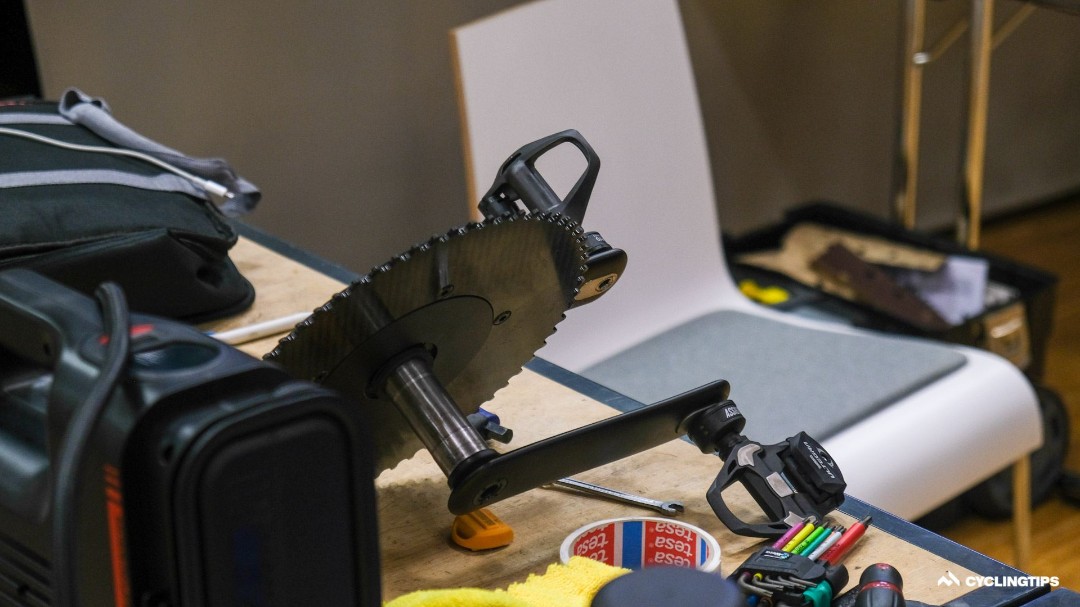
nice catch with that photo of the backside of the crank pedal insert!
an aside: have you seen the weight on that crankset?! I almost suggested it to a pro over the 3T Torno, but couldn’t once I saw the weight. I get that on the track that’s not an issue.
Interesting points, however there are some questions on the table.
Like what or when is a cranklength considered short?
Frodeno, quite a tall guy, rides his Canyon very steep with a 170 mm crank and I would say that is a ‘short’ crank for his legs.
Sam Laidlow, extended plate/spacer on his Canyon size large, also a taller guy is at 165 mm but rides also very steep.
Magnus Ditlev is a very very tall guy also extended cockpit, saddle also not super slack as you suggest and looking at how tall he is a 172,5 mm crank isn’t that long. I would say it compares about to a 165 mm for a 180 cm body length, normal morphology.
So your points are interesting but the above mentioned pro’s do not match your profile so I think there is more on the table then what you suggest.
Although I agree with you we need longer bikes;-)
Jeroen
Would have to do the study to see at what distance x for a given rider height the scale is tipped between quad and glute muscle recruitment. As it is, many fitters are placing riders further back towards the bb to engage the posterior chain without examining if the distance x is the driving factor for that decision, and how crank length affects that distance x and quad vs glute engagement, or how that affects the rider on race day in terms of the rider inching forward to get their center of mass more forward, then having to scoot back persistently during the race, and how that affects the run.
Frodeno and Laidlow are definitely examples of athletes getting their centers of mass further in front of the bb. Would Laidlow have had less issues outside of IMWC’s this year with different cranks? I don’t know. Would Frodeno’s position this year looked better than it did? I don’t know; it definitely did not look as good this year as year’s past.
In the OP, I reference quad vs glute engagement during weighted squats with knees further over or behind the person’s toes, for which there is published research, but I haven’t heard anything about that - the OP and my later responses were a lot less about profiling pro’s than how distance x affects muscle engagement.
Although I agree with you we need longer bikes;-)
100% need frames with longer pad reach/x.
- I’d also suggest taller stack seeing just how may spacers are under most pro’s and amateurs aerobars nowadays. And, filling in the space between the frame/bento-box and torso could contribute to the bottle-down-the-jersey aero benefit.
- for a frame with a stack/reach of 54cm/42.4cm, suggesting an updated stack/reach of 56cm/48.4cm.
- the bike in the image below has a 78deg sta. look how far forward the saddle is and also how far forward many pro’s currently have their saddles.
- update the frame to have an 82deg sta.
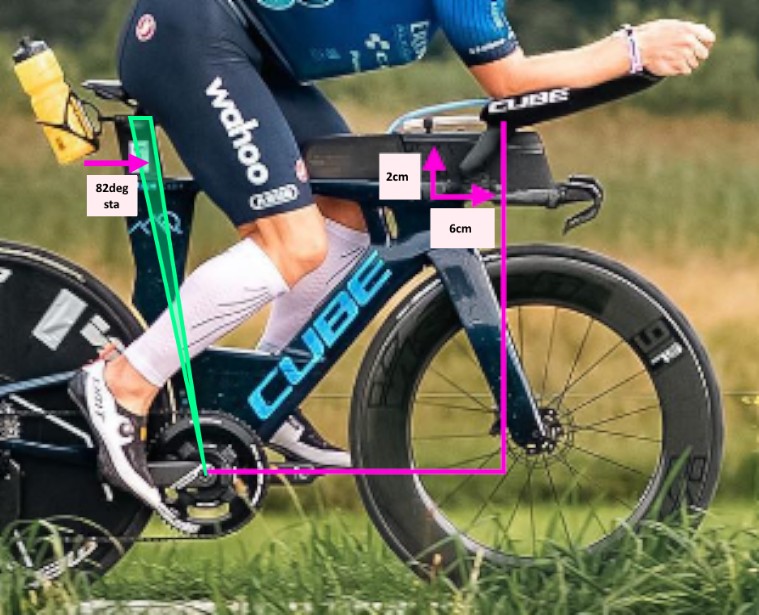
Now this is an interesting bike fit -
“https://www.facebook.com/reel/1008052383646480”
Kiddy Kranks?
.
Although I agree with you we need longer bikes;-)
100% need frames with longer pad reach/x.
- I’d also suggest taller stack seeing just how may spacers are under most pro’s and amateurs aerobars nowadays. And, filling in the space between the frame/bento-box and torso could contribute to the bottle-down-the-jersey aero benefit.
- for a frame with a stack/reach of 54cm/42.4cm, suggesting an updated stack/reach of 56cm/48.4cm.
- the bike in the image below has a 78deg sta. look how far forward the saddle is and also how far forward many pro’s currently have their saddles.
- update the frame to have an 82deg sta.
Looking more and more at the women last weekend in Kona and men in Nice, most have their saddles slammed forward. Many/most have aerobar systems adjusted to gain significantly further pad reach than their stock bikes allow for.
It seems a lot is being asked of saddles (slamming forward creates a lot of leverage) and aerobars (have to go after market solutions to increase pad reach and extension reach).
I wonder (hope?) we seem frame manufacturers update geometries. I see the update I suggested in my prior post better for amateurs, too.
Longer frame reach would also make the handling better compared to athletes moving their mass further forward over the steering axis.
Almost want a poll of the number of IMWC athletes with seats slammed forward, and using aftermarket solutions to increase pad reach/x.