http://www.brightroom.com/view_user_photo.asp?EVENTID=4478&PWD=&ID=9212684&FROM=photos&BIB=351
.
It’s not heel-striking if you’re moving fast enough – and from what I understand, you move pretty fast, pal.
I recorded bits of the Olympic marathon on the DVR and played back some frame-by-frame. Every single runner there lands on his heels. They key is that they don’t stay on the heel. They roll right on across to a mid-foot plant. The heel might touch first, but it’s not a “strike”.
You look very strong! Good lean body, good strong quads.
You’re not the only one that does it
http://www.brightroom.com/view_user_photo.asp?EVENTID=5423&PWD=&ID=9048487&FROM=photos&BIB=45
This seems to happen to me when I’m running slightly downhill
jaretj
.

.
And it’s not only the men. Quick, someone send them both the pose book before it’s too late to win a medal…

Ned
I’ve been wondering about this… I definitely strike on my heels, but usually have a respectable (by no means fast) run split
http://www.photoreflect.com/scripts/prsm.dll?eventorder?photo=055Q002C040072&start=0&album=0&adjust=-1
http://www.photoreflect.com/scripts/prsm.dll?eventorder?photo=055Q002C040071&start=0&album=0&adjust=-1
All this heel strike stuff had me ready to start trying messing with my form…
Proper running form has NOTHING, ZERO, ZILCH, NADA to do with LOCATION on the foot that lands first.
ANYONE who tells you otherwise has no idea what they are talking about.
Want better form? (all the pictures above could use work) run without shoes on. There is no wrong form when running barefoot. DO NOT THINK, just run. Right foot, left foot, repeat. (may reverse order) Do this twice a week and your form will get better.
It is near impossible to THINK your way to better running form. POSE is close but they are flawed. Besides, why pay for something you can do for free?
You got me thinking. This may be a stupid question, but what will a better form give me?
You got me thinking. This may be a stupid question, but what will a better form give me?
Chicks.
Really hot chicks!
Better form means better run times and less injuries.
Economy of motion. Runner “A” has a VO2 of 85 and runs a 16:00 5k. Runner “B” has a VO2 of 70 and runs a 16:00 5k. Both runners are equal height, weight, age and sex.
Who is the better runner? Niether, they are both 16:00 5k runners.
Who has better economy? Runner B. Runner B gets more forward motion out of set capabilitys than runner A.
If runner A gets better economy, he/she will be faster that runner B without more effort.
Interesting. My vo2max was recently measured at 65. When I compared my performances with the expected ones for such a vo2max, I started feeling like a slacker! A friend told me my mileage was just too low for me to reach my potential. Does the difference between my performances and the theoretical numbers indicate that I have a poor form? (if that matters, I recently ran a 18:02 5k on about 30-35 miles/week)
(Almost forgot: I am already married to a hot chick  )
Cant really tell over the internet. I would say that from what you have given me you are spot on for you fitness. VO2 max is not a very good judge of ability. 18min 5k on 30-35 a week and (assuming here) cycling swimming and the whloe tri bit is not that bad, but dont expect to drop to 16:00 any time soon.
Without seeing you run, seeing your traning schedule and knowing how hard you are running per workout I just cant tell.
Like swimming, we should be doing drills for running almost all the time. There is a certain amount of skill involved in running. Less than swimming and golf, more than weightlifting and cycling. The good part is that it is really easy to get better at it. Run barefoot.
Skill trickles down into so many parts or running. Here in the states, too many athletes are obsessed with running X pace per mile for Y time in a 5K. Thats why we can look at the 5K Olympic final and say that americans should have been able to run for the Gold medal because the time was “slow” Not true, they could have TT a faster time but what they cant do is run 10.5 laps at 13:40 pace then close the last 800 in 1:55. What the hell am I talking about?..sorry got off track there…
Expected times from 65 VO2max? that sounds like a table that needs to be tossed out. Are there more variables in there like # of miles run per week, per year, lifetime, age, sex?
Thanks for the reply. I will try and include barefoot running to my schedule. That, and also try and ramp up to 50 miles/week. I am not dreaming of 16:00 but I would be happy with 17:00!
FYI, here is the link I was talking about. But, I agree, I did not put too much importance into their numbers.
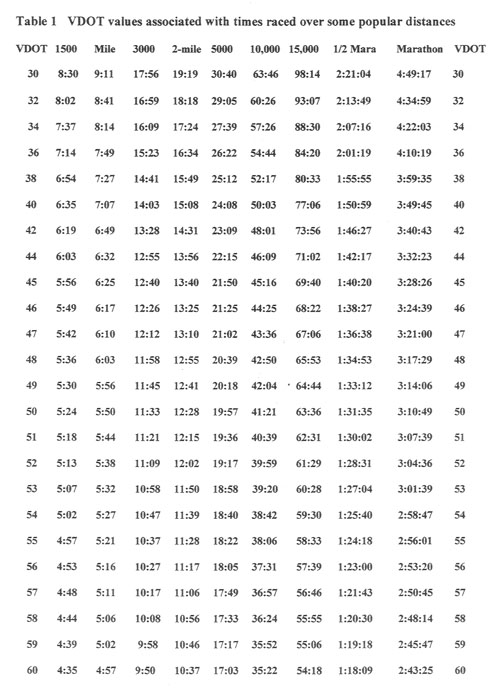
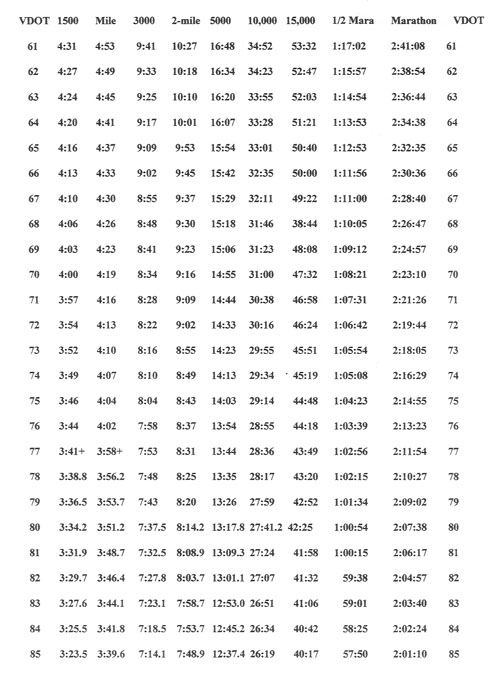
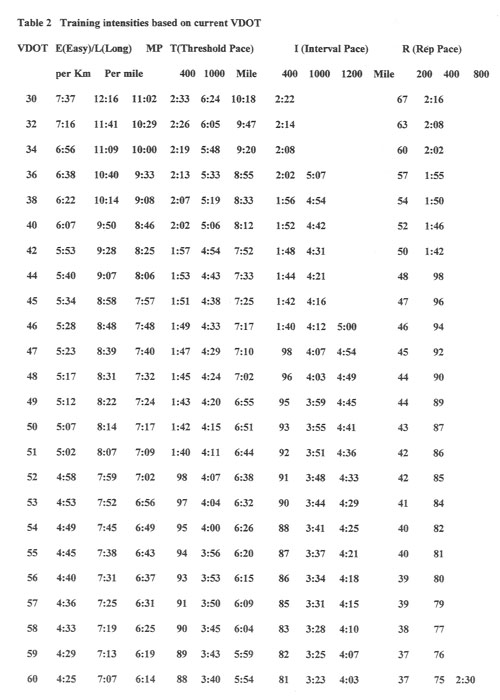
Here are some better #'s that you can actually apply to training. Find VDOT then use the last chart to determine proper pacing for different runs.
A little off topic but this is a great tool to get the most out of your miles. Get the book for more details. Jack Daniels Running Formula. B&N, Borders etc usually have it.
http://www.coacheseducation.com/endur/jack-daniels-nov-00.htm

You got me thinking. This may be a stupid question, but what will a better form give me?
The question might be better asked “what will better form take from me?” I think the answer is tension.
Running barefoot is certainly a mysterious thing, full of power, and I’ve come as close to floating as ever while running barefoot. Because of that it scares a lot of people into thinking they can’t handle that type of energy, and they convince themselves they should get injured if they try to transmit such delightful impulses that we have a birthright to. If you are truly wondering whether your form needs work, but don’t want to risk barefoot running to find out, there is something else you could do as a test. The idea behind this exercise is that from stillness power is borne. Take your 10K time, say 40:00, and stand straight up with eyes closed, barefoot, in a quiet environment perfectly still. Do not move any muscles save your diaphragm. Take note of all the places you get sore during this 40:00, it’s where you are not letting energy freely pass. Those are the muscles that need awakening, through drills or however you know how to go about the process. It’ll be a longer 40:00 than any 40:00 10K has seemed to you.
I think I will be running barefoot before taking your scary test! I have never heard of stillness power before. I guess I need to spend more time with my friend Google.
well, I guess my form can improve then…
vdot is 79 but I am nowhere near under 28’ for 10km and 2h09’ for a marathon! 
So does this mean you are one of the few sub 3:40 1500M triathletes? Impressive, when was the last time you did NOT post the fastest run split in a tri?
Different question LaWoof… looking at the VDOT #'s, I consistently run 1/2 marathons at 1:27 - been there for three years or so (been working on biking and swimming). However, my 5k times are at 18:00. Now, I’ve done no speedwork and have been training for the IM the last two years. Why would my shorter distance races yield a higher VDOT and my longer races a lower VDOT. I usually train by HR on the run, and this yields training paces a bit slower than the lower VDOT #. Any thoughts? THanks in advance.
79 Francois? LOL…