700 x 23
.
Can you produce any data to backup your claim of higher rolling resistance at higher tire pressure? The only studies I have ever seen indicate an asymptotic lowering of rolling resistance as pressure increases for road tires on road surfaces.
http://www.terrymorse.com/bike/imgs/rolres2.gif
http://www.terrymorse.com/bike/rrdiscuss.html
I’d love to hear a synopsis, if anyone is willing to actually read this discussion with jobst brandt regarding his rolling resistance testing.
Tubulars tires with road glue always has the highest rolling resistance. The optimum setup for tubulars is shellac which dries completely hard and is only available in hardware stores - onerous in that changing a flat to a spare is not safe since the spare will not adhere to the dry rim. (Also road glue and shellac are incompatible so if you switch it’s going to be very painful to go the other way.) Clinchers have the lowest rolling resistance. Wider tires have lower rolling resistance than narrow tires. Higher pressure changes the rolling resistance measured (esp for high rolling resistance tires) but not as much as switching to tires with a lower rolling resistance to begin with. Tires with tread have higher rolling resistance, the worst case example being mountain bike knobbies.
Where the tradeoff between lower rolling resistance and higher aerodynamics lies - who knows?
Modern studies in wind tunnels by Willett/Cobb show that the tire/rim interface is a critical component of aerodynamics.
The Plot thickens!
Just did the same test with my Hed3 Carbon front and Zipp disk rear with Tufo Jets and tufo tape.
Result
No loss of power!!!
So it must be the tires.
By the way the problem tires are not S2 they are Elites, I mispoke.
Almost every bike tire manufacturer has stated that the lowest rolling resistance is between 110 and 130 psi. I posted an article a few weeks ago that I’ll try to dig up. Tom Demerly can confirm from his conversations with Continental (and others).
My S3 Lites say 115-220. Max pressure does not equal correct pressure.
Technical Q&A with Lennard Zinn - PSI, nasty roads
By Lennard Zinn
VeloNews technical writer
This report filed February 2, 2005
PSI too high?
Dear Lennard,
I’ve been reading some of Zipp’s comments on tire pressure and rolling resistance attached below. When you really sit down and talk to them about tire pressure they’re recommending pressures of 100-120psi (sometimes less) depending on the tire, casing, and environment. I am including comments from Josh at Zipp on this topic. One thing I quickly noticed was the absence of weight in his recommendations. A larger rider running 120 psi compared to a lighter individual (say 30 pounds difference) would exhibit a larger contact patch (resistance or traction however you look at it) due to weight so I’m really not jiving on his basic psi recommendations.
Leaving road conditions out (rain, etc.) what are your thoughts on tire pressure? The common theme of tubulars is the advantage of both weight and tire pressure. The ability to run pressures of 180-200 psi. I know for myself I feel faster (have never tried to test this with rollouts or anything) when running pressures of 140-160 psi (clincher) and 180-200 psi (tubular). I’ve ridden a number of tires and prefer the ride of higher psi tires such as Vittorias, Vredestein and Tufos.
Do you know of any numbers or tests that prove these thoughts on tire pressure? I’ve had a number of lengthy conversations with Biomechanists in terms of rolling resistance (friction) and don’t know how a general recommendation on lower pressures can be faster especially not taking weight into account. It goes against everything I’ve read about rolling friction. It’s pretty easy to point out that the average pro in the peloton only weighs about 150 lbs., so of course it’s common sense that they wouldn’t need to run similar pressures as you or I, but 100-120 psi seems a bit low when you’re talking tire pressure for the most efficient rolling resistances.
I’ve also been reading your blurbs about tubulars, Tufo and their clincher tubulars. Taking Zipp’s tire pressure recommendations in mind where do you stand in regards to Tufo and their clincher tubies and other high pressure tires?
Tom
Dear Tom,
I agree with Josh, and yes, there are lots of test numbers to back it up. It is the same reason a suspension bike (or car) is faster over rough ground - less mass must be accelerated when bumps are encountered, thus saving energy and reducing momentum loss. Every little bump that gets absorbed into your tire (another reason that supple, handmade casings roll faster than stiffer, low-thread-count casings) is a bump that does not lift the entire weight of you and the bike.
You feel fast on a rock-hard tire for a similar reason that people like the feel of stiff brakes (V-brakes with the levers set on low leverage). The brake feels good and stiff because you are doing more of the work. If you increase the leverage, the brake feels spongy, because the extra mechanical advantage allows a modest pull to squish the pads.
When you ride a tire at 170psi, the bike feels really lively and fast. That is because you are being bounced all over the place by the surface roughness of the road. However, every time you are bounced, energy you applied to the pedals to get you up to speed is lost. Also, you have less control of the bike, so it feels like it is going faster, even though it isn’t. Ever notice how driving down the highway at 75mph in an old Jeep feels crazy fast, and you can cruise smoothly along at 100mph in a nice Saab or BMW and feel like you are going maybe 60mph unless you are looking at stationary objects passing by?
There is simply no question about it; rolling resistance tests conducted with bicycle tires rolling over surfaces akin to normal road surfaces always indicate the lowest rolling resistance at pressures a lot closer to 100psi than to 170psi! Years ago, for example, I saw results like this at the Continental tire factory. I was told of similar results at a number of other tire factories I have visited.
Lennard
Technical writer Lennard Zinn is a frame builder (www.zinncycles.com), a former U.S. national team rider and author of several books on bikes and bike maintenance including the pair of successful maintenance guides " Zinn & the Art of Mountain Bike Maintenance" and "Zinn & the Art of Road Bike Maintenance."Zinn’s regular column is devoted to addressing readers’ technical questions about bikes, their care and feeding and how we as riders can use them as comfortably and efficiently as possible. Readers can send brief technical questions directly to Zinn. Zinn’s column appears here each Tuesday.
Written by Josh at Zipp - Supplement to LZ Column
This report filed February 2, 2000
Written by Josh at Zipp: Here is an excerpt from a PM I sent to somebody a few weeks ago on this identical topic. I hope this helps clarify things somewhat…
The outer aluminum hoop in our clincher rims weighs only 200 grams, and therefore will get much hotter than a standard aluminum rim. Since the temperature of something is relative to the energy input/mass, a 200 gram rim will get twice as hot as a 400 gram rim for the same energy input. What happens is that if your descending a mountain at 70 degrees and you brake for 2 minutes and your standard aluminum rims heat to 220 degrees (an increase of 150) this same condition with a 200 gram clincher rim will result in a rim temp of roughly 370. Since the carbon is such a good insulator, the rims just have nowhere else to put the heat, so they get hot. This in itself is not the end of the world, except that tubes can melt at these temps, but considering that your tire pressure will rise at a rate of roughly 1psi per 10 degrees, you will see a corresponding tire pressure increase of 30psi.
Assuming your tire pressures are at 125, everything is fine almost regardless of the tire you are using, but if you were at say 160 and then had this same situation, your pressure could elevate to 190 which could be a terminal situation causing the tire to blow off of the rim.
We have seen temperatures intermittently hit 350-400 degrees in mountain testing in the Alps, so the case described here can actually happen. Since there is a pretty wide band of tolerance for tire fit, we can only guarantee that your tires will remain properly seated at their recommended pressures, and must recommend a pressure of our own. We make our rims at the large end of the diameter tolerance for ISO classification, meaning it is harder to get tires onto the rims and therefore harder for them to blow off, but air pressure is such a powerful and explosive force, that when combined with heat we must be very, very safe, not to mention that as tires age and stretch, their pressure capability is reduced, so there are numerous factors which must be accounted for here. Every rim manufacturer has a recommended pressure in this range in their literature, some just advertise it more than others, Mavic for example has a nifty sliding scale relative to tire width allowing for 135psi MAX for a 19mm down 115 psi MAX for a 25mm tire, and we have advised similarly, and for all the same reasons.
The other issue to consider is that most every tire on the market runs at optimal rolling resistance between 105 and 125psi depending on load and road surface condition. We have seen data from numerous manufacturers and had enlightening talks with others to learn that nylon cased tires like Michelin or Continental tend to run optimally around 105-115 and cotton or bias cased tires like Vittoria or Vredestein tend to run optimally at 115-125 maybe as high as 130 for Vredestein, but all of them actually will increase in rr at higher pressures due to the tread rubber beginning to fail in shear as it locally deforms to meet the contour of the road imperfections when the casing is too rigid. Think of it in terms of heat input, as the over inflated tire struggles to conform to all the tiny surface imperfections to make the necessary contact patch, a lot of heat is generated. Not only is there higher rr, but faster tire wear as well at higher pressures, not to mention the tires decreasing ability to stay mounted on the rim as pressure increases. In an ideal world tire manufacturers would list a recommended pressure and not just a MAX pressure (the max pressure is simply a predetermined percentage of the bursting pressure of a given tire as set out by industry standards and has nothing to do with the pressure you should actually run) but they are between the rock and hard place as consumers continually push for higher and higher pressures feeling that ‘if some is good, more is better’. Of course none of this even mentions comfort, which we believe to be of increasing importance as more and more data has shown fatigue to be caused by vibration. It may be that by increasing tire pressure by 20-25 psi, you feel faster as your tires are transferring more of the high frequency vibration to your body (you’re feeling a higher frequency ‘faster’ vibrations’ so it really does ‘feel’ faster) but are actually expending more energy to do it, while simultaneously wearing out the tires faster and inducing fatigue.
Looking to pro road teams, most of them are running 100-110 psi in tubulars and 105-120 psi in clinchers, and this has been a bit of a knock against the clinchers from the pros, that they prefer the lower pressures for improved handling, grip and feel, but need additional air to prevent pinch flats. Especially of issue are rainy races, where they may even lower pressure to 95 psi or so for better grip and control in the corners. The only real exception here would be track racing, especially on wood, where the surface is so smooth that very high tire pressures can yield excellent RR results, but still generally reduce grip slightly, but even this is specific as a board track may run well at 220psi, but a concrete track favors 150-160psi, and some track surfaces are no better than most roads… For an analogous example, look to Inline Skate racing, where they carefully select the durometer (firmness) of their wheels to the surface they are racing on, this is nearly as critical as ski wax in ski racing as it can win or lose races for you. It is so critical as too hard a wheel will get you dropped like a hot rock on most road surfaces, whereas that same wheel is the only way to be competitive indoors on wood.
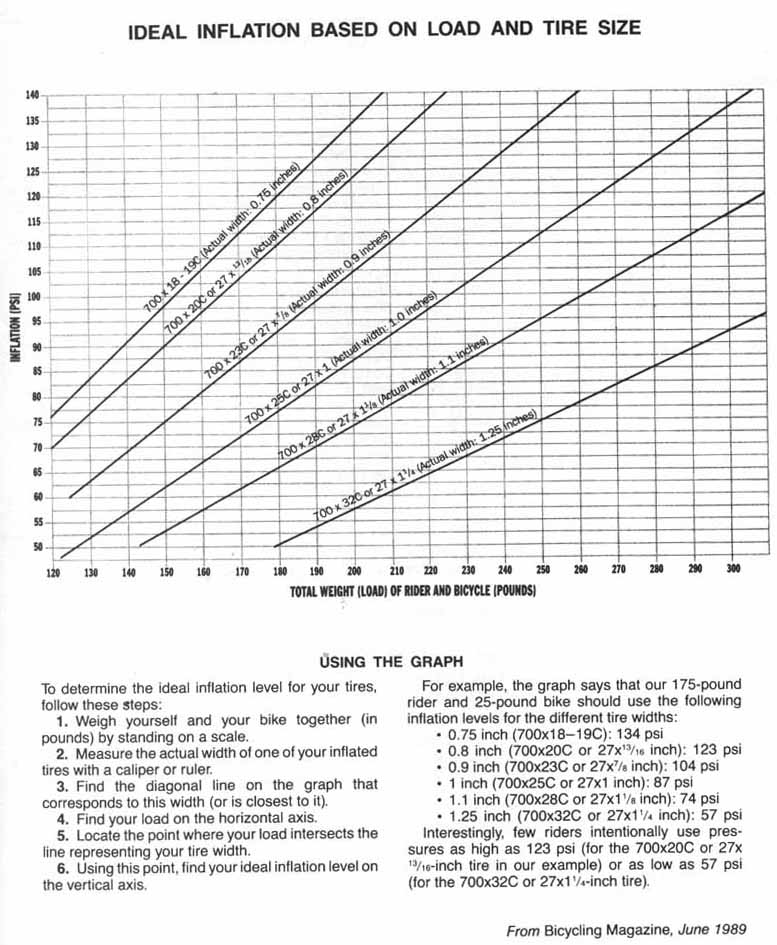
I don’t dispute that higher pressure leads to other problems, but we were only talking about one factor, rolling resistance. I never inflate above 115 due to the factors stated in that article, but I find it amusing that the recommended pressure for me is about 75 according to that bicycling chart.
I read that when it came out and the funny thing is - they don’t publish any data.
Zipp makes good wheels, but after that X% power claim with ceramic bearings, I respectfully demand data to back up whatever someone says.
http://www.velonews.com/tech/report/articles/5327.0.html
followed up by
http://www.insidetri.com/train/bike/articles/1960.1.html
Agreed. But since no bicycle tire manufacturer has anything to gain by stating “our tires have the lowest restistance at a psi of between 110 and 130” I tend to believe them. It’s probably more than a coincidence that every manufacturer I know of says the same thing about tire pressure (lower is better for decreased rolling resistance on roads).
As for your optimal tire pressure, why is that hard to believe? While 70 psi might not bode well for other factors, we’re only talking about rolling resistance.
I’m sure the data exists somewhere. I’d be interested in reading it myself so I"ll see what I can find over the weekend.
As for Zipp’s data, anyone can play connect-the-data-points, so I’m sure Zipp could provide you with data for their ceramic bearings, or their dimpled wheels (uh huh), but I bet it wouldn’t be too convincing.