The ROTOR cranks fast forward the idling crank
through the dead spot area while the working
crank is still receiving power. You eliminate part
of the dead spot area. With the biopace you always
had a dead spot area but you did not spend as long
in the area as with normal cranks. I am not well
informed on the Biopace system but that is how I
understand it. THE ROTOR system forces you to use the higher gear ( when compensating for dead spot
area) between 1 and 3 o’clock, not the most
powerful area of the stroke which for normal riders
is between 2 and 4 o’clock. But a complete change
of pedaling technique can change your main power
application area to operate between 1 and 3 o’clock
and this enables you to gain maximum advantages
from these cranks in addition to many other
advantages that are ideal for time trialling and
eliminates even the worst cases of cycling related
lower back pain.
good for TT, tri, road, mtb
read the revew, Biopace is nothing like Rotor
.
The ROTOR cranks fast forward the idling crank
through the dead spot area while the working
crank is still receiving power. You eliminate part
of the dead spot area. With the biopace you always
had a dead spot area but you did not spend as long
in the area as with normal cranks.
Exactly. Dave: as the review suggest, the simplest, quickest way to grasp the mechanics of the Rotor system is to launch this little video loop (takes a moment to load):
Hello,
I’m using Rotor Cranks now since march 2002 and have been riding about 15.000km since then. I intentionally liked the idea of the concept (intuitively and from my educational background, applied physics engineer), but was a little affraid of the impact on the body, especially around my knees. I tested it and did not experience any health problems and started using them in races since Ironman Australia in april 2002. I did some testing with them myself and also participated in a test held by the dutch magazine ‘Fiets’ (means Bike in english). The results of these tests can be found on my website, unluckily for you not in english: http://www.triatleet.nl/sponsoren. Scroll down for the images of the torque during the cycle compared to normal cranks. Also a heart frequency curve can be seen riding Rotor and normal cranks.
If there is more interest I will translate it into english.
I will be riding the Rotor cranks also in Ironman Florida, so if you’re in the neighbourhood, you see me there in november.
Regards,
Guido Gosselink
http://www.triatleet.nl
Thanks for posting that link, Guido.
Interesting that you have already ridden ~15,000km on this system – I think that counts as a valid test period 
Do I understand correctly from the chart (see below) your site posted that your’e estimating about an 11 watt advantage over standard cranks at the same level of effort? (171 vs. 160 in your test chart)
Interesting that everyone who’s actually raced on these (granted it’s a small sample) seems to be positive and enthusiastic (myself included).
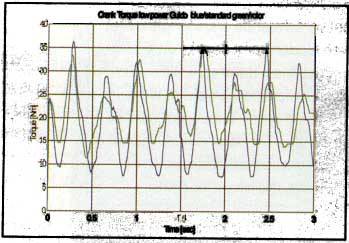
What you see is that the torque (in Nm), which is put on the wheel shows lows which are less deep for Rotor than for normal cranks. This is the so-called elimination of the dead spot area. The peak values are less high for Rotor, but the average during the 3sec shown for the Rotor is higher than for normal cranks. As Power is given in Watts, which is Nm/sec, you see that an higher average torque per second is an other way of saying Rotor gives a little higher Power output (171 vs 160W). So you understand it well.
In the test we had to keep 80 rpm, and for both Rotor and normal cranks the same gear. For me this also gave a little lower average heartrate on Rotor, next to the little higher power output. These results were for other people in the test not so clear positive, but could be caused by not being adapted to the Rotor neuro-muscular movements, which for me at that time was no issue, as I had already ridden 4000km before the torque-test. The other testers were people from the magazine self.
The main difference for the rider is the different pedal-stroke you have to make. So it’s really changing something in your body, you have to use your muscles in a slightly different manner, which is really strange the first few times on the bike. For me now it’s totally normal biking, doesn’t feel anything abnormal.
Guido
These results were for other people in the test not so clear positive, but could be caused by not being adapted to the Rotor neuro-muscular movements, which for me at that time was no issue, as I had already ridden 4000km before the torque-test. The other testers were people from the magazine self
One could also interpret this the other way…that the riders that were new to Rotors were still ‘adapted’ to using normal cranks, and therefore produced more power(relative to you) when using the normal set up. Likewise the reason you made less power with normal cranks may be due to the fact that you were NOT adapted to the use of normal cranks (having used Rotors for soo long).
Scott
Bedankt, Guido – very, very helpful follow-up.
Interesting that even though the peaks are slightly lower, not only is the overall power output higher on the Rotors, but the output is ‘smoother’ as well (less oscillation) – wonder if this alone has a physiological payback once the muscles adapt.
On another thread, we were saying that there is some comparison to the effect of riding a fixed gear (which some folks timetrial very successfully on); on the fixed gear, the trailing crank is ‘automatically’ returned to you, though arguably not as quickly/efficiently as on the Rotors.
I agree about the adaptation thing. Humorous part is that now it’s the “normal” (Dura-Ace) crankset on my road bike that feels odd when I ride it. Maybe I should be like Gary and just spring for a second set.
BTW: great photo of you suffering doing a VO2 max test. Good fun, eh?!?
I think I’d discount that possibility, Scot. In my own case, I found I was (slightly) faster the first time I did a max effort on the Rotors, then got progressively faster – albeit it in decreasing imcrements – thereafter as my muscles better adapted.
I may be at a significantly lower level overall, than Guido, but I’m 51 years old and have raced TT’s for the past 10 years or so, so it sure ain’t a ‘growing into form anyway’ thing.
Some empirical backup: my alltime PR for an official course (wind/terrain neutral, out-and-back) 40km is 55:00. At this year’s State TT championship, I was 26:41 after completing the turn at 20km, and had a 31:06 through the first 23.6km before flatting – was thus on course for ~53:00 even had I faded a bit in the final third (which I rarely do). Happily, still retained the agegroup title despite the flat.
But as I said earlier in this thread, I actually have zero interest in trying to convince competitors that these things work.
It does not surprise me that the peaks are lower.
The objective of ROTOR is to give minutes of extra
pedaling time per hour not to increase peak power.
But if you could manage to do both you would have
a double gain and it can be done.
One of the reasons for the drop in peak power is
your cadence has dropped with that higher gear
between 1 and 3 o’clock, so at 3 you have to be
prepared for that increase in cadence (normal)
after 3 o’clock, otherwise you will drop power by
retaining that slower cadence. It’s all a mental
approach, just as Anquetil’s completely different
technique is and not a matter of stomping on the
pedals. The ability to call on arm power could add tremendous benefit to these cranks as Gary said
you have the opportunity to produce more power
but you also need that special extra power generating technique if you are to make the most
of this opportunity.
It does not surprise me that the peaks are lower…
…One of the reasons for the drop in peak power is
your cadence has dropped with that higher gear
between 1 and 3 o’clock, so at 3 you have to be
prepared for that increase in cadence (normal)
after 3 o’clock, otherwise you will drop power by
retaining that slower cadence.
???
Guido says specifically that, during the test from which those data were drawn:
“In the test we had to keep 80 rpm, and for both Rotor and normal cranks the same gear.”
In my own experience, cadence didn’t drop at all – I was simply able to turn a slightly higher gear at the* same *cadence. This in turn puts added stress on the muscles involved, until you adapt to it. Had I stayed in the same gear, my cadence would actually have increased, not decreased, using the Rotors.
In my own experience, cadence didn’t drop at all – I was simply able to turn a slightly higher gear at the* same *cadence
His point is that during each pedel cycle, the cadence is variable. It is slower than the overall cadence during the power stroke as the crank arm rotates back to horizontal. It is faster on the upstroke as the crank arm rotates forward of horizontal to get ready for the power stroke.
So yes, the cadence, in terms of revolutions per minute may be 80, but the speed of the crank arms is sometimes effectively faster or slower depending on where in the cycle you are.
In regards to the posts about where in the pedeling cycle the slow down in cadence occurs (and the need to change your pedeling style to maximize the benefit), where the cam effect takes place is variable. The ‘regulation’ setting adjusts where the cam effect takes place. While it is true there are several studies that show peak power can be applied between 2-4 o’clock, those tests were done on road bikes using traditional geometry. I don’t know where peak power is for non-traditional set ups. The ideal place for the cam effect to take place also depends on the terrain, Rotor reccomends an early transition for climbing, a late one for flats. Again, that would depend on your baseline bike position. In any event, it’s adjustable for individual preference.
It still begs the question that having a more even power distribution is a good thing =).
Scott
“The ability to call on arm power could add tremendous benefit to these cranks as Gary said
you have the opportunity to produce more power
but you also need that special extra power generating technique if you are to make the most
of this opportunity.”
Arm power in the TT position? Leverage possibly, but last time I checked, you cannot flex your biceps to make the cranks spin faster.
“special extra power generating technique”
You have been speaking of this for weeks, if not months, and keep going back to Ankling, wheter or not you want to admit to it. Your technique is a complete mystery to ALL of us because you are either cryptic or uncomprehensable. So I offer you the opportunity to:
- Explain how your special ankling technique will make us faster
or
- Confuse us even more, post a cryptic description of the technique, and continue in your ‘troll like ways’.
http://www.teamintraining.org/all_page?item_id=8088"Pedaling Technique:
Some coaches advocate ankling (increasing plantar flexion between the top and the bottom of the stroke). After three months of practice, ankling was still found to be physiologically more inefficient than regular pedaling."
Got it – thanks. I think of cadence simply as revs/minute, here he was using ‘variable cadence’ to mean varying crank speed within a given revolution. This only occurs with the ‘trailing’ crank.
Got it – thanks. I think of cadence simply as revs/minute, here he was using ‘variable cadence’ to mean varying crank speed within a given revolution. This only occurs with the ‘trailing’ crank.
That is what ROTOR does ok but your crank speed
has to increase after 3 o’clock in order to bring it
back to normal cadence speed before starting to
increase at 9 o’clock. As I said it’s mental but you
must remember this as you are turning the pedals and applying the power.
Got it – thanks. I think of cadence simply as revs/minute, here he was using ‘variable cadence’ to mean varying crank speed within a given revolution. This only occurs with the ‘trailing’ crank.
That is what ROTOR does ok but your crank speed
has to increase after 3 o’clock in order to bring it
back to normal cadence speed before starting to
increase at 9 o’clock. As I said it’s mental but you
must remember this as you are turning the pedals and applying the power.
This problem is caused because the area where
maximum pedal power is required by ROTOR does
not coinside with a rider’s maximum pedal power
application area: ROTOR is 1 to 3 oclock while
rider’s max power area lies at 2 to 4 (approx).
Gary the basic difference between Anquetil’s style
of pedaling and all other rider’s is that while
everyone’s including Anquetil’s main power application direction when riding out of the saddle
is in a direct downward direction: when in the
saddle all riders except Anquetil retained that same
direct downward direction for main power application.
By the clever use of muscles and ankle Anquetil
succeeded in applying this power at a 45 degree
angle(approx.). This simple technique is where the
secret of all his success lay because for a start it
eliminated the dead spot area, made the use of
combined arm resistance/hip/leg power possible,
reduced the stress on the knees, (even though he
could never have known it) it eliminates the root cause of cycling’s back pain but where this
topic rotor is concerned it changed a rider’s maximum power application area to between
1 and 3 o’clock and this is why they make the
perfect combination. Forget about ANKLING,
Anquetil never used it at speed in time trials.
Anquetil’s style will be tested on 10 of the worst
lower back pain victims before Xmas and should
end their torture. Once the secret is out, it will be
a matter of " why did’nt anyone think of that before"
Ironically, just moments ago got an e-mail from Rotor announcing an upgraded RS4 version to be launched shortly at “new prices” (which, it hints, will be lower than the current ones) – see photo below
Also says: “Successful results achieved in 2003 cycling competitions have all contributed to the development of the ROTOR RS4 and will continue to do so: thanks to Eneko Llanos, 2003 World Champion in Long Distance Triathlon; Ana Burgos, 2003 European Champion Olimpic Distance Triathlon.” So there are two more racer references.

Don’t see why you need to ‘increase your crank speed’ at all during the downward stroke of the pedal that is applying power, simply to compensate for the fact that the trailing pedal will be returned to you almost immediately after you’ve finished the current stroke’s effort phase. This assertion makes no sense to me at all (nor, I suspect, to anyone else who’s actually ridden and raced on Rotors).
All you are doing effortwise is going “stroke-stroke-stroke” at a constant cadence – rather than stroke-quasipause-stroke-quasipause-stroke. The speed of the stroke during the downward phase – and even for the first 2/3rds + of the return phase – is constant. Only the very end of the return is accelerated, and this (by definition) is an area where you are applying little if any effort. Again, go check the video loop on the Rotor site referenced above: http://www.rotorbike.com/eng/simulator.htm
Also fail to understand why you think the area of maximum pedal power (portion of downward stroke) is at any different place on Rotors than it is on any other crankset. My Rotor crankset is perfectly circular, the same diameter, mounted onto the same bottom bracket, and connects with the chain in precisely the same way as my Dura Ace conventional one. The power phase of the stroke is placed identically.
Also, as Gary has pointed out, the rider’s arms are useful as an additional point of leverage, but that’s about it.
Finally, Jacques Anquetil (Maitre Jacques) was indeed a huge natural talent and a masterful time trialist – aside from his 5 TdF victories, he won the Grand Prix des Nations TT something like nine years in a row. He also ‘broke’ the world Hour Record, but this was went unregistered because he refused to submit to the required drug-testing at the finish to validate that his effort was clean.
His ankling technique worked for him – but doesn’t provide any instant alchemy for others, any more than adopting Mel Ott’s bizarre batting stance would be likely up your power or increase your lifetime batting average. Had ankling worked for others, it would have been stolen instantly – it didn’t, and therefore wasn’t. I like Gary’s description of it as “urban legend”.
PS: there was a time when Sean Kelly was the most dominant one day racer in the world; one glance at any photo of him will tell you his position on the bike was terrible – hunched up as though he were in a trash compacter. No-one thought for a moment of copying it, nor should they have – it worked for him because he grew up riding that way, and possibly because it suited his own individual physiology.
Our observations based on extensive testing with one particular athlete show that adaptation can take up to 3 months. We noticed no improvement the first few days. Significant gains were noticed within 1 month and slow improvement continues up to 3 months (which is where we are at now).
Our case study is published on our website:
Herb,
Nice to see you here at this site.
-
Why do you think adaption is ongoing over 1-3 months? My riding of the cranks does not uncover any obvious explanation for this delay.
-
When you use the word significant I assume you mean “reasonably large” not statistically significant.
-
Since you have a reasonable experience with both RotorCranks and PC’s, and you classify PC’s as training equipment and RC’s as performance equipment, wouldn’t you agree that whatever the benefits are of each device they should be additive to the other?
-
You wrote: “A muscle EMG study is underway to compare NC with RC and Powercranks.” I look forward to that result.
Frank