how many people are constantly replacing aluminum wheels from wear down due to rim brakes? I see that happening with carbon wheels… but even then, how often?
I still think that if rim brakes came out today after disc brakes they would be adopted. Cut pounds off your bike! Lighter wheels. Lighter bike. Almost no loss in braking power. More aero. Way less maintenance. Much cheaper.
I disagree on all these.
If rim came out after disc, it would be the same argument - at it’s core, disc vs rim isn’t an argument of the specifics of the tech, it’s just bc people struggle with change. And the industry adoption of disc instead of rim is a huge change.
If rim never existed and came out after disc, we’d all say “but there’s less braking power, why would I use those?!” And “my rims are going to wear out faster!” And “Now I have to learn how to change the cables and toe in brake pads!”. And, “WTF, I can’t fit 32c tires on my road bike!” We’d be having the exact same discussion griping about it bc it’d be a change in what we know.
Discs are better.
“Pounds” off your bike? You may have just been exaggerating to prove your point, but that’s the problem. But even if we give you that claim as accurate, the industry is also moving away from weight savings in favor of aero savings bc aero matters more. This cannot be argued, it is fact. A 16 pound modern disc bike is going to be faster 99.9% of the time compared to a 14 pound rim brake bike, I would think. And it’ll be safer and allow more confident riding 100% of the time. If youre focused on speed alone and wanna hold that 0.1% against the disc brake, so be it, but I’ll happily take the aggregate gains and tech advancements and leave you in the dust. I’ll also be able to stop quicker when a car pulls out in front of me cutting me off. I’ll be more confident and safe in the rain. I’ll do less overall maintenance. My wheels will last longer. And I’ll enjoy greater tire clearance and more aero rim shapes.
Can someone please explain why a Disc brake applies more force to the wheel than a rim brake… I get it that the disc is just on one side, so more spokes are needed on the disc side, however, the braking force is between the contact patch (road) and pivot point (hub), overall it doesn’t matter where the caliper is between the tyre and hub
Personally I love all the cheap rim brake parts and second hand bikes. However, I also appreciate the advantage of a disc brake.
It’s not specifically that more spokes are needed on one side, but the spoke pattern needs to be cross-laced as opposed to radial to deal with the circumferential forces. The same thing applies to the rear wheel from the drivetrain, which is why you never see radially spoked rear wheels.
The disc brake probably is capable of more absolute braking force than rim brakes, on average. The caliper pressure multiplied by it’s distance from the center of the wheel give you the torque of the braking system. It’s a bit more complicated because the surfaces/pad materials are different, but that can be factored into the equation. The take home message is that a rim brake cannot be moved any further away from the center of the wheel, so the only way to increase braking force is by increasing caliper pressure. A disc brake can be set to a larger disc size and have it’s braking force increased with no change in caliper pressure. So yes, a disc brake can have nominally higher braking force through trivial changes. (one can imagine a disc brake set up where the disc is the same diameter as the rim of the wheel, still using the same disc brake calipers. This would clearly have more maximal braking force than rim brakes solely because of the increased caliper force)
This is all moot of course so long as the maximal braking force is more than the total system deceleration limits, either from tire slippage or from the center of gravity shifting ahead of the front wheel.
Cut pounds off your bike! Lighter wheels. Lighter bike. Almost no loss in braking power. More aero. Way less maintenance. Much cheaper.
Where did you get your info about rim vs disc brake weights and costs?
Less material is needed for disc brake rims, so weight is less than rim brake rims.
Rotor weight may offset the lighter weight, making weight differences a “wash.”
Rim construction is simpler for DB wheels, and with less time and material required for construction they cost the same or less, right?
Zipp 404 Firecrest clincher
Rim brake: 1621g/set (claimed), $1076 - $1291
Disc brake: 1516g/set (claimed), $976 - $1050
Shimano C50 clincher
Rim brake: 1790g/set (claimed), $DISCONTINUED (tubular only available)
Disc brake: 1441g/set (claimed), $2100/set
PCW Peak 4550
Rim brake: 1348g/set (claimed), $3100
Disc brake: 1297g /set (claimed), $3100
Aerodynamics: this is an apples to oranges comparison since wheel shapes and frame designs are purpose-designed to decrease drag of the entire system, not just a rim or a hub.
To claim a bike is “faster” because it’s more aero ignores the aero drag and effects of a rider.
Braking power: there is no comparison; disc brakes provide superior stopping in any conditions. This is evidenced by riders waiting longer before braking into turns, etc. GCN examined this. And this can be quantified in average rider speeds in hilly/mountain stages of grand tours for which there are decades of data available for all but the newest routes.
So the only arguments rim > disc are maybe/possibly: total maintenance costs or emotional attachment.
Rim brakes look better (specially when hidden by the frame), they are lighter and easier to maintain.
Disc brakes (outside of MTB) solve a problem that doesn’t exist.
The manufacturers have settled this for us already. If you want a new bike or new wheels you buy based upon what is compatible with disc brakes. If you want rim brakes, you don’t have many choices unless you buy used.
I still think that if rim brakes came out today after disc brakes they would be adopted. Cut pounds off your bike! Lighter wheels. Lighter bike. Almost no loss in braking power. More aero. Way less maintenance. Much cheaper.
I disagree on all these.
If rim came out after disc, it would be the same argument - at it’s core, disc vs rim isn’t an argument of the specifics of the tech, it’s just bc people struggle with change. And the industry adoption of disc instead of rim is a huge change.
If rim never existed and came out after disc, we’d all say “but there’s less braking power, why would I use those?!” And “my rims are going to wear out faster!” And “Now I have to learn how to change the cables and toe in brake pads!”. And, “WTF, I can’t fit 32c tires on my road bike!” We’d be having the exact same discussion griping about it bc it’d be a change in what we know.
Discs are better.
“Pounds” off your bike? You may have just been exaggerating to prove your point, but that’s the problem. But even if we give you that claim as accurate, the industry is also moving away from weight savings in favor of aero savings bc aero matters more. This cannot be argued, it is fact. A 16 pound modern disc bike is going to be faster 99.9% of the time compared to a 14 pound rim brake bike, I would think. And it’ll be safer and allow more confident riding 100% of the time. If youre focused on speed alone and wanna hold that 0.1% against the disc brake, so be it, but I’ll happily take the aggregate gains and tech advancements and leave you in the dust. I’ll also be able to stop quicker when a car pulls out in front of me cutting me off. I’ll be more confident and safe in the rain. I’ll do less overall maintenance. My wheels will last longer. And I’ll enjoy greater tire clearance and more aero rim shapes.
Their argument is also missing the benefits of wider rims allowing lower tire pressures for many applications. This doesn’t work so well with rim brakes.
Yes, true, agreed, good point.
Can someone please explain why a Disc brake applies more force to the wheel than a rim brake… I get it that the disc is just on one side, so more spokes are needed on the disc side, however, the braking force is between the contact patch (road) and pivot point (hub), overall it doesn’t matter where the caliper is between the tyre and hub
The rim brake stops the outside of the wheel, which is a huge difference. The outside of the wheel is the part that has to stop, and it has huge leverage over the hub. Force transmission to the hub is tiny. Disc brakes have to “transfer the stop†from the small-ish diameter rotor into the smaller diameter hub, and then to the much bigger diameter rim/tire. The leverage from the rim brake is reversed, and the force transmission is way higher.
It is nearly impossible to get to the UCI weight limit with disc brakes. I recently built two brand new bikes. A Scott addict supersonic HMX SL with SRAM red AXS, zipp 303, look keo carbon ti pedals, a 69g carbon seat, the lightest bar tape, etc. I got down to around 7.1 kilos. And paid around 13000 euros.
Then I built a team Michelton Scott Scott foil HMX, with run brakes. Again red AXS, carbon seat, main difference is this one has zipp 404s NSW instead of 303s. It cost me less than 5k and it weighs 6.8 kilos at the UCI limit. In the dry (I never rude when it rains) it brakes as good, if not better than the addict.
The bottom line is I paid more than twice for a climber that weighs significantly more than it’s aero counterpart. i.e. is worse in every condition, except perhaps in long wet descents.
Relative to the GCN test, it’s as BS as it gets. Different bikes, different tyres, zero science.
N=2 and personal anecdote about not riding in the rain and observations about braking technique.
That’s some good science, eh?
Aero is more advantageous than weight in all but a very (very) few use cases.
This has been tested and proven in the lab and in real world scenarios. And it has also been noted above.
But since you want to flog the dead horse, these are stock bikes that come in at/below UCI requirements:
• Specialized S-Works Aethos Dura-Ace: 6.23kg (claimed)
• Trek Emonda SLR9 eTap: 6.75kg (claimed)
• Cervelo R5 eTap: 6.8kg (claimed)
I’m sure there are other bikes from from Wilier, BMC, Cannondale, etc. used at the WT level.
Why do you hate science and evidence so much?
I don’t hate science, I laid down facts. Scott is arguably one of the finest brands at pro-tour level. Their rim brake aero bike is lighter than their disc-brake climber. Those are facts. It is also a fact that price is around half the price. I haven’t taken either to the wind-tunnel, but I would bet my house that the foil with 404s is not only lighter, but also significantly more aero than the addict.
All the bikes that you have mentioned spec their weights without pedals and with the lightest, tyres. Plus, they still cost twice as much as equally or better performing rim-brake equivalents. it is not anecdotal that it has taken half a decade for a tour to be won on disc brakes. Until last year almost all podiums on all big stage races where full with rim brake bikes.
Look, disc brakes are great, and I would not think about not using them on a mountain bike, but in road bikes they are the greatest thing ever for the industry, not so much for the consumers, who basically pay twice for the same in the best case.
I don’t mind my disc brake Rouxbaix. I have 2012 r3 and can’t ay I’ve ever gone yay I’m glad I had disc brakes today. Suppose bikes are like anything else, the industry will make you upgrade.
For all the talk of the fastest bike, for most of us would think the position is more important than the 2 watts the bike on its own in the wind tunnel gets.
Disc brakes I get it, we are not going back, but we didn’t need to go there
[
Braking power: there is no comparison; disc brakes provide superior stopping in any conditions. … GCN examined this…
I have yet to see a comparison where the rim brake setup was something I’d consider near “best in class”. In fact, they’re typically done using carbon braking surfaces and less than ideal brakes. I don’t think GCN is any exception. It’s REALLY easy to spec a poor performing rim braking setup by mistakenly valuing certain wheel properties that aren’t actually main performance drivers.
Also, I think if you add back the 150-200g of disc brake rotor and mounting hardware back onto those wheel weights you quote, you’ll find that in most cases (comparing same generation of product to each other) the disc brake setups are no lighter, and in many cases heavier, than the rim setups, when looked at as a system (i.e. functionally equivalent…including braking surfaces).
Also, I think if you add back the 150-200g of disc brake rotor and mounting hardware back onto those wheel weights you quote, you’ll find that in most cases (comparing same generation of product to each other) the disc brake setups are no lighter, and in many cases heavier, than the rim setups, when looked at as a system (i.e. functionally equivalent…including braking surfaces).
Wait, are there ever times when, with equal caliber bikes (and all other things being equal when appropriate), that a disc brake bike is lighter or more aero than a rim brake bike?
To me, it seems that, if you aim for best in class with every component and system, a rim brake bike will always be more aero and lighter.
Saw Richie Porte riding now retired with an older model Trek from his earlier days with rim brakes.
Mate said that he was joking how it was 3.5 kilos lighter than the tank he was forced to ride in the last years of his career. This debate isn’t even a debate if you ask the pros in an honest moment.
Saw Richie Porte riding now retired with an older model Trek from his earlier days with rim brakes.
Mate said that he was joking how it was 3.5 kilos lighter than the tank he was forced to ride in the last years of his career. This debate isn’t even a debate if you ask the pros in an honest moment.
Which Emonda or Madone was he riding that was 10.3kgs???
This is from a 2020 article,
“Richie’s bike for stage three (which he won) was exactly 6.8kgâ€.
You forgot to mention “and significantly cheaper”
.
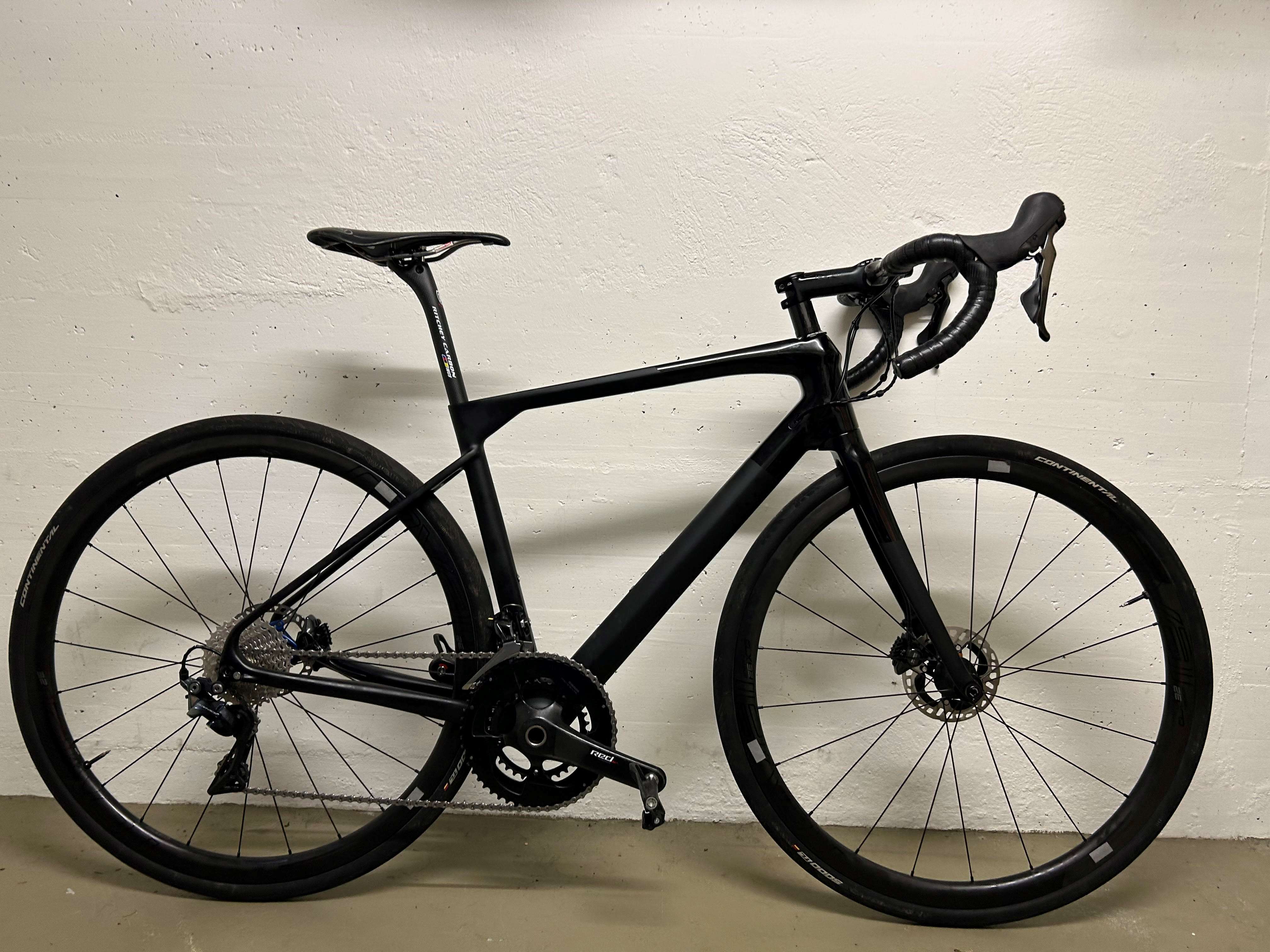
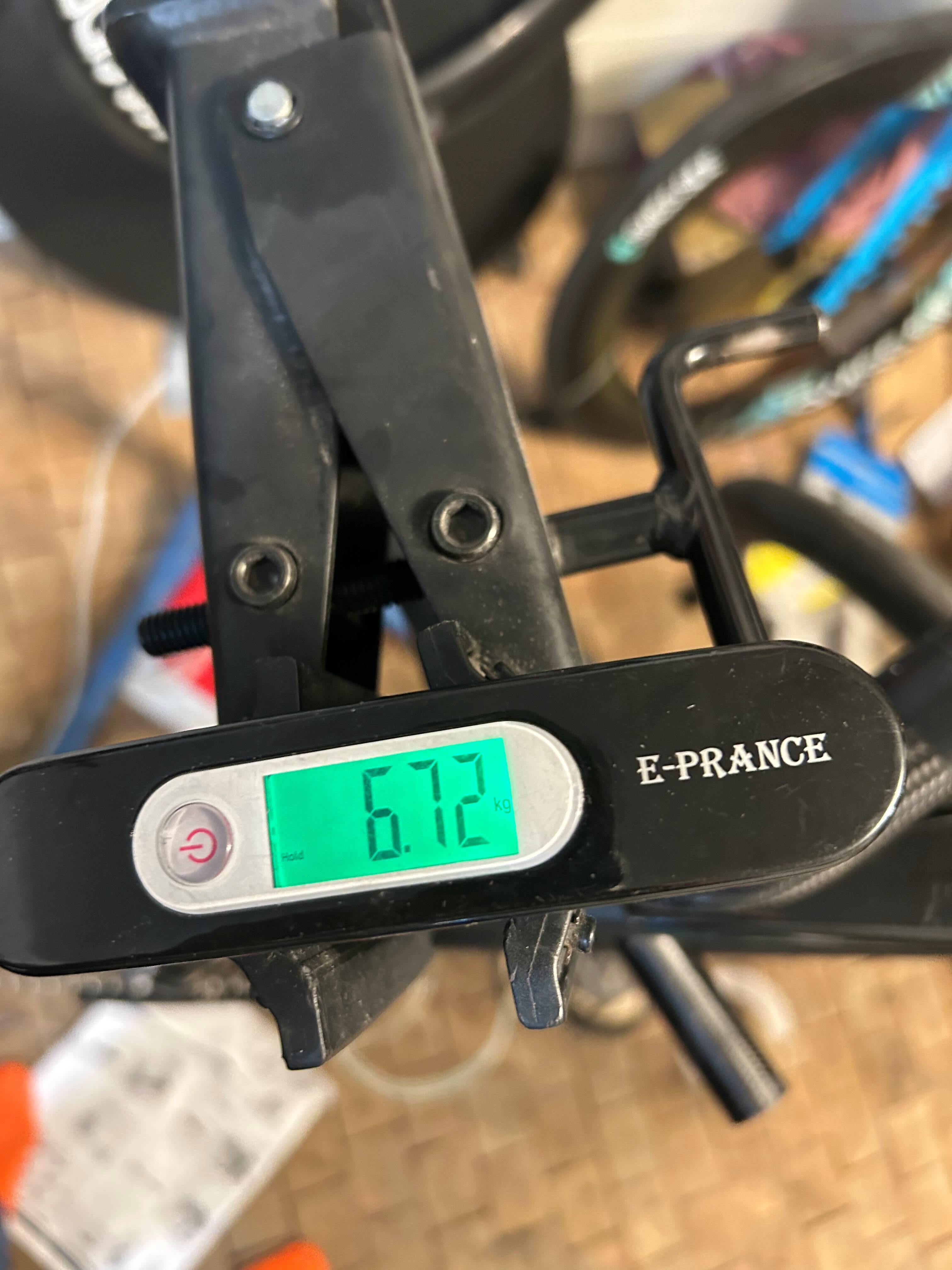
My rim brake road bike has 6.3 kg all inclusive for about 6000$, the rim brake road bike of my wife has 5.3 kg for about 5000$ (most parts 2nd hand).
I just built my new Ultra distance bike.
Frame Airstream Marathon S, inc headset (new) $700
Groupset Shimano 9120 second hand $400
Brake calipers Shimano 9270 $280
Discs Swiss stop Catalyst Race 140mm - $90
Cassette Ultegra 11-32 - $70
Ritchey Carbon WCS (second hand but unused) - $55
Haero Carbon K.155 MTT SL Bars with integrated extensions (used) - $200
Brake Hoses - $40
From my spares collection
SRAM Red Crank 165mm 52/34
New SRAM Red GXP BB
Roval CLX32 wheels
Continental GP5000 TL 32mm tires
Dura Ace Chain (new)
Assiona pedals
Lizard Skin bar tape
Jagwire Road Elite Link set
Pro Vibe 110mm stem
Saddle Selle Italia Titanium 130g
Cost $1835
Weight 6.7 (excl pedals and bar tape)
This was never supposed to be a superlight build. I want comfort and reliability for multi day Ultras. I was surprised by weight which is 500g lighter than expected. Its easy to build a UCI min weight bike on lowish buget