Won’t they just reallocate the legacy slots to whatever “other” pathways. IE do you think in a what a field size of 2600-2700 capacity, they’ll have 2xxx men, leaving ~less than 7xx women? I don’t think IM wants to have a men’s field size starting with a 2xxx in current kona capacity. ~3k capacity I can see, but not this year.
I was just pointing out that if a lot of women got legacy spots to Kona out of that 235 non qualifier slots, then they won’t need to allocate as many to women legacy athletes in 2026. Not sure how/if that changes any mix, but in theory it should
Capacity = 2500 amateurs and 100 pros (50-50)
I posit that Ironman ‘want’ at least 30% of competitors to be female, if only for presentation purposes (and as mooted by De Rue).
Implies 730 women, of which the current KQ regime will generate 599 plus or minus 36 (±2% swing in female participation on average either side of 31%). Other means slots for women = between 95 and 167.
Yes it’s likely that the percentage of women legacy is very near nil at this point compared to men. But I don’t think they would then fill those women’s spots with legacy men spots; they will just go down the list of whatever initiative they want to, to make sure the women still get those spots.
To Ajax’s numbers if they go with 2600 and ~600 KQ, they are very likely to go with what ~150 additional women spots; 800 total females (including WP), and ~1800 total men (including MP’s).
1 Like
Would be nice to see how the rejection rate spread across the season. Even with less slots being offered to women, it looks like there were at least 6 events where they said, “any women want to go to Kona?” and were scraping the edges of the cookie bowl to get the others? Just guessing 6 races or so based on 91 slots not being taken and I assume those didn’t all come from the last two races, but were from a handful of races where they rolled very deep.
Which suggests, 1500 slots to finishers is so many that they are essentially letting anyone who finishes and feels like going get a slot (on average, some races I assume a few were disappointed).
What this means to me is, this idea of 1000 women (or more?!) needing to be offered slots is very overzealous IF you want a Kona slot to have a scarcity value. To keep it scarce you need to be in the 6-700 (iykyk) range at the highest?
1 Like
I think it’s going to be a balancing act IM is going to have to handle. Obviously if they increase overall Kona capacity, then by default W numbers will have to go up. If they are going to be at near ~800 in '26, I don’t think it’s overzealous to think a 3k will have 10xx women and 20xx men. It is likely not going to be an exact 3000 ever, knowing that they could literally find a place to fit 32 people if it was actually 3032; while also accounting for the 1% that wont actually show up in Kona for various reasons; so thus only really need to find room for damn near 3000 exactly (but again likely always being able to “find” space if they have too).
They could offer 1k to women and then backfill however many slots they need to with whatever initiatives they want to get that number actually to the island. So if there were 91 slots not taken in what near 1600 slots; it would basically be what about ~60 slots to figure out beyond KQ. No one’s bib or race is made to feel any less for being a legacy/fundraiser/IM begged you to do the race after turning it down at roll down 3 months later…a spot is a spot on race day.
From what I understand, rejection rate roughly increases the closer to that year’s Kona you get. Naturally some outliers depending on where people are going from (e.g., Lanzarote couldn’t give all their slots away). But, roughly speaking, races in the Americas won’t have that problem.
It’s overzealous IF you want to maintain some semblance of scarcity value. Just because an extra 1000 men show up, which the demand is there for and it will still be something you need to qualify for, only then it would roll to 6 or 7th place instead of 2nd or 3rd, does not mean that suddenly more women will show up.
You’re talking about optics of ratios and having enough women qualify that most of the complaints go away.
What I’m talking about is Ironman already limited the field specifically in 2025 because they clearly wanted to manipulate the perceived value of a Kona slot among women. 1000 women getting slots, without a corresponding increase in women suddenly racing Ironman will mean at most races there would still be very very deep roll downs, which obviously affects the scarcity value if as a woman you know you can pretty much get a (roll down) slot anytime you cross the finish line.
Who said anything about scarcity…Getting 1k women when the race moves to ~3k is basically maintaining the current alignment they have now.
Again you just solved the riddle. Create 1k/1k KQ split, knowing that some small % likely won’t take the spots even if IM is “giving them away”. They can then plan ahead and give those slots to other non-KQ pathways, all the while winning the “equality” PR…AND still getting 2k men to Kona in a 3k race and having a nice 1xxx for women.
Ironman did. That’s why they limited slots offered to 2025 Kona women to 1600. They wanted to maintain some scarcity and even then they couldn’t get them all used. They weren’t going to rock up to Kona with just 800 women and no one else so they had to go at least a little big, but it’s clear they were concerned about maintaining scarcity. That’s my point.
They placed some value on it. 1600 was clearly way too many. The ideal number of women at Kona can’t be close to that number moving forward if the value of the slot is going to have any worth. If anytime anyone wants to qualify for Kona, they essentially just need to go finish an Ironman and have very good chance at a roll down what does that do to the perceived value of that slot compared to the current status quo for men?
That has to weigh on their minds based on how many women passed on a chance to go.
If we are talking rejection rates, to a degree society gets in the way of women doing Ironman. For example look at the thread about women running alone. There are a lot of societal factors that get in the way, that men just don’t face, so when a man gets to a start line, generally he had a more collaborative path going all the way back to when he won the 50m sprint in the kindergarten fitness event.
I don’t know how much any of you have been involved in coaching youth sport for the 12-18 year old cohort, but here in Canada we lose a ton of girls from sport to “other interests”. The girls getting on podiums stay, but the MOP and BOP leave just when they are in the critical formation stage towards becoming athletes for life. Generally by the time women get back into sport they did not leverage the same extensive sport conveyor belt that guys did. And the examples go on.
If we get to races where the call is, “we have slots for any women” I think we should absolutely celebrae the ANY Woman who takes it. There is zero need to add another layer of headwind AGAIN after they went through life long headwinds to do sport. Give them these women the Kona Cherry on top.
Also for this year’s Kona, there were some late season European races, where some quantity of women qualifiers, rejected traveling to the US. I can kind of get over it going to the Kingdom of Hawaii or Puerto Rico colonized by the US, but most people see it all as US and with the admin waging economic combat and just generally making things harder for visitors, a number of European women may just skip out on the travel to Kona. For many travelers right now its a values thing and no amount of “you will be fine” gets them over the hump.
Right I just showed you how IM can get 1k women when it expands capacity, win the “equality” fight when it’s dealing with the KQ and still get 2k men.
I think though there’s a difference between celebrating qualifiers (even deep roll downs) and creating the impression of scarcity - even if there are barriers women face that men don’t (this is partly addressed by having more women’s slots as a % of total finishers - whether this is enough is a subjective discussion).
As long as Kona is branded as a WC, there needs to be some measure of scarcity with respect to competitive slots. Yes, Kona is more than this, but it’s the competitive slots which contribute to this part of what makes Kona Kona (as opposed to the weighted lottery model you get at UTMB).
If, in the name of equity, we constructed a scenario whereby any woman who finished any IM got to go to Kona, I believe this would be a disservice to women’s sport. Not in the sense that they didn’t earn it - but in the sense that you’ve killed the goose that laid the golden egg. You’ll have killed off the pull that attracts people at the higher end of the sport and keeps people registered year to year. IM reports that once people go to Kona, they tend to drop out of IM racing higher than on average.
If you make it too easy, then the achievement looses value.
2 Likes
A pool of 1k athletes isn’t even top 3 at every AG over 40 races. I don’t know that that’s creating a scenario where “everyone” can go and cheapens the ones that do in fact win and earn the spot. Even if 20% of those spots roll down and/or don’t get used up, I don’t think that then cheapens the ones who go, not at a 1k scarcity number. 2500 field size for women only is different, and I said from day 1 I assumed IM would give women 1xxx in Kona in a split field- just to win optics of equality. I certainly didn’t think they’d have men and women competing for the very same scarcity item, that’s for sure. So now that they’ve sorta pivoted and divided out the ~30% slots to women, when field size increases, duh so will women’s slots be increased. You can’t increase field size and keep the women the same number, they’d be running into the same “women’s rights” issue they just had to solve when they had to tweak this KQ mixed gender policy.
The catch, obviously, is that we don’t know where that line between scarcity (keeping slots hard to reach) and equity (giving one gender more as a share of participation) lies.
With the current state of participation, these ideas are obviously at odds with each other. And finding the balance point is a subjective exercise based on policy.
Whether that line is at 800, 1000, 1200, or 1500 slots remains to be seen. Though we did start to see IM’s policy in restricting it to 1600 on an every other year basis, with some races showing deep roll-downs. Which is not the same as 800 each year, so we’ll see how this all plays out.
1 Like
Right, but we know a few things:
-
IM will never do a 50/50 true equality in Kona. So 1500/1500 is out. (I also don’t think anyone has actually ever thought a true 50/50 was ever in consideration)
-
Women are currently going to have ~600 KQ and what likely 100 additional slots (WP included) to have them likely closer to 800 than 700? Is that fair?
-
So if Kona capacity increases, only logical step is increase in both men and women numbers. So if they increase by 350+ spots to get to 3k, how is ~1k not probaly the logical number they get to for women (including that gets W to ~33% participation number).
I tend to agree that everyone wants to go having qualified and not complete-ify. Having said that there are enough events that the slots are not going to anyone who finished. I had a few women friends go from Ottawa IM this Aug. They are moderate fast , not pointy end fast (like tenth in age group but not last) and I did not hear about the slots rolling thru field. As much as Canadians are at a receiving end of the current admin in Washington as Canadians we are used to traveling to US and it’s easier to get over that hump. For a European woman doing maybe a once in a lifetime trip to USA maybe the answer is ‘not now’. I think we are underestimating how that sentiment may have affected slot acceptance no to mention planning a trip for 6 weeks away
- We ‘know’ the 600 (you are regurgitating what I’ve told you, and it’s plus 36 or minus 18 depending on what the average % of women starting IMs in the Q period ends up as) but we don’t “know” the rest (I will guess <750 total amateur women entries for IMWC 2026 - closer to 700 than 800).
- None of this is “known”. if if if
You seem to have a fetish for 1000 or 1xxx: why is that a “logical number”. "If Kona capacity increases" that the 750 (2026) will increase is to be expected.
Currently (assume 2500 amateurs) IRONMAN are offering 1933 KQs (77%). It’s reasonable that for every extra 100, the KQ figure will increase by 77. (But NB for 2027 the base figure is the original 2026 figure which was 1881.)
Yes and there are quite a few races with barely 3 women in the AG, and I’m not talking just the 70 year olds. And the roll down often went quite deep when the races were trying to fill that many slots.
And it’s got nothing to do with being afraid to run at night, though I do recognize that as a tragic reality. No more, and certainly less a tragic reality than the much higher rate of suicides of males, which suggests widespread feelings of hopelessness amongst that cohort. It’s not as if one side has a monopoly on the human condition.
Obviously, Ironman “can” say 1000 slots work, and still find away to fit more men in and reduce the squabbling over fairness of number of slots.
That’s got nothing to do with what I’m talking about.
They could not fill a 1600 person race at all with the number of female finishers they had. Clearly they had deep roll downs at some races. That means 3rd, 4th, 50th, and 20th (if the AG was even that large) rejected at times. The perceived value of that slot you are chasing is a big reason why people chase it. Human nature right? Less value, less chasing?
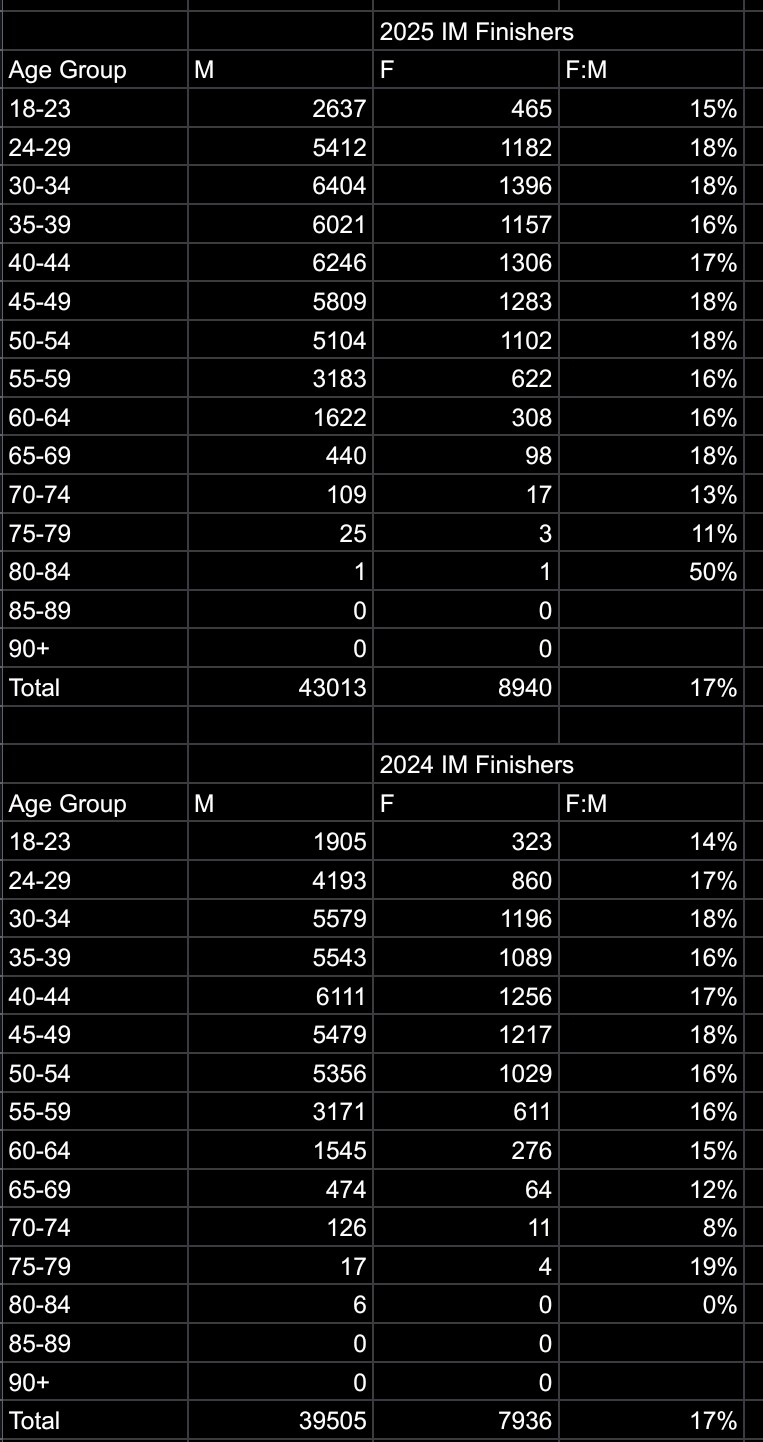
I pulled some data comparing M:F over the last two years.
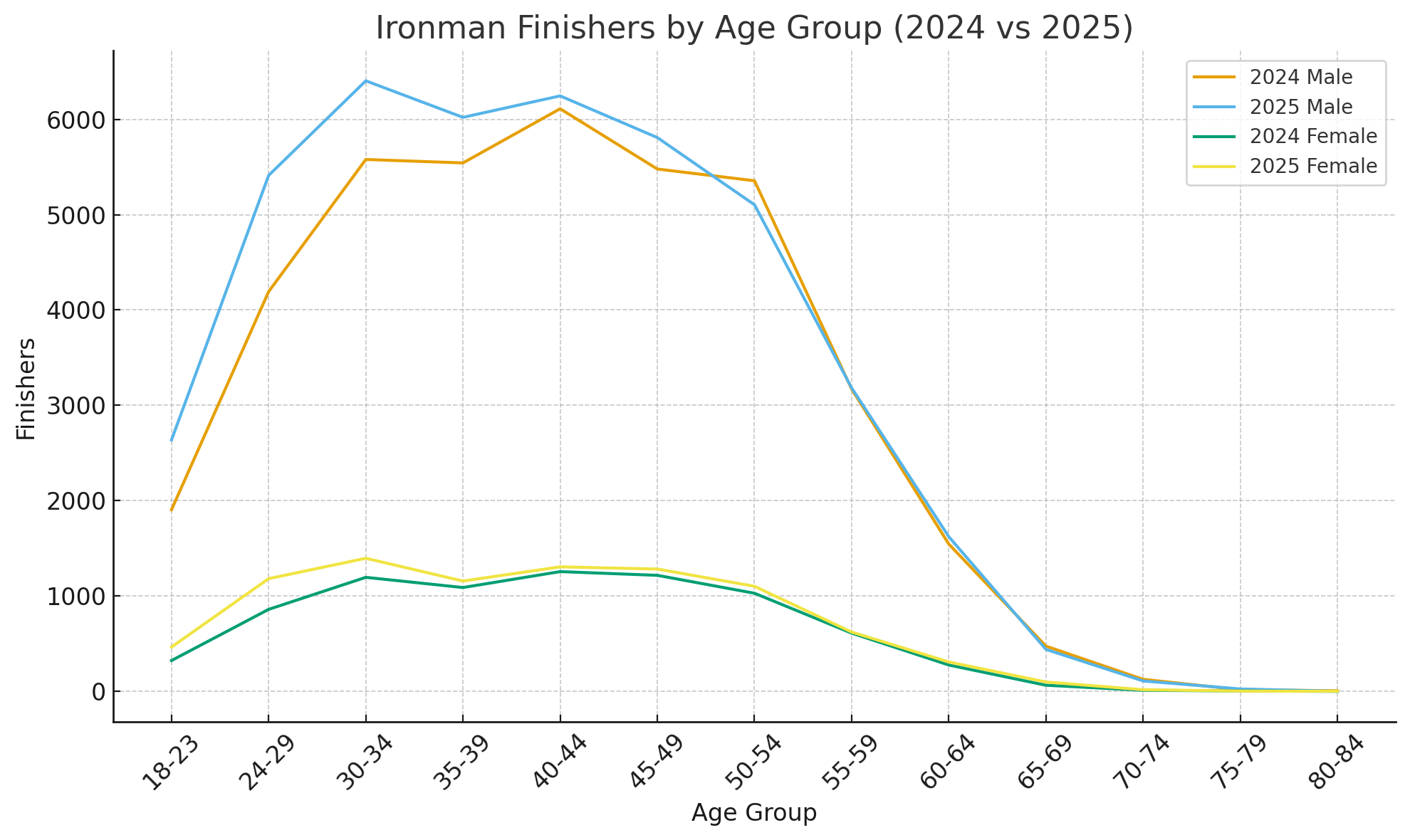
Overall, women went from 16.7 to 17.2 pct of the field. That’s either a small increase or a rounding error and we can say women are holding consistent on average about 17% of finishers. The men had a more sizeable increase, make what you will of that.
If I’m Scott Derue, I’m hoping that 2026 increases some more again, as otherwise a reasonable case could be made the new separate Kona policy is sending registrations backwards. Important note though - This is finisher data, not registrations. Important for Kona slot allocation bickering, but not the full picture for business analysis.
Data I was working with pulled from historical AWA IM only rankings which lists everyone who finished an Ironman. As some of these finished multiple Ironmans, the number of entries was obviously much higher for both, I assume even more so for the men.
3 Likes
Because I can do basic math. If they have as you put it near 750-800 for a 2600 field. When they increase near 400 spots, the chances the women in Kona have a 1xxx number by them is seemingly logical. Of course you would argue anything I say, so there is that (adding snippets that I’m reguritating what you say…no shit if your using the actual numbers of what the KQ will be, no shit I’ll use that, wtf otherwise).
@Lurker4 if we are talking 2 different points- cool. There is a point that IM “scarcity” matters for the women. There is an “equality” issue as well. IF IM is going to increase capacity, there is very little chance that I don’t think that eventually gets the women to 1k. Again your data is showing “1k” can solve IM’s women’s issue all together. They can use 1k for slot allocation knowing that likely a small percentage isn’t going to actually take the slots and then use those slots for all the other women iniatiives. So whether that actually means 1k/1k or 1k W / 1500m as the KQ (and then backfill 500 or 800 with legacy men, CEO, etc), that’s how they get to 1k women, and I don’t think the “scarcity” issue really affects 1k.