Thought the following was a pretty good read on the building of a controversial bike lane in Vancouver and the failures that initially sidelined it:
Thought the following was a pretty good read on the building of a controversial bike lane in Vancouver and the failures that initially sidelined it:
http://www.citylab.com/...al-bike-lane/383272/
What more American cities need to realize is that car commuting simply does not work. Furthermore, prioritizing the city landscape for cars at the expense of cycling, walking and public transit is not only foolish, it’s unfair. Simply put, America needs strong progressive leadership to increase Cycling, pedestrian and public transit infrastructure that is attractive and discourages automobile use.
If commuting is a big part of that bridge’s use; it might make sense to have the lanes follow the commute. 2 lanes one way, 3 the other. Reverse it in the evening. Last I checked, this is how the Golden Gate Bridge works.
I have ridden this bridge and run it hundreds of times. If they put just a little more thought in there, they could have made it work perfectly. BUT the city is a bunch of idiots. Honestly, a little bit of common sense (not common anymore) and creating the EASY way (instead of creating problems the easy way) they really could have made this work out very well but did not.
If commuting is a big part of that bridge’s use; it might make sense to have the lanes follow the commute. 2 lanes one way, 3 the other. Reverse it in the evening. Last I checked, this is how the Golden Gate Bridge works.
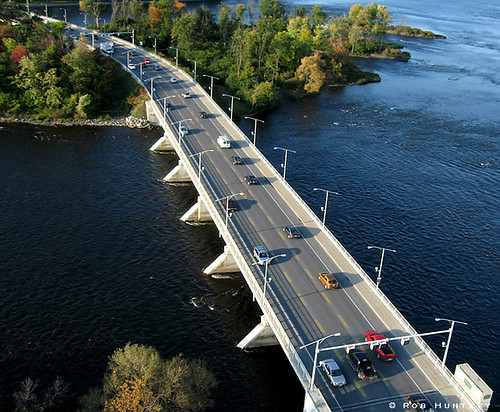
We have that set up on one of the bridges in Ottawa (Champlain bridge). 2 car lanes into the city in the morning, one leaving and flipped the other way in the evening. But there is one permanent bike lane each way all the time and one permanent pedestrian path each way. Before the bridge was expanded it was simply 1 car lane each way, and pedestrian path on one side. We’d have to bike with traffic or on the side walk…both of which were problematics…kudos to the planners that gave cyclists two permanent lanes…they could have made car traffic both ways all day and shove cyclists on the sidewalks…but cyclists, and pedestrians got permanent lanes both ways out of the gate. That really was awesome. I can literally put my head own on my P3 and ride in the aero position with no worries as there is plenty of space to pass other cyclists too. That’s not to say the entire city is this way, but bridges are key choke points where if it is cycling friendly it makes a big difference.
Edit: Image to provide the visual of the set up:
Two things:
-
Vancouver is not in America.
-
Go Away.
Thought the following was a pretty good read on the building of a controversial bike lane in Vancouver and the failures that initially sidelined it:
http://www.citylab.com/...al-bike-lane/383272/
What more American cities need to realize is that car commuting simply does not work. Furthermore, prioritizing the city landscape for cars at the expense of cycling, walking and public transit is not only foolish, it’s unfair. Simply put, America needs strong progressive leadership to increase Cycling, pedestrian and public transit infrastructure that is attractive and discourages automobile use.
Last I checked Vancouver BC was in Canada…
We are using lane control quite a big in Calgary and are about to pilot it on some downtown streets that are normally 1 way during times of heavy volume.
Vancouver is an American city. A North American city.
Thought the following was a pretty good read on the building of a controversial bike lane in Vancouver and the failures that initially sidelined it:
http://www.citylab.com/...al-bike-lane/383272/
What more American cities need to realize is that car commuting simply does not work. Furthermore, prioritizing the city landscape for cars at the expense of cycling, walking and public transit is not only foolish, it’s unfair. Simply put, America needs strong progressive leadership to increase Cycling, pedestrian and public transit infrastructure that is attractive and discourages automobile use.
Last I checked Vancouver BC was in Canada…
Yes, I know that Vancouver BC is in Canada, All I’m suggesting is that it’s wrong to place the wants of motorists above the needs of cyclists and pedestrians. Who voted for cars to rule the streets anyway? not everybody drives to work. some of use bike walk or take public transit. If you are a triathlete, you shouldnt be car commuting anyway.
Canada is a democracy you #$%@ing dumbass.
Motorists make up the majority. Public transit users and cyclists are a significant minority and should be accommodated within reason. A reasonable accommodation was found but it was not a politically easy process… it’s not as easy as the uber minority hippy elite cyclists demanding cycling lanes. The majority rules.
Thought the following was a pretty good read on the building of a controversial bike lane in Vancouver and the failures that initially sidelined it:
http://www.citylab.com/...al-bike-lane/383272/
I live about 5km from the bridge and use it frequently. I’ve only been here a year, but that bridge does handle a LOT of bike/run/walk commuters daily. I think having easy, safe access to downtown combined with an inability to park anywhere reasonably close for free (it costs around $4 per hour to park downtown) has led to a massive bike commuter community. They are in the process of installing a bike counter to log and display the number of riders taking the bridge daily.
This bike path now essentially connects downtown to the University of BC with the construction of a few new paths and closure of roads to through traffic in the area. This road closure is a current hot topic around here as it slightly hinders a select group of peoples daily commute. Oh well.
Here is some more. When I used to bike commute over the river in Montreal, I had three options. Use the sidewalk on the Jacques Cartier Bridge (generally OK, because almost no one walks it). I see they added a suicide prevention barrier because on average 10 people committed suicide there every year…I commuted there in 1988…long time ago:

The bridge itself has 5 lane with 3 going the “majority way” depending on time of day.

For the Champlain Bridge it is a highway, so there is a parallel pedestrian and bike bridge that cars don’t use (the lower one on the left):

This bridge in Ottawa is an old railway bridge. It now has 2 lanes of cars (one each way). On the side there is an additional lane with half allocated to pedestrians and half to bikes. That pedestrian/bike lane is heavily used:


Vancouver is an American city. A North American city.
Technically yes, although I’ve found this is mostly just a European thing.
**Motorists make up the majority. Public transit users and cyclists are a significant minority and should be accommodated within reason. A reasonable accommodation was found but it was not a politically easy process… it’s not as easy as the uber minority hippy elite cyclists demanding cycling lanes. The majority rules. **
Yes . . but . .
The problem is that for the past 50 years in North America the car has ruled. It’s ruled over the infrastructure build out. It’s ruled over urban planning. It’s taken over many people’s entire lives. That’s fine, but we are now starting to see the problems and challenges with that.
- Brutal traffic congestion
- Many people living almost totally INactive lives
- Ever-spiraling up energy consumption and thus CO2 emissions
Something has to change. In North America, because of the way the infrastructure was built out with an assumption that just about everyone would drive everywhere, this is going to be hard.
There is going to be a lot of resistance to the substantial shifts, to alternative transportation options - chiefly, transit, bikes, even walking.
So we can continue on the same way or . . . .
Interesting article, thanks. It’s amazing how much political effort is required to make these changes. I hadn’t really grasped that before.
To semi-hijack, I’ve just moved back to NYC and have a car. I use it a couple times a week to get out the city, but parking on my return is always a pain. After hunting for parking spaces I’m realising how much of traffic in the city is by people looking for parking spots (every time a spot becomes free, there is inevitably a guy just in front of me that slides into it).
I’d love to see more initiatives like this to help increase ridership and decrease traffic in the city. If more people ride bikes as their main method of transport I guess fewer people will see the need to have a car in the city. Ideally, that would lead to more zipcar/hertz-on-demand/etc and bring down the prices of renting a car in the city, leading to more rental cars, bike lanes, etc. I’d exclusively use rental cars but it’s cheaper to own and store a car, plus I don’t have to worry about making reservations.
It’s amazing how much political effort is required to make these changes. I hadn’t really grasped that before.
It’s takes a MASSIVE amount. Why? Because, as I mentioned the default thing to do is to make EVERYTHING revolve around the car!
They built a new shopping mall about 1K from our house. It’s not that far. There’s even a nice off-road trail that you can take there by foot or bike if you like that shortens the distance. There are hundreds and hundreds of homes that live within an easy walk and an even easier bike ride of this mall. When it opened I rode my bike over to do some shopping. There was no appropriate place to lock the bike up. I nicely asked the store manager of one of the shops I was in, why that was the case. Her response: “We did not even think about that!”
A recent blog of mine where I talk about the challenges of cycling in suburban areas of North America - http://stevefleck.blogspot.ca/2014/11/the-challenges-of-cycling-in-york-region.html
They probably didn’t put bike locks on there so people would drive their SUV over there, see a good deal on a TV that they don’t need and can put it in their vehicle. Bicycles are good for areas with lots of services, but not so much for those selling consumer goods. That assumes they are conniving, not idiots.
Bicycles are good for areas with lots of services, but not so much for those selling consumer goods.
There is a bit of everything in this mall, including medical, dentistry, movie theater, two coffee shops, in addition to many other shops.
We make it over there on foot or by bike a number of times each week. Everyone else seems to drive! Note we have a car - we choose to walk or ride.
But then again there are kids on our street, that get driven to a school, *that I can see from a window in the back of our house *that is about 800m away (closer than the shopping mall). So that’s the mind-set you are dealing with. Everyone drives everywhere!
And I bet a % of those people complain how they just can’t drop weight!
That said I used to ask my parents for a lift home from school as a kid and I lived ~800m too.