19.5" arms and a neck over 18" and my coat size was a snug 48.
19.5" arms and a neck over 18" and my coat size was a snug 48.
respect.
I am 5’11’', got down to 8% BF last year and clocked in at 161. Having another 30 lbs of muscle would have been insane (and I thought I looked good).
Muscle mass doesn’t help much in this sport. It requires additional fuel. I was also the bodybuilder type(5’10" 210 lbs), but lost my mass because it doesn’t help tri performance(unless you play physical sports or powerlifting). I’m down to 185lb and usually race at 175-180lb. Now I focus more on functional strength.
I think body fat % is what you should target. I’d try to drop the % until you can’t or you get slower.
I’m 5’10" and my ideal race weight seems to be 135-140 lbs. For context, I’m 44 years old and nowhere near an elite or FOP racer, though I’ve cracked the top 10% in smaller 70.3 and Olympic races. My gym’s scale consistently tells me I’m ~ 11-12% body fat at 135 lbs. No idea how accurate that is.
There are probably guys my height who could never reasonably get to 135 lbs. (nor should they) given their muscle mass. If you’re a larger-boned guy with a higher-than-average amount of muscle mass, your ideal race weight will be far higher than someone like me, who is at the other end of the spectrum.
I’ve worked the past two years to GAIN weight in muscle mass, though I seem to gain as much or more fat compared to muscle as I eat and lift more…
Muscle mass doesn’t help much in this sport. It requires additional fuel. I was also the bodybuilder type(5’10" 210 lbs), but lost my mass because it doesn’t help tri performance(unless you play physical sports or powerlifting). I’m down to 185lb and usually race at 175-180lb. Now I focus more on functional strength.
Helps at the beach! Haha! 175-180 and <10% BF will do the trick as well
How does one find their ideal racing weight? Is it better to lose weight (hopefully without sacrificing muscle), or is it better to put on a few pounds to increase muscle mass. Either way, I believe the ultimate goal of anyone in triathlon should be reduced body fat percentage. But what’s the best way to get there? I read Matt Fitzgerald’s book “Racing Weight.” It offers some helpful advice on nutrition, but punts on the ultimate question of ideal racing weight by saying it’s only found by trial and error. I’m open to any other books on the topic. I’m 5’10" tall. What is my ideal weight and body fact percentage for triathlon?
First depends on your natural body type ~ you can train/modify it somewhat to at least be leaner, but to a significant extent your build is hard-wired within a general range where some people are simply more muscular than others for roughly the same input of training/diet.
Beyond that, even for your personal genetic predisposition, there’s a little bit of difference whether you’re targeting shorter distances vs longer. Besides the gross energy efficiency math, the IM-based distances also de-value the swim more than sprints & Olys so that favors skinnier folks even further. For me personally (at 6-1), my IM race weight was 168, whereas I felt stronger on the swim/bike racing Olys at about 172. And when I was in a much more run-focused period earlier in life, I even got down to 163, but that come at a cost to just about everything else.
How does one find their ideal racing weight? Is it better to lose weight (hopefully without sacrificing muscle), or is it better to put on a few pounds to increase muscle mass. Either way, I believe the ultimate goal of anyone in triathlon should be reduced body fat percentage. But what’s the best way to get there? I read Matt Fitzgerald’s book “Racing Weight.” It offers some helpful advice on nutrition, but punts on the ultimate question of ideal racing weight by saying it’s only found by trial and error. I’m open to any other books on the topic. I’m 5’10" tall. What is my ideal weight and body fact percentage for triathlon?
First depends on your natural body type ~ you can train/modify it somewhat to at least be leaner, but to a significant extent your build is hard-wired within a general range where some people are simply more muscular than others for roughly the same input of training/diet.
Beyond that, even for your personal genetic predisposition, there’s a little bit of difference whether you’re targeting shorter distances vs longer. Besides the gross energy efficiency math, the IM-based distances also de-value the swim more than sprints & Olys so that favors skinnier folks even further. For me personally (at 6-1), my IM race weight was 168, whereas I felt stronger on the swim/bike racing Olys at about 172. And when I was in a much more run-focused period earlier in life, I even got down to 163, but that come at a cost to just about everything else.
Just want to say that I’ve read a number of articles over the years that ITU athletes tend to be thinner than elite Ironman, the latter which requires more physical reserves that fast ITU racers do not need. Of course there are exceptions to every generalization, but I would disagree that IM favors skinner folks. Here’s Matt Dixon basically saying of getting too thin for IM/IM70.3: http://firstoffthebike.com/triathlon-training/the-real-skinny-on-triathlon-race-weight/
5’7" and 110lbs looks like it gets the job done pretty well. http://www.nytimes.com/2016/12/28/sports/ed-whitlock-marathon-running.html?_r=0
That was a really enjoyable story.
I’ve been running / triathlon now x 30 years. It made me want to take a year off 
I’m 5’10" and my ideal race weight seems to be 135-140 lbs. For context, I’m 44 years old and nowhere near an elite or FOP racer, though I’ve cracked the top 10% in smaller 70.3 and Olympic races. My gym’s scale consistently tells me I’m ~ 11-12% body fat at 135 lbs. No idea how accurate that is.
There are probably guys my height who could never reasonably get to 135 lbs. (nor should they) given their muscle mass. If you’re a larger-boned guy with a higher-than-average amount of muscle mass, your ideal race weight will be far higher than someone like me, who is at the other end of the spectrum.
To reinforce your point, I’m 40 years old and also 5’ 10" and I don’t think I’d have the energy to get out of bed at 135 lbs. The lightest I’ve been in the last 20 years was maybe 164 lbs. and my wife told me I looked emaciated. I think my ideal race weight is probably a few pounds lighter than that, maybe around 162 lbs., but it takes a lot of discipline for me to get down that light. I’d consider myself AG-competitive, at least in local races. Ironically I’ve PR’d my open 5k, half marathon and marathon times in the last 6 months at around 173 lbs., but that extra 10-11 lbs. probably cost me the overall 5k win and a BQ marathon time.
5’7" and 110lbs looks like it gets the job done pretty well. http://www.nytimes.com/...on-running.html?_r=0
good read
To your point, ideal racing weight is different for everyone.
Jan Ripple (top Oly-distance pro in the 90s)

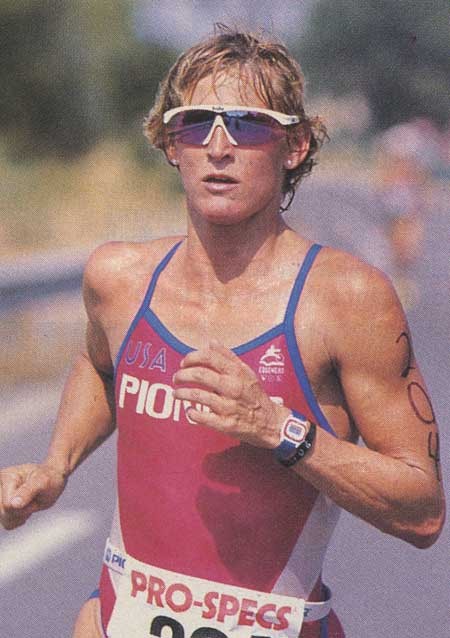
Liz Blatchford (two podiums at Kona)


It even varies by event; Mark Allen would race Kona 5lbs. heavier than he did for the Bud Light Olys. He felt that the extra muscle helped keep him from breaking down during the race.
Ideal race weight varies, I agree, but is there an ideal off season recovery weight? I’ve gained 12 LBS since IMAZ. How much more should I put on? I’m pretty proud of my accomplishment and it shows.
Had to repost this:
“the trick is to keep losing weight until your friends and family ask you if you’ve been sick. then you know you’re within 10 pounds. if they start whispering to each other, wondering if you’ve got cancer or aids, you’re within 5. when they actually do an intervention, you’re at race weight.” - Slowman (Dan Empfield)
well as a cancer survivor, i dont appreciate the comparison in a positive light and its a bit off. i’m 5’7" and have been most comfortable racing at 152-153. i was 175 before i got into shape. but when i had cancer, i got down to 142 or so and my doctor was not happy with it. my wound nurse brought over a mcdonalds shake for me every day to help bulk me back up. ideally, if i had a very thin frame, i’d be race at 149-150 or so, but cant seem to lose the mid section weight. and remember, the body weight is meaningless without considering BMI, etc.
Had to repost this:
“the trick is to keep losing weight until your friends and family ask you if you’ve been sick. then you know you’re within 10 pounds. if they start whispering to each other, wondering if you’ve got cancer or aids, you’re within 5. when they actually do an intervention, you’re at race weight.” - Slowman (Dan Empfield)
well as a cancer survivor, i dont appreciate the comparison in a positive light and its a bit off.
I could be wrong, but I *think *Dan’s intent was to show how ignorant our family and friends can be about any kind of weight loss = you can only lose weight if you are deathly ill
I mentioned elsewhere that D’Wife’s nickname for me is “Skinny Little Shit” … and I’m not even CLOSE to any kind of racing weight
Ideal race weight varies, I agree, but is there an ideal off season recovery weight? I’ve gained 12 LBS since IMAZ. How much more should I put on? I’m pretty proud of my accomplishment and it shows.
I think it depends on how easily you gain/lose weight. I have a really hard time dropping weight (took me about 5mos. to drop 12lbs before my A race last year), so I try to keep the winter gain to 5-7. I know other folks that gain 10-15, and shed it in a couple months once the weather warms up.
How does one find their ideal racing weight? Is it better to lose weight (hopefully without sacrificing muscle), or is it better to put on a few pounds to increase muscle mass. Either way, I believe the ultimate goal of anyone in triathlon should be reduced body fat percentage. But what’s the best way to get there? I read Matt Fitzgerald’s book “Racing Weight.” It offers some helpful advice on nutrition, but punts on the ultimate question of ideal racing weight by saying it’s only found by trial and error. I’m open to any other books on the topic. I’m 5’10" tall. What is my ideal weight and body fact percentage for triathlon?
First depends on your natural body type ~ you can train/modify it somewhat to at least be leaner, but to a significant extent your build is hard-wired within a general range where some people are simply more muscular than others for roughly the same input of training/diet.
Beyond that, even for your personal genetic predisposition, there’s a little bit of difference whether you’re targeting shorter distances vs longer. Besides the gross energy efficiency math, the IM-based distances also de-value the swim more than sprints & Olys so that favors skinnier folks even further. For me personally (at 6-1), my IM race weight was 168, whereas I felt stronger on the swim/bike racing Olys at about 172. And when I was in a much more run-focused period earlier in life, I even got down to 163, but that come at a cost to just about everything else.
Just want to say that I’ve read a number of articles over the years that ITU athletes tend to be thinner than elite Ironman, the latter which requires more physical reserves that fast ITU racers do not need. Of course there are exceptions to every generalization, but I would disagree that IM favors skinner folks. Here’s Matt Dixon basically saying of getting too thin for IM/IM70.3: http://firstoffthebike.com/...iathlon-race-weight/
Doesn’t sound to me like the OP is doing any ITU, nor are there any ITU races anywhere near me either. I just mean IMs have a proportionally shorter swim, so I’ve gotten used to seeing folks w/ more upper body swimmer mass or even the more muscular ‘look at me’ Crossfit types who can power through a sprint or Oly pretty well, but the added weight penalty becomes a much bigger burden at 5-7 hours for a half or 12-15 hours for a full IM. Having a little extra BF reserve might serve you well in really long endurance events but that’s within the framework of having a slimmer vs heavier build overall.
Ideal race weight varies, I agree, but is there an ideal off season recovery weight? I’ve gained 12 LBS since IMAZ. How much more should I put on? I’m pretty proud of my accomplishment and it shows.
I think it depends on how easily you gain/lose weight. I have a really hard time dropping weight (took me about 5mos. to drop 12lbs before my A race last year), so I try to keep the winter gain to 5-7. I know other folks that gain 10-15, and shed it in a couple months once the weather warms up.
Thanks for the advice, but I replied this more to change to direction since most of us aren’t racing right now and are in the middle of party season.
I’ll get back on topic. One other factor is temperature, if it is a hot race you are much better off being lighter as body is able to shed heat faster.
Its cold where I live now so I’ll be alright for a few more months.
We might be in agreement. An average person can get away with extra body mass in the shorter distances but would be best served by slimming down for long course. But conversely, at the elite level, one finds a more svelte physique at the olympic distance, and particularly at draft legal events where running is paramount. But if you are too thin, it can be a disadvantage in ironman racing. On the other hand, I don’t think Chrissie Wellington could have gotten much leaner!
I think you need to re-read his book. He does provide a guide and a calculation in his book to help get you close to your racing weight (see pages 33-37). Do you really think that one person could write a book with a formula that would get everyone to their individual perfect racing weight? That would be impossible.