one thing that most applications don’t or can’t do is a rality check. Say you wish for an x gain in, let’s call it FTP, but could be running pace etc, the program looks at where you are, what your weekly hours are and gives you that coach truth, “that is unrealistic/ realistic” but here is what you can achieve in x weeks (say 6 weeks) at your current hours per week if you follow this plan. But if you do this number of hours in this sort of plan then here is where you can get, you choose. This would be wonderful insight.
1 Like
100%, thats a good insight. I`ll look into that - pretty sure I can come up with something. will report back!
I am thinking of something like a dose response curve… ie this does elicited this response either positive or negative from historical data. This is something taht I would think is in the realm of AI modelling.
2 Likes
Just shipped both ideas into the build, want to share where I landed:
Reality check tool: when you state a goal like “250W → 280W FTP in 8 weeks”, the coach now pulls your PMC, recent training trends, and actual weekly hours, then tells you straight whether the target is realistic at your current volume.
It lays out two paths:
(A) what you can actually hit in the timeframe at current hours, and
(B) what’s possible if you bump volume, and what that bump looks like.
You choose. Grounded in documented adaptation rates so it isn’t just vibes.
Dose-response analysis: this one was the harder ask and I went back and forth on scope.
Built a tool that mines your historical data and asks “when stimulus X happened, how did response Y move vs your 14-day baseline over the next 1-2 days?” You can pick the stimulus (high-intensity session, long endurance, strength, weekly volume, back-to-back hard days) and the response metric (HRV, RHR, sleep, readiness, TSB).
It bins events by dose into tertiles and reports median delta + sample size per bin, so you can see your personal sweet spot and where things start tipping negative.
Honest caveat I built in deliberately: it’s observational n=1, confounders (sleep, stress, illness, alcohol, weather) aren’t controlled, and the tool always reports sample size so the coach can hedge when bins are thin.
I resisted the temptation to fit fancy curves on data that can’t really support them.
Want to see it work on real history before deciding whether to expand.
Both should be live now.
Genuinely appreciate the nudge on these, exactly the kind of thing that makes the product worth using - let me know if that works for you!
2 Likes
This is all very interesting. Your post and interactions with athletes moved me from “not interested in AI coaching” to thinking maybe I’d give it a try.
I’d be interested to hearing more about your own involvement in triathlon, goals, past races and that sort of thing.
3 Likes
I was thinking if the AI agent could look at the past as you mention in the first part, then explain how you were responding to that situation, maybe starting with a week the, expanding outwards. So if yu do say 2 1 hour interval sessions but they are low stress (ie low TSS) vs another week where you did 2 1 hour sessions but at higher TSS how did the relate to the following week’s response to the training stimulus, ie did heart rate decrease over similar intervals, did perceived exertion change up or down, that sort of responce type variable. Not sure if you are using something like DFA alpha in calculations but runalyze does have it in their system so maybe it can be pulled from there? These sort of both numerical responses as well as subjective response (RPE) could relate to the dose as the response? Also on a more macro point it could look at how FTP increases or decreases over time vs how you inut your dose, that is alrady available to most in charts but this is to take it out of having to try to interpret you various charts that already exist, like CTL, TSS, FTP, etc In other words it looks at the standard chart but tells you how your personal responses behave, something a good coach can do and then tell you what you need to do to maintin fitness or improve it. Just my way of thinking about AI agents.
Hey Sharon, really glad to hear that!
I’m based in Berlin (Germany) / San Francisco (US) - traveling between those two cities for work haha.
I was a professional track athlete (400 & 800m) - part of the extended under 20 german national team when i was younger.
I was not able to reach the performance I needed to become a pro, so I kinda quit the speed training and solely focused on computer science.
After about a year of just going to the gym, I started running again and eventually did a Marathon in Berlin last year. That fully hooked me into endurance sports in general and I did more runs here and there and eventually a triathlon with a friend in a small town near Berlin.
I am now actively training for 70.3 this summer and was drowning in all the information and data, which is exactly why I built this coach for myself. showed it to a few peers in my local triathlon club and they were very impressed and said I should just launch it somewhere haha
I’m not an elite athlete by any means, I’m just someone who trains seriously, loves the data side of endurance sport, and got frustrated enough to build something about it. Most of the features in athletedata came directly from problems I was hitting in my own training + now a ton of the feedback I received in various forums and blogs.
I saw you signed up already, so if you have any initial thoughts or feedback just lmk - I am super happy to answer and work on anything that comes up.
Thanks for the quick response. Yes, I did go online, selected the platforms I’m already using (Withings, Strava, Garmin, race calendar) and immediately got cogent and relevant feedback and questions.
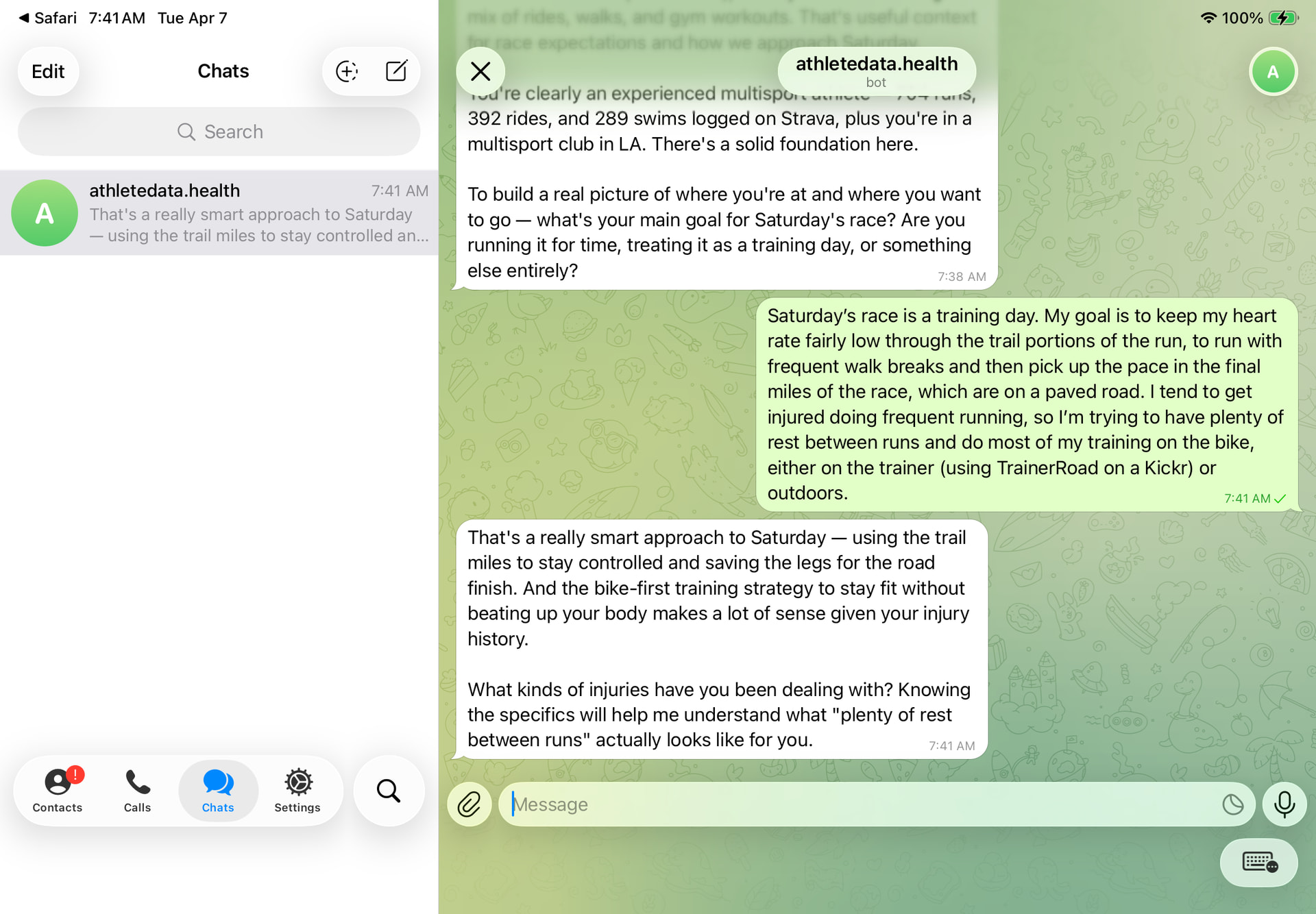
I had a detailed interaction with the coaching app, and I liked the tone and content of the feedback. I’m an experienced and self-aware athlete who uses a coach IRL, so I wasn’t super-surprised that it validated my race schedule and training. But it also put in some reality checks as to my long run plans and overall race goals.
I’m looking forward to the integration of Training Peaks and, if possible, TrainerRoad. I wonder if MyFitnessPal might also be in the works?
Ultimately, I decided to go with the 7-day free trial and $39 monthly training plan as a supplement to my own coach. What would the AI give me that my coach would not? I think a closer read of the training data. My coach is a very good friend who focuses on group workouts, and I don’t want to give that up. And it looks like the AI schedule of workouts can match our group things, so best of both worlds.
I’m very interested to see how this develops.
1 Like
Sharon, this honestly made my day! 
The “closer read of the training data” framing is exactly the right framing!
TrainingPeaks integration is actively in progress - awaiting their approval.
TrainerRoad wasnt on my radar yet, but I´ll take a look tonight and keep you posted.
MyFitnessPal does not accept additional partners right now - trying to reach out to them via multiple platforms → probably just need to proof demand for the integration and they wont be able to ignore us haha. You can be sure I am really trying my best.
1 Like
Hey again Sharon, a few quick question so I can prioritise correctly:
While I am waiting for the full TrainingPeak integration, whats most important for you for athletedata to see? Planned workouts from your coach, completed workout data, or the PMC/CTL/ATL metrics? (Or all three.)
Asking because there’s a lighter path I could ship quickly (tonight) - pulling planned workouts via the TrainingPeaks calendar feed.
I could integrate that today while I am waiting on TP’s partner API.
TrainerRoad is the harder one - no public API at all, so a direct integration isn’t possible right now.
But the same trick could work here as well: TR exposes a calendar feed for planned workouts, so I can pull those in the same way. And if you have TR auto-pushing completed rides to Strava, those are already flowing into athletedata via the Strava integration today. (similar to how intervals.icu does it)
Please let me know if that sounds useful and I’ll get both calendar feeds wired up.
But I´d also want to flag that if you have those workouts in your google calendar (and connect that as an integration) its basically the same.
I have requested TP partner API over 2 months ago, they even sent me a survey form to complete. I don’t expect to hear from them anytime soon, so have also done the workaround via the calendar feed and getting the bearer token. The token changes hourly.. I would suggest you look at this option, if you want something sooner
1 Like
thanks for the heads up, really appreciate it. will go the calendar feed route then.
Hey everyone! another batch shipped today, a lot of it driven by feedback
from this thread and other beta users:
What’s new:
 Reality Check tool: state a goal like “250W → 280W FTP in 8 weeks” and
the coach pulls your PMC, training trends, and weekly hours, then tells you
straight if it’s realistic. Lays out two paths: (A) what’s achievable at
current volume, (B) what’s possible if you bump hours. You choose. Grounded
in documented adaptation rates, not vibes. Dose-Response analysis: mines your historical data: when stimulus X
happened, how did HRV / RHR / sleep / readiness / TSB move vs your 14-day
baseline? Pick the stimulus (hard sessions, long endurance, strength, weekly
volume, back-to-back hard days) and see your personal sweet spot and where
things tip negative. Profile page: click your avatar to see and edit the markdown profile
your coach builds about you. Goals, training context, preferences, all in
one place. Smarter activity dedup: if Garmin auto-uploads to Strava, the
dashboard no longer double-counts. Also handles padel, tennis, long ultras,
and pause-heavy sports correctly. Withings + Garmin weight import: fixed two ingest bugs silently
dropping body composition. Weight, body fat, and HRV from scales/watches now
flow into wellness charts. HR Zone Distribution: computed from raw Strava HR streams using your
LTHR (no Strava Premium needed). Time-in-zone with bpm ranges, plus a
“Recompute zones” button.

 Readiness bands on the readiness chart so you can see at a glance
when you’re primed vs. cooked. Sport filters on training volume and sport distribution: toggle off
walks, padel, or anything you don’t want skewing stats. Preference is
remembered.- Sport-aware thresholds form: runners no longer see an FTP field.
Threshold pace and LTHR are surfaced instead.  Coach is now analytics-aware: every message includes a compact snapshot
of your current PMC, last 7-day volume, and recent wellness. The coach is
required to check your TSB and intensity distribution before recommending
what to train next. Better wellness sourcing — Garmin readiness now derived from daily
stress, and the wellness pipeline does per-field merging across providers so
a higher-priority source doesn’t block weight from Withings.
Plus smaller fixes: chart card heights aligned, TSB tooltip explained
properly, profile markdown rendered with full formatting, and the “latest
weight” card now finds your most recent weigh-in instead of going blank on
rest days.
Big thanks to everyone sending feedback!!! a lot of this shipped because
someone took the time to write a paragraph about what wasn’t working.
Keep it coming.
Currently working on a Calendar Feed integration for TrainingPeak and TrainerRoad - should go live tonight.
2 Likes
Just want to say that:
- The Whatsapp integration (“coming soon”) would probably be the difference for me in terms of trying the app - Telegram is a no-no.
- I haven’t tried it, so I can’t say for sure, but based on this thread it still has a bit of a beta feel? Saying this because I understand that the first 7 days are free right now, and then it’s a paid subscription?
Anyway, best of luck to you Julian, if you need it - and I suspect you don’t because you seem to have quite the brains and certainly a super helpful attitude.
1 Like
really appreciate your message!!
Regarding the whatsapp integration..I 100% feel you haha, I just use Telegram for athletedata and would have preferred whatsapp from the beginning as well, but sadly whatsapp has some limitations I need to figure out first. (actively working on that)
Once its live, I´ll keep you in mind and reach out if you want.
Regarding your second point, Its still early and I am iterating very fast based on everyones feedback … the pricing reflects the cost of running frontier models for genuinely good coaching analysis.
For everyone in this forum, I added code SLOWTWITCH for a 30-day trial instead of 7.
–
If you’re already on Claude/ChatGPT, you can also use my MCP integration at https://www.athletedata.health/mcp to chat with your training data directly.
But if you want proactive coaching that reaches out to you, that’s where athletedata shines haha
Thanks again!!!
1 Like
I’d put Training Peaks priority higher because those have planned workouts and completed workout data, it also pulls from completed (but not planned) rides on Trainer Road and MyFitness Pal and Garmin.
I don’t have a good understanding of the metrics you mention — the ATL etc.
i don’t use the TR calendar feed for planned workouts. TR pushes those to me, but I tend to choose longer duration less hilly workouts for spinning trainer bike rides.
1 Like
Thanks, this sounds great and I went to test. However the test link leads to a localhost address: http://localhost:3000/?code=a7ebdcc6-1e3b-49c4-b5dd-6de373bf39ad after I fixed that, when I enter the promo code SLOWTWITCH I get the following message: “This code is valid, but doesn’t apply to items in your order.”
1 Like
Heyyy, can you please verify which link redirect to localhost ? (huh embarrassing)
I added the coupon directly to your account, so when you open the stripe page, you´ll directly see the 30d trial.
I just forgot to add the coupon for the mcp product as well, my bad haha. (fixed that)
Please let me know if that worked 
Thank you, I´ll try to push the full TP integration then. Got so many messages asking for this, there is no way the TP can ignore this haha
1 Like
I have already signed up and synced my apps. However, I do not wear my watch in the pool, so I usually upload my swim workouts manually to TrainingPeaks.
One of the main reasons I continue using ChatGPT is that my VO2 test results are uploaded and integrated into my prompt. That said, I am not sure whether Telegram is capable of reading PDFs in order to provide more personalized responses.
1 Like