Hello Spector and All,
My $0.02
Different humanitarian customs are applied in different sports, but not without criticism. (Current Mt Everest climbers can be heartless - but not always - see ‘Into Thin Air’ by Jon Krakauer.)
While USAT rules prohibit athlete to athlete assistance it appears to me that the USAT rule to to protect the health, safety, and well being of participants takes precedence … and IMHO regardless of the USAT rules each of us should not hesitate offer help (as needed) when a fellow comptitor is injured.
===============================================================================
Everest Pioneer Condemns Climbers
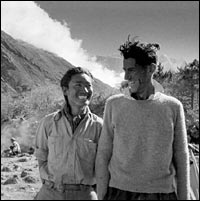
Sir Edmund Hillary, right, and Sherpa Tenzing Norgay smile at base camp after their legendary first successful ascent of Mount Everest in 1953. Reuters/CORBIS © 2006
WELLINGTON, New Zealand (AP) – Mount Everest pioneer Sir Edmund Hillary said Wednesday he was shocked that dozens of climbers left a British mountaineer to die during their own attempts on the world’s tallest peak.
David Sharp, 34, died apparently of oxygen deficiency while descending from the summit during a solo climb last week.
More than 40 climbers are thought to have seen him as he lay dying, and almost all continued to the summit without offering assistance.
“Human life is far more important than just getting to the top of a mountain,” Hillary was quoted as saying in an interview with New Zealand Press Association.
New Zealander Mark Inglis, who became the first double amputee to reach the mountain’s summit on prosthetic legs, told Television New Zealand that his party stopped during its May 15 summit push and found Sharp close to death.
A member of the party tried to give Sharp oxygen, and sent out a radio distress call before continuing to the summit, he said.
Several parties reported seeing Sharp in varying states of health and working on his oxygen equipment on the day of his death.
Inglis, who was due to arrive back in New Zealand on Thursday, said Sharp had no oxygen when he was found. He said there was virtually no hope that Sharp could have been carried to safety from his position about 1,000 feet short of the 29,035-foot summit, inside the low-oxygen “death zone” of the mountain straddling the Nepal-China border.
His own party was able to render only limited assistance and had to put the safety of its own members first, Inglis said Wednesday.
“I walked past David but only because there were far more experienced and effective people than myself to help him,” Inglis said. “It was a phenomenally extreme environment; it was an incredibly cold day.”
The temperature was minus 100 at 7 a.m. on the summit, he said.
Hillary and Sherpa Tenzing Norgay in 1953 became the first mountaineers to reach Everest’s summit. Hillary said in an interview published Wednesday in a New Zealand newspaper that some climbers today did not care about the welfare of others.
“There have been a number of occasions when people have been neglected and left to die and I don’t regard this as a correct philosophy,” he told the Otago Daily Times.
“I think the whole attitude toward climbing Mount Everest has become rather horrifying. The people just want to get to the top,” he told the newspaper.
Hillary told New Zealand Press Association he would have abandoned his own pioneering climb to save another’s life.
“It was wrong if there was a man suffering altitude problems and was huddled under a rock, just to lift your hat, say ‘good morning’ and pass on by,” he said.
He said that his expedition, “would never for a moment have left one of the members or a group of members just lie there and die while they plugged on towards the summit.”
Three climbers, from Brazil, Russia and France, died descending Everest in separate expeditions in the past week, a Chinese official said Tuesday.
More than 1,500 climbers have reached the summit of Mount Everest in the last 53 years and some 190 have died trying.
============================================================================================
USAT Rules state: (excerpts with empahsis added)
** 1.2 Purpose. **These Rules are designed to set forth a standard set of parameters within which athletes can participate in triathlons and compete in a positive atmosphere of equal opportunity. These Rules are intended: a. to promote and maintain sportsmanship, equal opportunity and fair play; b. to encourage and reward individual performance and initiative; c. to protect the health, safety, and well being of participants; d. to promote the integrity of sport and triathlon as a positive cultural force in modern day society; and
e. to foster the foregoing ideals through the establishment and enforcement of punitive rules.
d. Unauthorized Assistance. No participant shall accept from any person (other than a race official) physical assistance in any form, including food, drink, equipment, support, pacing, a replacement bicycle or bicycle parts, unless an express exception has been granted and approved, in writing, by USA Triathlon. The receipt of information regarding the progress, split times, or location of other competitors on the race course shall not be considered the acceptance of unauthorized assistance. Any violation of this Section shall result in a variable
time penalty.
What do you think?
Cheers,
Neal
